The Cover-up: IAF Narrative of the May 2025 Air Battle

Even after one year since the India-Pakistan May war of 2025, the Indian discourse regarding Operation Sindoor remains uncertain under its pretence of restraint. The Pahalgam attack on 22 April, which killed 26 people, triggered an escalatory spiral. New Delhi quickly accused Pakistan-linked elements, while Islamabad refuted the allegation and demanded an independent investigation. On 7 May, India launched attacks deep inside Pakistan under what it later termed as Operation Sindoor. The political motive was intended to turn the crisis into coercive signalling by shifting the blame onto the enemy and projecting a sense of military superiority. This episode, however, began to fray immediately as war seldom follows the intended script. Within minutes PAF shot down 7 IAF aircraft including 4 Rafales. On 8 May, Reuters reported that at least two Indian aircraft were shot down by a Pakistani J-10C, while the local government sources reported other aircraft crashes in Indian-occupied Jammu and Kashmir

Continue ReadingThe Cover-up: IAF Narrative of the May 2025 Air Battle

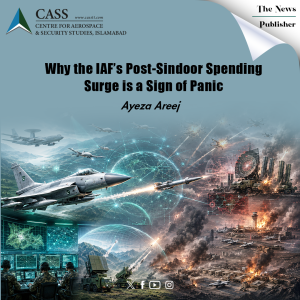
Why the IAF’s Post-Sindoor Spending Surge is a Sign of Panic

After Operation Sindoor, India is spending billions of dollars on new weapons. This is being taken by many people as an indication of military prowess. It is not. This rush to procure weapons is in fact an acknowledgement that the Air Force in India had failed to do what it was meant to do. The costly jets and missiles that India had purchased over the years failed to yield the promised results.Sindoor was soon followed by India in sealing the gaps which the operation had exposed. It was reported that Indian Air Force (IAF) is looking to speed up its purchases of more than 7 billion USD. This will involve other Rafale fighter jets with India already ordering 26 more Rafales to the Navy in 2024 at an estimated cost of about 3.9 billion USD. India is also seeking long-range standoff missiles, Israeli loitering munitions and increased drone capabilities. Special financial powers of the Indian military were activated to issue emergency procurement orders. The magnitude and rate of these purchases speak volumes.Indian media and defence analysts have over the years considered the Rafale as a game changer. When India purchased 36 Rafales aircrafts at an approximate cost of 8.7 billion USD, analysts vowed that the aircraft would provide India with air superiority over Pakistan. Operation Sindoor disproved all those allegations. Indian aircraft did not even fly in Pakistani airspace when the fighting started. India solely depended on standoff weapons that were launched at a safe distance. The air defence system of Pakistan, comprising of the HQ-9 surface-to-air missile system and its own fighters, stood its ground.

Continue ReadingWhy the IAF’s Post-Sindoor Spending Surge is a Sign of Panic

May 2025: Mosaic Warfare and the Myth of Centralised Air Power

Visualise a modern-day Air Force commander sitting in the operations room, miles away from the combat zone, overseeing every friendly and enemy aircraft and all assets involved in the campaign. In a split second, he can task a fighter, reposition a drone, and authorise a strike. In today’s promising technological era, he does not even need an operations room; a laptop on his desktop will suffice. The situation looks promising as it offers efficiency, precision, and control. The term used for such operational control is ‘centralisation’, which has been made possible with advanced networking, integrating space, cyber, surveillance, artificial intelligence, and seamless communication, enabling a single commander to manage an entire campaign from a single node. Centralised command and control, championed by the Western air forces and then adopted by many others, has thus been seen as a pinnacle of modern military power. The concept of centralisation, enabled by state-of-the-art networking, may seem promising, but it is nothing more than a myth.

Continue ReadingMay 2025: Mosaic Warfare and the Myth of Centralised Air Power

PAF’s Transformation: Operation Swift Retort to the 4-Day War of May 2025

The Air Force is an inherently technology-sensitive force, and without adopting emerging technologies, concepts, and doctrines, it risks falling behind in effectiveness and relevance. Aware of this eventuality, the leadership of Pakistan Air Force (PAF) has always remained open to change and ready to embrace the evolving character of warfare. The PAF’s success in the “4 Day War of May 25” lies in its transformation during the period from Operation Swift Retort in 2019 to the May 25 war. Prior to ‘Operation Swift Retort’ in 2019, the air power balance between the PAF and the Indian Air Force (IAF) was defined by distinct yet comparable capabilities. The IAF operated a technologically diverse fleet that included SU-30 MKI, while the remaining fleet comprised older legacy fighters, such as Mirage-2000, MiG-29, MiG-21, and Jaguars. The PAF, meanwhile, had in its inventory the F-16 Fighting Falcon

Continue ReadingPAF’s Transformation: Operation Swift Retort to the 4-Day War of May 2025

MISADVENTURES INTO PAKISTAN’S AIRSPACE

The Treaty of Westphalia is considered to be the foundation and a reference point for the conceptual establishment of the idea of a “Nation State”. It solidified the notions of territorial sovereignty, state autonomy, and the structure of the international system. Signed in 1648, the treaty stabilised patterns of interstate conduct it reinforced. Since 1648, various other treaties, pacts and arrangements have been signed at international, regional, and bilateral levels. These were aimed at streamlining state-to-state relations and the movement of people and goods across geographical borders. Under “Schengen States” arrangement, for example, citizens of member states can cross over to other member states without visa or border checks. Today, the Schengen area covers over 4 million square kilometres with a population of over 450 million people and includes 29 countries. Even with this relaxed arrangement, state sovereignty and state laws are held inviolable and military activities

Continue ReadingMISADVENTURES INTO PAKISTAN’S AIRSPACE

Analysing the Strategic Paralysis of the IAF: May 2025 Air War

The May 2025 Air War between the PAF and the IAF will go down in history as the largest Beyond Visual Range (BVR) battle between two nuclear-armed neighbours. So too would the consequences of a 7-nil loss for the IAF, which resulted in a ‘strategic paralysis’ of the Indian political and military leadership. This consequential event can be analysed in light of leading air power application theories in conflicts to see how these have been affected by the advent of emerging technologies and concepts.

Continue ReadingAnalysing the Strategic Paralysis of the IAF: May 2025 Air War