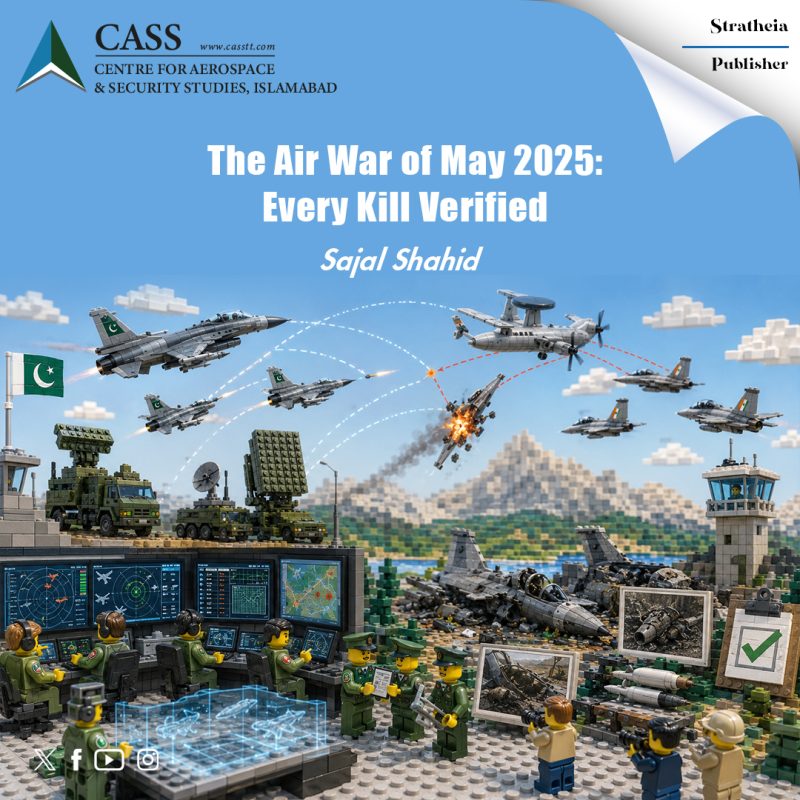
On 7 May 2025, 114 combat aircraft clashed in what has been described as one of the largest beyond visual range (BVR) air engagements since WWII During the 52-minute aerial battle triggered by India’s Operation Sindoor, traditional visual confirmation of kills became difficult. Missile impacts occurred at unprecedented ranges from 160 km to 190 km, often beyond the horizon, while claims and counter-claims continued to spread rapidly across social media platforms, amplified by unverified facts and AI-produced imageries. Amid this torrent of conflicting claims, determining what actually happened was as disputed as the battle itself.
Amidst this fog of confusion, Pakistan’s clear and unambiguous claims backed by published evidence as well as openness to independent verification provided a welcome breath of clarity. As the prevalence of BVR battles increases and the spread of disinformation continues to outpace verified data in shaping both domestic opinion and international perceptions, the authentication of aerial victories will become critically important. In this regard, the dedication of Pakistan Air Force (PAF) to a transparent and stringent verification system has been a key factor in ensuring that the battlefield triumphs are supported by factual evidence instead of mere empty rhetoric.
The PAF exhibits a record of verified triumphs starting with Squadron 15 called ‘The Cobras’ destroying an Indian PR-57 Canberra in 1959, confirmed both by eyewitness account and a physical investigation of the debris. This kill pattern persisted in 1965 when Flight Lieutenant Imtiaz Bhatti destroyed two Indian Vampire jets which were again confirmed by both ground witness and pilot testimony. These historical victories, though largely backed by eyewitness reports, examination of debris, and aircraft Video Tape Recorders (VTR) where physical wreckage could not be recovered, were employed to give a clear and transparent starting point, by which all assertions were to be justified.
This culture of verification would persist into the modern age as an Indian MiG-21 was shot down after the aerial encounter at Balakot in 2019, confirmed by the capture of its pilot, Wing Commander Abhinanadan and the physical remains of the aircraft including its intact missile pods and all four missiles (two R-73 and two R-77). During the engagement, the PAF also shot down an Indian Su-30 fighter aircraft, the debris however fell in Indian territory. Following the incident, Pakistan opened the sites in Balakot to international observers and journalists to verify its claims independently. In sharp contrast to this, India’s claims of shooting down a Pakistani F-16 jet contained no such backing and were instead disproven by physical audits of the fleet by US defence officials.
The May 2025 India-Pakistan crisis was a classic pattern of competing claims, as Pakistan claimed to have shot down seven Indian aircraft, including Rafales, MiG-29s, and Su-30MKIs which India tried to deny. Nevertheless, Pakistan could validate its claims by using a networked ecosystem whereby data collected by ground-based radars, Saab 2000 Erieye AEW&C aircraft, and J-10C fighters were integrated through the indigenous Link-17 datalink, resulting in a complete digital record of each engagement. Conclusions drawn from this data were presented globally through ISPR press briefings alongside additional proof such as tail numbers of specific Rafales and audio transcripts of IAF pilots (call sign Godzilla) noting a missing member in their formation. Exclusive access was granted to international analysts such as Alan Warnes, whose findings supported these claims and further validated the independent confirmations from US and French officials.
In comparison, India’s claims, such as assertions that its Russian-made S-400 system shot down Pakistani aircraft, remained unsubstantiated, with little publicly available evidence to support them. As time passed this story became even weaker, and the Indian Chief of Defence Staff, General Anil Chauhan later admitted that Indian planes had been lost in the 7 May engagement. India also undermined its own arguments by rejecting the Pakistani proposal to conduct a joint audit of aircraft inventories with international observers.
This divergence in transparency between the two states highlighted a deeper contrast in how each side approaches the credibility of its operational claims. India stood strongly by its claims and refused all opportunities for independent verification as opposed to Pakistan, which provided empirical data and invited third-party scrutiny. In the current age of active disinformation, increased transparency enhances credibility and contributes to strategic stability which is especially crucial in the nuclearised environment of South Asia. The fact that the claims were founded on verifiable evidence enabled the PAF to reduce the risk of miscalculations and undermine the destabilising power of propaganda.
Sajal Shahid is a Research Assistant at the Centre for Aerospace & Security Studies (CASS) Islamabad. The article was first published in Stratheia. She can be reached at [email protected]