The tale of how the Pakistan Air Force (PAF) and the Indian Air Force (IAF) entered the era of Beyond Visual Range (BVR) air combat spanned decades before it came to its culmination on the night of 7 May 2025. For almost 50 years after partition, the PAF and IAF engaged each other in close-distance dogfights. Pilots would often recognize the tail markings on the fighter aircraft they were attempting to shoot down with their short-range guns and heat-seeking missiles. As such, all aerial engagements during the wars of 1965 and 1971 were conducted within visual range. The technological enablers for BVR engagements and corresponding doctrines did not develop in South Asia until the 2000s.
In BVR air combat, the first one to see, lock on, and fire their missiles wins the engagement. Initially, the IAF had the ‘First Look, First Shot’ advantage. PAF’s fighter aircraft were capable but carried missiles with limited range, hindering effective long-range engagements. PAF did not remain oblivious to this asymmetry and trained its pilots for engagement geometries that could neutralise the IAF’s standoff reach.
The tactical discipline ingrained in PAF pilots during years of hardware disadvantage was augmented when the range of their missiles caught up with and eventually surpassed those in the IAF’s inventory. Subsequently, on 27 February 2019, PAF downed two IAF aircraft in the first BVR engagement with the IAF during Operation Swift Retort. The scale of the engagement was limited, and India sought to downplay the loss of an upgraded MiG-21. What Operation Swift Retort established, however, was that the PAF would no longer absorb standoff pressure without a credible and swift response.
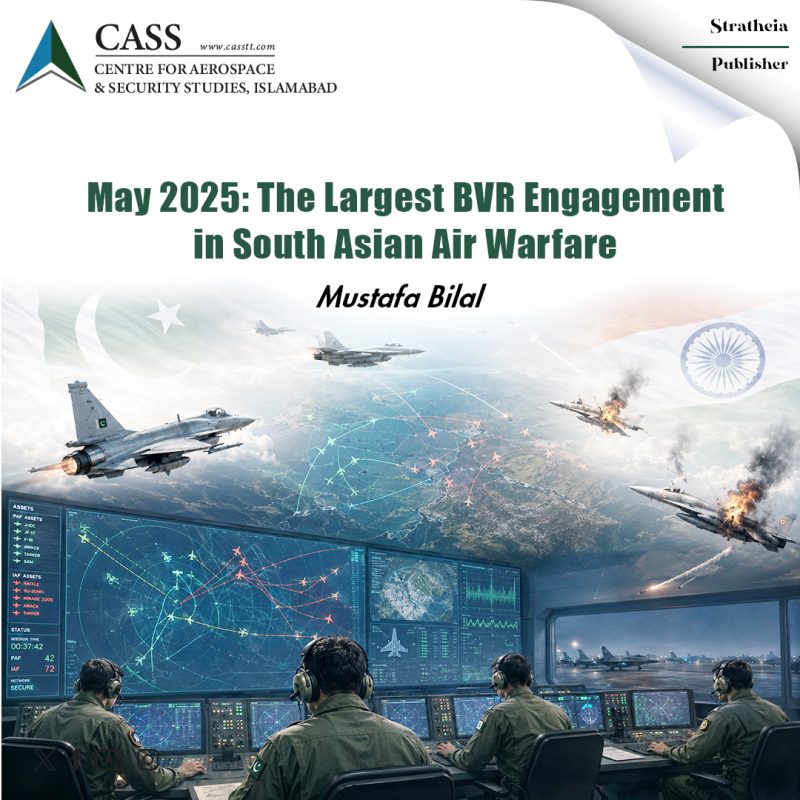
On the night of 7 May 2025, 114 aircraft were simultaneously airborne for 52 minutes; 42 aircraft of the PAF were up against 72 aircraft of the IAF. According to reports, Indian aircraft were deployed at what their intelligence had assessed as a safe standoff distance. Consequently, Indian pilots assumed they were not at risk from long-range BVR missiles of the PAF. However, as it became apparent over the next hour, the missiles reached them before the threat was fully registered.
While Indian employment strategy presented the opportunity, it was the PAF’s operational discipline that exploited it. The outcome was determined more by years of sophisticated BVR training than by the performance of any single weapon. The Cobras from No. 15 Squadron spearheaded the engagement. The PAF pilots had extensively drilled emissions discipline, sensor fusion, and missile envelop coordination in complex multi-aircraft scenarios.
Their preparation converted a technological edge into an operational victory. The PAF downed seven IAF aircraft, including four Rafales that Indian officials had labelled as game-changing since 2020. This was the longest and largest BVR engagement in South Asian and military aviation history. It was also historically the largest aerial confrontation involving advanced 4th- and 4.5th-gen aircraft.
The structural composition of the IAF fleet added to their challenges that night. The IAF operated Rafales, Su-30MKIs, and Mirage-2000s, a fleet built to different national specifications and not optimised for sharing sensor data across all platforms. The flaws in the IAF’s fleet composition became a significant weakness under intensive jamming.
The PAF had no equivalent fragmentation. Its sensors and shooters were synchronized into a coherent kill chain, reflecting years of integrated training. The procurement reaction and spending surge by the Indian government that followed 7 May made the outcome hard to dispute. India accelerated its air-to-air missile programmes in a bid to restore stand-off-range parity.
Capital markets also reflected the prevailing consensus among international military aviation circles as Dassault Aviation’s stocks fell whereas Chengdu Aircraft’s rose. Moreover, Indonesia confirmed plans to acquire 42 J-10Cs even though it was expecting the first deliveries of Rafales after signing a $8.1 billion deal for them in 2022.
Reflecting on 7 May 2025, there is a tendency to merely reduce the engagement to the performance of a single weapon, whereas in reality, the ecosystem and pilots who fired those shots extended stand-off reach while minimizing their electromagnetic signature and executed their actions under pressure. BVR air warfare has no tolerance for fragmented systems and incoherent coordination between platforms and pilots. The PAF and IAF have spent decades acquiring what warfare demands. However, on 7 May 2025, it was the PAF that proved it was second to none in effectively executing those demands to win South Asia’s longest and largest BVR engagement even before the first missile left its rail.
Mustafa Bilal is a research assistant at the Centre for Aerospace & Security Studies (CASS), Islamabad.The article was first published in Stratheia. He can be reached at: [email protected]