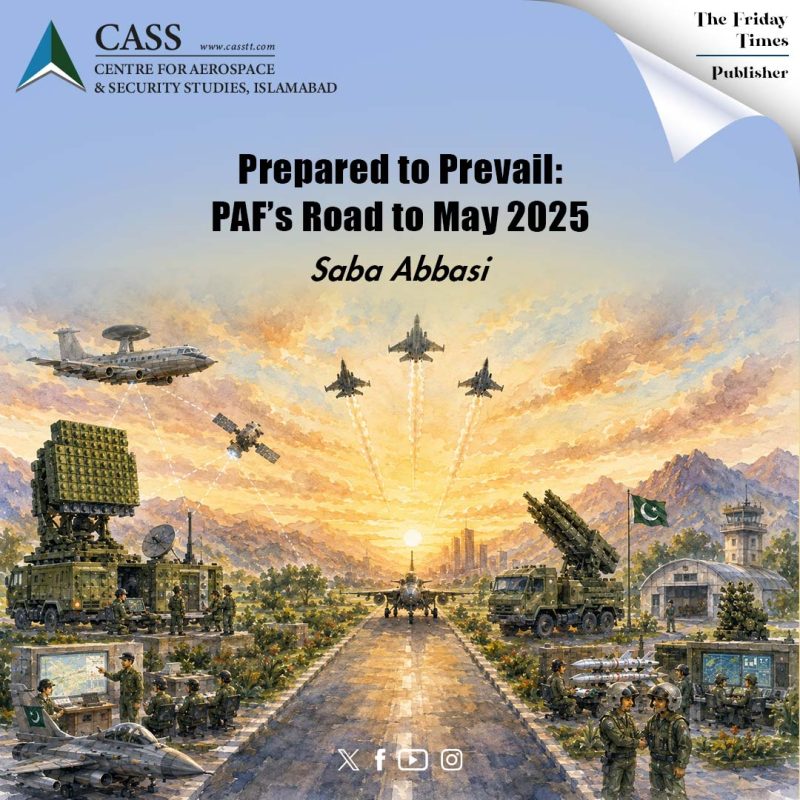
Operation Bunyan-um-Marsoos was a watershed moment for the air forces of Pakistan and India. The silent years of Pakistan Air Force (PAF)’s preparation that led to the outstanding outcome of the May 2025 war continue to be of global interest. With international air forces studying PAF’s kill chain model and arms markets prioritising Chinese platforms, because of how they were operated by Pakistani pilots, PAF carries the honour of being a formidable air force that has made the world rethink airpower and the future of air combat.
However, before May 2025, it was 2019’s Operation Swift Retort that had set the tone for PAF’s response to any future aggressive action by the adversary. Pakistan clearly anticipated that India would repeat its tactics and therefore remained prepared. It consolidated its capability and capacity in the face of the perpetual threat of India’s misadventure. Post Balakot incident, PAF continued to crystallise its offensive defence doctrine, in which decisive air actions would be executed to uphold deterrence without triggering uncontrollable escalation.
Starting in 2021, in the face of Indian leadership’s boastful rhetoric and exaggerated claims about the induction of Rafales, PAF silently procured J-10 C. Although both air forces were recruiting the best platforms to upgrade their arsenals, one key difference that ended up setting PAF’s inventory apart was the interoperability of its platforms. By contrast, Indian platforms operated in a disjointed and disintegrated manner, which greatly hindered their effectiveness in a high-tempo and interconnected air war theatre. For PAF, procuring state-of-the-art platforms and weapons was not the only goal; it was part of a broader strategy – a strategy in which every part of the air war connected and coordinated with each other to facilitate a network-centric kill chain, giving PAF an unprecedented beyond-visual-range (BVR)advantage.
However, the BVR capability is not entirely contingent on an inanimate object such as an aircraft. As PAF spokesperson had said in one of his press briefings during the May 2025 conflict, ‘Rafales are a potent platform if employed well.’ The statement clearly indicates that the defining factor in an air force’s success is not merely a first-class aircraft, but rather the pilot and the entire ecosystem behind it. For this reason, PAF’s pilots are selected under strict criteria and undergo rigorous training to be able to employ their platforms effectively. During the critical Dissimilar Air Combat Training, the PAF pilots are given complete freedom and responsibility to form and execute their own mission plans. Such training prepares the pilot to adapt to high-pressure, high-tempo situations where, at the tactical level, decisions have to be made within seconds, without any room for pause or paralysis. PAF pilots are trained on a psychological level to operate under stressful and at times uncertain situations, where their response to quickly changing combat situations influences the entire outcome of the war. Hence, autonomy in training and stress inoculation are major parts of a PAF pilot training program, which manifested remarkably during the May 2025 episode.
Another factor that distinguishes PAF from the IAF is its Pilot-to-Aircraft Ratio. The PAF trains more pilots, approximately 2.5 pilots per aircraft, which in turn allows it to generate more sorties per day during wartime. It allows for crew rotation and the ability to conduct continuous operations, especially in a swift and decisive conflict. It is beyond doubt that PAF’s pilots were pivotal to the May 2025 aerial theatre. The downing of seven IAF aircraft in less than an hour highlighted that the real force behind the victory was not the machines but the humans that were operating those machines. Verily, without a highly skilled pilot in the cockpit, even the most advanced and sophisticated aircraft cannot be utilised to their full potential.
The May 2025 conflict was not solely a duel between J-10Cs and Rafales, but a real-world demonstration of how in the air war theatre, not just the brand of aircraft, but training, operational jointness, and doctrinal clarity determine the outcome. IAF’s appetite for testing its numerical advantage over PAF was perhaps diminished after the May 2025 conflict, which had kept its forces in a delusion due to the previous limited and localised nature of encounters. PAF’s resounding victory has been a result of its silent and consistent preparation, where it meticulously worked on every aspect of the force, to live up to and translate the Quaid’s founding directive for PAF — second to none — into reality.
Saba Abbasi is a Research Assistant at the Centre for Aerospace and Security Studies (CASS), Islamabad, Pakistan.The article was first published in The Friday
Times. She can be reached at [email protected]