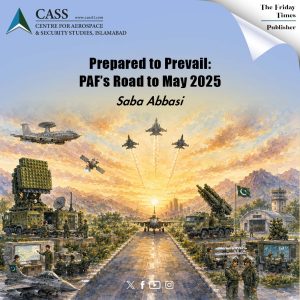
Prepared to Prevail: PAF’s Road to May 2025

Operation Bunyan-um-Marsoos was a watershed moment for the air forces of Pakistan and India. The silent years of Pakistan Air Force (PAF)’s preparation that led to the outstanding outcome of the May 2025 war continue to be of global interest. With international air forces studying PAF’s kill chain model and arms markets prioritising Chinese platforms, because of how they were operated by Pakistani pilots, PAF carries the honour of being a formidable air force that has made the world rethink airpower and the future of air combat. However, before May 2025, it was 2019’s Operation Swift Retort that had set the tone for PAF’s response to any future aggressive action by the adversary. Pakistan clearly anticipated that India would repeat its tactics and therefore remained prepared. It consolidated its capability and capacity in the face of the perpetual threat of India's misadventure. Post Balakot incident, PAF continued to crystallise its offensive defence doctrine, in which decisive air actions would be executed to uphold deterrence without triggering uncontrollable escalation.
Continue ReadingPrepared to Prevail: PAF’s Road to May 2025

Marka-e-Haq and the Air Defense Grammar of Aerial Warfare

Marka-e-Haq transformed the May 2025 battlefield into a testing ground, where integrated doctrine and advanced technology redefined the future of aerial warfare. The war provided a paradigmatic example, where a well-integrated air-defence architecture and offensive-defence strategy could successfully counter even the most advanced threats. The unified air-defence architecture of Pakistan transformed numerical disadvantage into strategic superiority, providing crucial lessons on the need to integrate systems and employ multi-domain synergy in the twenty-first century. The May war was more than a fight in the air; it demonstrated that comprehensive planning, innovative technology, and a multi-layered defence can turn the tide in modern war.

Continue ReadingMarka-e-Haq and the Air Defense Grammar of Aerial Warfare

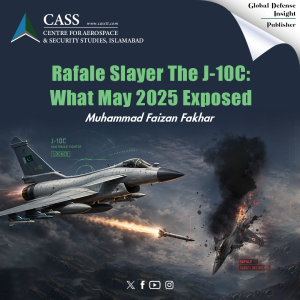
Rafale Slayer The J-10C: What May 2025 Exposed

The May 2025 conflict between India and Pakistan fundamentally altered the course of modern aerial warfare. From the very onset of the conflict, the superiority of PAF over its adversary became abundantly clear as it in quick succession it shot down seven Indian aircraft without suffering even a single loss. PAF employed J-10Cs fighter aircraft, and the score of 7-Nil became even more striking since four of the downed Indian aircraft were Rafales. These were the same Rafale fighters that were being presented as a hallmark of armed forces modernisation by Indian politicians, military leaders, and analysts. However, the combat loss of Rafale jets to J-10Cs not only shattered the assumptions about technological superiority in the battlefield but also solidified the critical role played by the, strategy, tactics and training in air combat. Yet this cannot be viewed as an isolated incident as it was a direct outcome of the contrasting training, procurement strategy and platform integration by both sides

Continue ReadingRafale Slayer The J-10C: What May 2025 Exposed

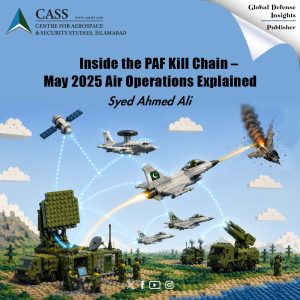
Inside the PAF Kill Chain – May 2025 Air Operations Explained

  • Post author:

Air combat has come a long way from traditional visual based kinetic manoeuvre warfare. Modern aerial combat relies heavily on technological sophistication which has given the birth to new concepts such as Beyond Visual Range (BVR) capability, multi domain operations, systems and network centric warfare. This complex web of intertwined capabilities, platforms and domains culminates into a single kill chain providing a firing solution. On 7 May 2025, Pakistan Air Force (PAF) demonstrated its superiority over its archival India by shooting down seven of its aircraft. The PAF achieved this feat by compressing its kill chain while simultaneously disrupting the adversary’s targeting cycle. The Air & Space Forces Magazine defines Kill Chain as a process used to put munitions on a specified target. This complex process is broken into five different parts

Continue ReadingInside the PAF Kill Chain – May 2025 Air Operations Explained

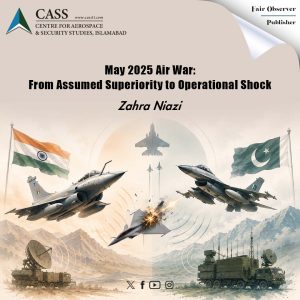
May 2025 Air War: From Assumed Superiority to Operational Shock

n the night of 6-7 May 2025, the Indian Air Force (IAF) faced an unprecedented setback. Pakistan Air Force (PAF)’s downing of seven Indian aircraft during a high-intensity aerial engagement that night, including four state-of-the-art Rafale fighters, regarded as the linchpin of India’s air power modernisation, was a game-changing event.The outcome represented the breakdown of an assumption that had shaped Indian strategic thought in the period following the 2019 India-Pakistan crisis, that is, the belief that advanced fighter aircraft platforms could decisively shape future battlefield outcomes in India’s favour.In 2019, PAF downed IAF’s Sukhoi-30MKI and a MiG-21 Bison in a retaliatory air operation following the Indian Balakot strike, with the MiG-21 crashing in Azad Jammu and Kashmir (AJK), resulting in the capture of its pilot, Wing Commander Abhinandan Varthaman. While Abhinandan was released 60 hours after his capture as a ‘peace gesture,’ the episode marked the first major shock for the IAF, which had been outmanoeuvred by a rival force despite possessing advantages in terms of fleet size, budgetary resources, and force depth.  The lesson was thus unmistakable: conventional military superiority alone cannot guarantee battlefield success.Rather than internalising this implication, the IAF, aligning with the government’s position, underplayed the losses while perpetuating the narrative that the acquisition of more advanced platforms can shape future battlefield outcomes in India’s favour. The then Chief of Air Staff, Air Chief Marshal BS Dhanoa,

Continue ReadingMay 2025 Air War: From Assumed Superiority to Operational Shock