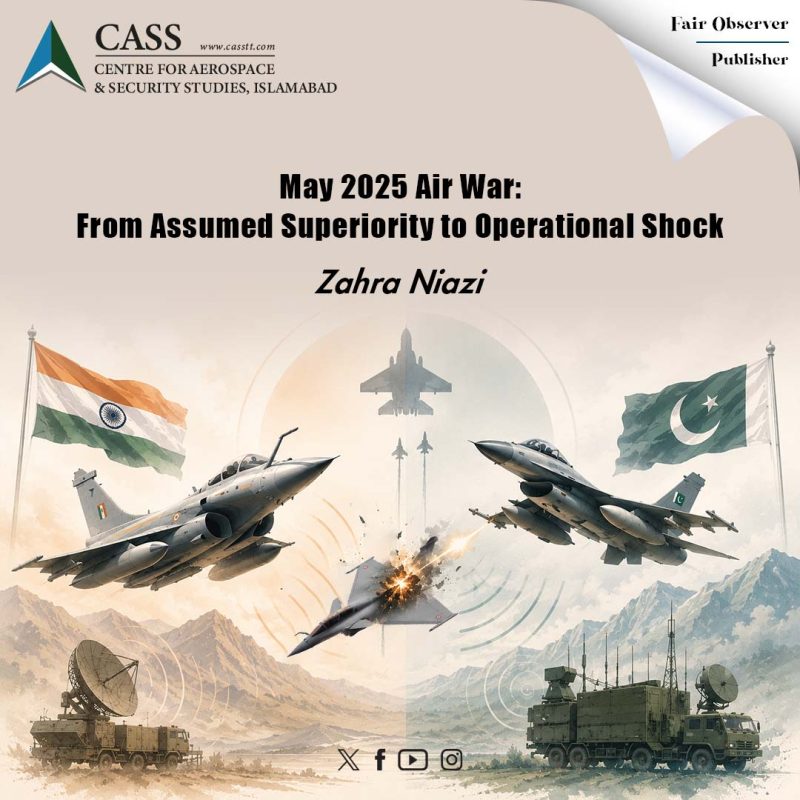
On the night of 6-7 May 2025, the Indian Air Force (IAF) faced an unprecedented setback. Pakistan Air Force (PAF)’s downing of seven Indian aircraft during a high-intensity aerial engagement that night, including four state-of-the-art Rafale fighters, regarded as the linchpin of India’s air power modernisation, was a game-changing event.
The outcome represented the breakdown of an assumption that had shaped Indian strategic thought in the period following the 2019 India-Pakistan crisis, that is, the belief that advanced fighter aircraft platforms could decisively shape future battlefield outcomes in India’s favour.
In 2019, PAF downed IAF’s Sukhoi-30MKI and a MiG-21 Bison in a retaliatory air operation following the Indian Balakot strike, with the MiG-21 crashing in Azad Jammu and Kashmir (AJK), resulting in the capture of its pilot, Wing Commander Abhinandan Varthaman. While Abhinandan was released 60 hours after his capture as a ‘peace gesture,’ the episode marked the first major shock for the IAF, which had been outmanoeuvred by a rival force despite possessing advantages in terms of fleet size, budgetary resources, and force depth.
The lesson was thus unmistakable: conventional military superiority alone cannot guarantee battlefield success.
Rather than internalising this implication, the IAF, aligning with the government’s position, underplayed the losses while perpetuating the narrative that the acquisition of more advanced platforms can shape future battlefield outcomes in India’s favour. The then Chief of Air Staff, Air Chief Marshal BS Dhanoa, in April 2019 categorically stated that the results would have been skewed in India’s favour had it inducted Rafale aircraft in time, and their induction would shift the technological balance in India’s favour, mirroring Prime Minister Modi’s earlier assertion that India would have achieved much more if the country had the Rafale aircraft.
While electoral dynamics and the need to boost the population’s morale explain the timing of the messaging, there also appeared to be an actual sense of strategic overconfidence within decision-making circles. Messages along similar themes continued to be echoed in subsequent years, as New Delhi received the first batch of Rafale fighters in 2020, with deliveries completed by late 2022. Notably, following the arrival of the first batch of Rafale fighters, Indian Defence Minister Rajnath Singh famously stated, ‘If it is anyone who should be worried about or critical about this new capability of the IAF, it should be those who want to threaten our territorial integrity.’ Research has corroborated that leaders and decision-makers can easily succumb to mutually reinforced positive illusions, especially if other domestic actors do not meaningfully challenge those assumptions.
Within the aviation community, the Dassault Rafale is rightly considered a platform of stature for its range, strength, agility, and highly potent weapons suite. But as Stephen Biddle, the author of the book Military Power, puts it, ‘many nations failed to master complicated modern-system force employment, and variations in such behaviour have been more important than technology per se for observed outcomes.’
The 2025 India-Pakistan air battle served as a practical demonstration of this dynamic. Indian strategists not only misjudged the engagement range of the PL-15 missile but also the resolve, professionalism, and strategic acumen of the PAF. This allowed the PAF to achieve tactical surprise and a first-shot advantage. At the same time, the PAF used a networked ‘kill chain,’ by linking radars, airborne warning systems, and fighters through a data link, allowing the fighters to receive targeting data from airborne early warning and control aircraft and engage targets without using their own radar, while electronic warfare (EW) disrupted Indian sensors and communication, reducing the IAF’s situational awareness. The challenges were further compounded by limitations in cross-platform data integration within the IAF, which constrained coordination during the engagement.
The result was a seven-nil outcome. The claim was not random; Pakistan later disclosed the specific tail numbers of the four Rafale fighters, while statements from some members of the Indian military leadership also served as indirect acknowledgements of multiple jet losses. Notably, in one of his interviews, the Indian Chief of Defence Staff (CDS), General Anil Chauhan, on being inquired about the jet losses, remarked that ‘what is important is not the jets being downed but why the jets were downed,’ and that the IAF rectified the tactical mistakes and implemented the improved strategy two days later. The latter suggested that the IAF likely withheld its air operations for two days to reassess its strategy–an indication of operational shock. To regain lost pride, it resorted to launching stand-off weapons from within its own territory against targets inside Pakistan–an implicit acknowledgement that it could not match PAF in the air.
The episode thus served as yet another sobering reminder that battlefield outcomes rarely unfold the way the initiating states may have anticipated. From the Vietnam War of 1955-1975 to the United States/Israel-Iran War of 2026, the war literature is replete with examples of conflicts that were started based on assumptions about the ability to achieve rapid military victory, which could not stand the test of time. For India, it is all the more important to internalise this lesson, as every successive crisis in nuclear South Asia has shown increasing intensity, and the region cannot afford such a trajectory.
The writer is a Research Associate at the Centre for Aerospace & Security Studies (CASS), Islamabad.The article was first published in Fair Observer. She can be reached at: [email protected].