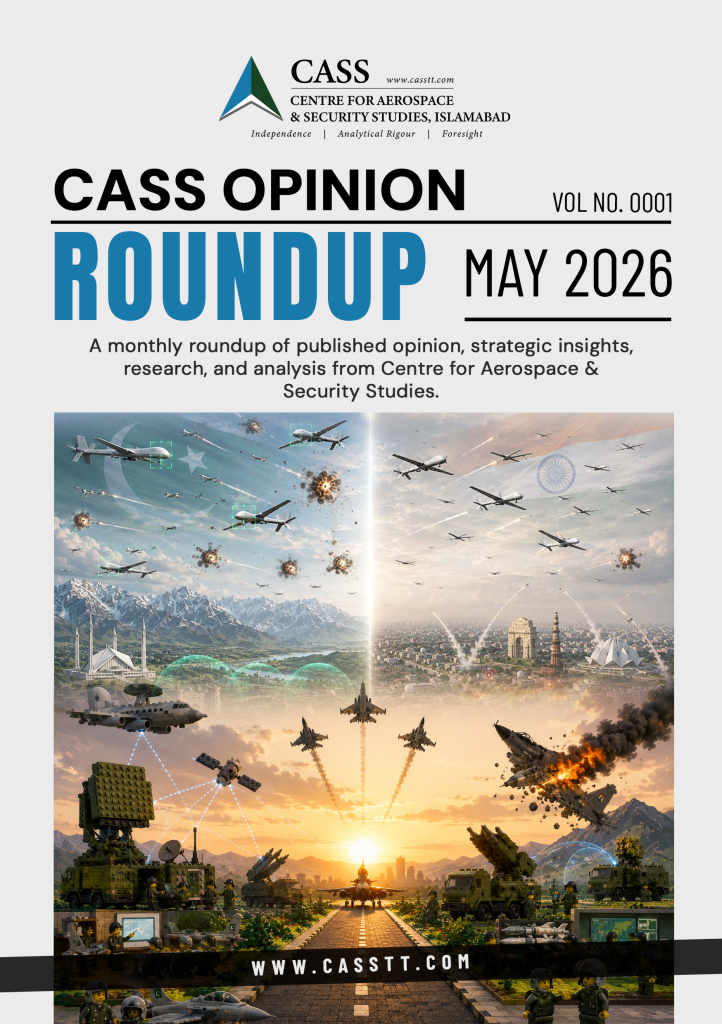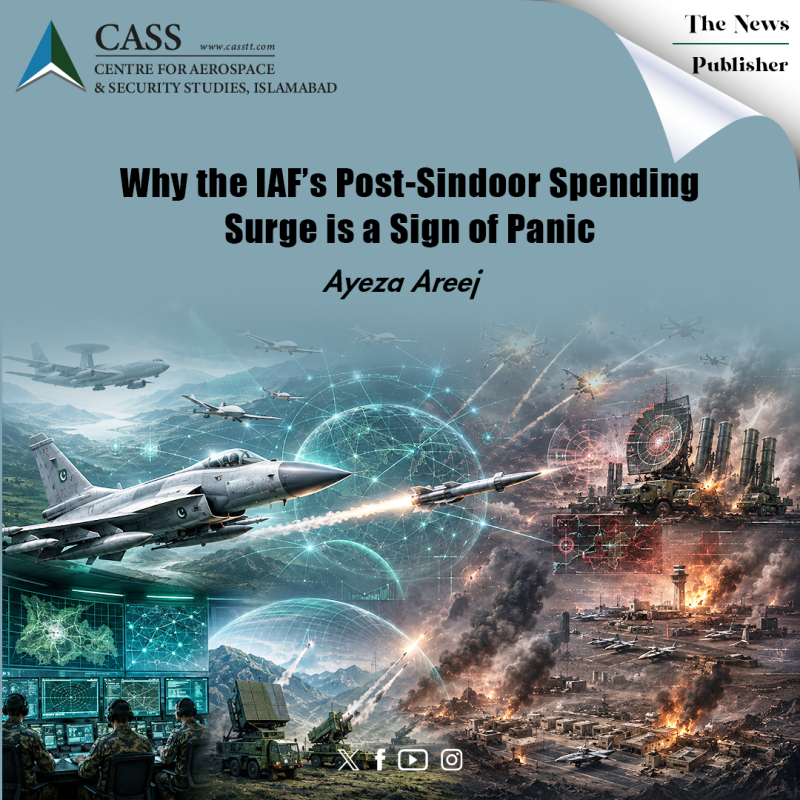
Marka-e-Haq transformed the May 2025 battlefield into a testing ground, where integrated doctrine and advanced technology redefined the future of aerial warfare. The war provided a paradigmatic example, where a well-integrated air-defence architecture and offensive-defence strategy could successfully counter even the most advanced threats. The unified air-defence architecture of Pakistan transformed numerical disadvantage into strategic superiority, providing crucial lessons on the need to integrate systems and employ multi-domain synergy in the twenty-first century. The May war was more than a fight in the air; it demonstrated that comprehensive planning, innovative technology, and a multi-layered defence can turn the tide in modern war.
The air defence architectures of both Pakistan and India before the May 2025 Crisis, were vastly divergent. On one hand, Pakistan not only employed an offensive-defence strategy but also a fully integrated network under a unified command by fusing Surface to Air Missiles (SAMs), Airborne Early Warning and Control (AEW&C) system, fighter jets and radars. India, on the other hand, had a formidable and advanced defence arsenal. Under the Narendra Modi regime, it heavily relied on sophisticated and costly imported defence platforms, including the S-400 air defence system and an expansive assortment of modern fighter jets like Rafales, Su-30MKIs, and MiG-29s. Despite having a numerical and technological edge, Indian Air Force (IAF) lacked a fully integrated architecture, which created exploitable lapses that the doctrinal coherence and operational synchronisation of the Pakistani forces were well placed to capitalise on.
It is a certainty that IAF was well prepared for Operation Sindoor, with targets identified, mission profiles simulated and pilots assigned to deliver precision-guided munitions at stand-off ranges. India, to facilitate the operation, deployed its state-of-the-art air defence, weaponry and frontline resources in order to maximise operational effectiveness. However, what was supposed to be a strategic surprise turned out to be a counter-surprise of much greater intensity.
The IAF made faulty assumptions regarding PAF’s capabilities and underestimated its training, resolve and preparedness. In contrast to India’s expectations, PAF demonstrated doctrinal clarity and operational readiness. Pakistan’s Multi-domain Operations (MDOs) successfully integrated manned aircrafts, radars, drones, ground-based air defences, satellites, electronic warfare and Beyond Visual Range (BVR) weapons in an impregnable air defense architecture. An ‘indigenous data link’ provided exceptional situational awareness and enabled integration among all assets, resulting in the formation of a highly responsive and agile kill-chain. It enabled a higher degree of interoperability and nullified New Delhi’s numerical advantage.
For countering a larger Indian strike package of 72 aircraft (including Rafales, Su-30 and MiG-29), Pakistan air defence efficiently employed approximately 40 fighter jets (including JF-17 Thunder and J-10C). The J-10C as the frontline defender provided PAF with rapid engagement ability and compressed the opponent’s response window. Moreover, the PL-15 missiles employed on the J-10C fighter jet provided Pakistan’s air defence with enhanced operational reach and extended engagement range beyond visual capacity. Its radar-guided design and capability to withstand electronic countermeasures provided a tactical edge to PAF. Thus, the results were unequivocal as PAF while defending its airspace managed to shoot down four Rafales, one MiG-29, one Su-30 and a Mirage-2000. The downing of Rafales was not merely a tactical success for Pakistan but also proved to be a major embarrassment for India.
The May conflict also exposed vulnerabilities of the top-notch Russian S-400 air defence system, which was debuted during this crisis. Although the system was claimed to be reliable, a Chinese-made CM-400AKG, deployed by JF-17 Thunder, successfully targeted the S-400 batteries in Poonch and Adampur. Apart from that, Pakistan’s coordinated strikes targeted 26 Indian installations, including BrahMos Storage site, airbases, command nodes and logistic depots. It substantiated the claim that technological sophistication alone does not provide the operational supremacy of impenetrability.
After facing unprecedented setbacks from the aerial combat, India resorted to a new phase of escalation through drones. However, even during this phase, the reaction of Pakistan’s air defence proved to be decisive and highly calibrated. Pakistan not only effectively intercepted 77 drones through a combination of hard kill and soft kill tactics but also launched its own salvo of drones against India, showcasing the strength of its ‘multi-layered defence system.’ Therefore, India’s attempt to overwhelm Pakistan’s air defences ultimately revealed susceptibilities in its own defence network.
The success of Pakistan did not depend on any single platform, missile or aircraft but on the combination of doctrine, organisation, training and technology in a coherent air-defence structure.This system turned the skies into a battlefield that could be controlled, where it is possible to detect, intercept and respond in a coordinated manner.The MDO operations enabled Pakistan to outpace the IAF in the conflict, which showed that firepower and numbers alone are no longer decisive.
Marka-e-Haq is not merely a case study about the past, but a template for the future war and the air defences employed. Network-centric supremacy and smooth integration of airpower, drones, missiles, cyber capabilities, electronic warfare, and intelligence systems are increasingly becoming the determinants of strategic preeminence. Ultimately, in the modern-day war, the skies are no longer with the more powerful force, but with the side that plans better and acts more swiftly.
Ayeza Areej is a Research Assistant at the Centre for Aerospace and Security Studies (CASS), Islamabad, Pakistan. The article was first published in The News.She can be reached at [email protected]