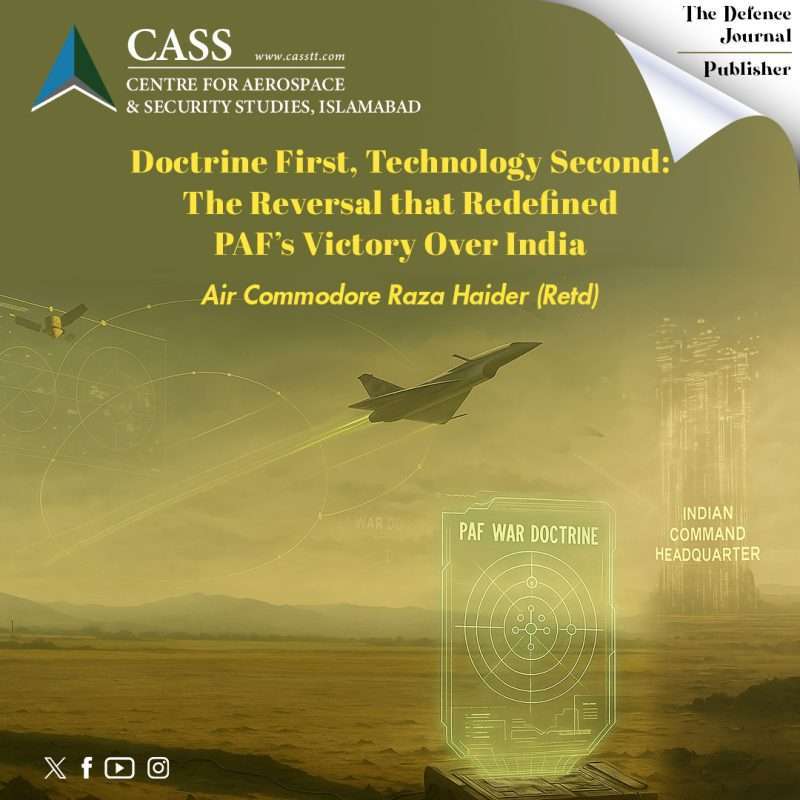
British naval strategist Sir Julian Corbett was cited by Geoffrey Sloan as saying that ‘doctrine is the soul of warfare.’ This ageless maxim resurfaced once again after the recent military showdown between India and Pakistan in May 2025. The crisis has served as a benchmark where the Pakistan Air Force (PAF) managed to outmanoeuvre the numerically superior Indian Air Force (IAF) by combining doctrinal superiority with cutting-edge technologies. In retrospect, the clash replaced the ‘hardware first’ myth with the ‘doctrine first, technology second’ reality.
The PAF employed superior doctrinal patterns in every aspect of the battle, taking the lead from the United States’ military framework ‘Doctrine, Organisation, Training, Materiel, Leadership, Personnel, and Facilities (DOTMLPF)’. This framework provided an overarching umbrella for conducting high-tech military operations. Following the Balakot incident in 2019, the PAF anticipated a similar conflict, albeit on a larger scale; therefore, it directed its focus on intercepting future IAF strikes and responding by involving advanced fighter aircraft, beyond-visual-range (BVR) missiles, emerging technologies, and force multipliers. Such seamless integration allowed the PAF to detect, track, and engage India’s airborne targets with pinpoint accuracy.
During the recent conflict in May 2025, the PAF’s doctrinal focus was on Multi-Domain Operations (MDO). It emphasised agility and adaptability by integrating numerous technological systems such as aircraft, drones, radars, satellites, ground-based air defences (GBAD), and electronic and cyber suites. For India’s strike package of 60 aircraft comprising advanced Rafales, Sukhoi-30, and MiG-29, the PAF effectively employed around 40 aircraft comprising JF-17 Thunder, J-10C, and F-16 with an exceptional situational awareness enabled by an indigenous data link system for seamless integration between all assets. This integrated doctrine created a predetermined ‘kill-chain’ which nullified the numerical superiority of the IAF.
The results were conclusive: the PAF managed to shoot down six Indian aircraft within the 55 mins of combat, particularly three advanced Rafales, along with one Su-30, one MiG-29, and one Mirage 2000. This aerial battle also marked the first confirmed combat kill of the French-made Rafale aircraft. An analyst termed the incident comparable to Serbia’s downing of F-117 Nighthawk, an American legacy stealth fighter, in terms of optics. Moreover, it underscored the instrumentality of air power and superior doctrine in preserving sovereignty and sustaining deterrence. Currently, the PAF is a network-centric integrated force that is now fully capable of warding off any threats posed by superior adversaries. The DOTMLPF framework enabled the PAF to fuse superior doctrines with advanced technologies, which have guided its operations at all levels of war. With the employment of cutting-edge technologies, superior training, and an indigenous R&D baseline, the PAF remained ahead of the curve against the IAF. Thus, the conformity in military doctrines, organisational structure, and employment modalities enabled the PAF to outmanoeuvre the IAF in the conflict.
It is worth mentioning that to execute such a complex task, PAF’s pre-war preparations played an instrumental role, which involved war games and exercises to integrate data and facilitate MDOs. These peacetime preparations have enabled the PAF to maximise its war-fighting potential in the active combat scenario. Furthermore, the PAF’s success also remained a key factor in maintaining deterrence in the South Asian environment. The downing of multiple jets was counterintuitive to India’s designs to establish escalation dominance and conduct low-scale operations under the nuclear shadow. PAF’s superior doctrine, combined with operational concepts, served as a guiding framework for its combat commanders to employ strategy and tactics effectively. It also dispelled Indian designs to establish a so-called ‘new normal’ of conducting cross-border strikes deep inside Pakistani territory.
The implications of Pakistan’s victory remain profound. By edging out the IAF, the PAF has emerged as a credible regional airpower capable of safeguarding its airspace from foreign incursions. Strategically, it also served as a credible deterrent signalling the cost of military adventurism to any potential aggressor. The recent military standoff demonstrates that Pakistan has remained ahead of the curve by adapting to changing operational realities of conflict. The PAF’s calibrated response suggests that doctrine is superior in guiding technology to success. The multi-domain operations conducted by the PAF tactically handicapped the IAF and managed to edge out a much larger force under its superior doctrine and operational agility.
Air Commodore Raza Haider (Retd) is Director at the Centre for Aerospace & Security Studies (CASS), Islamabad. Email: [email protected]. The article was first published in The Defence Journal.