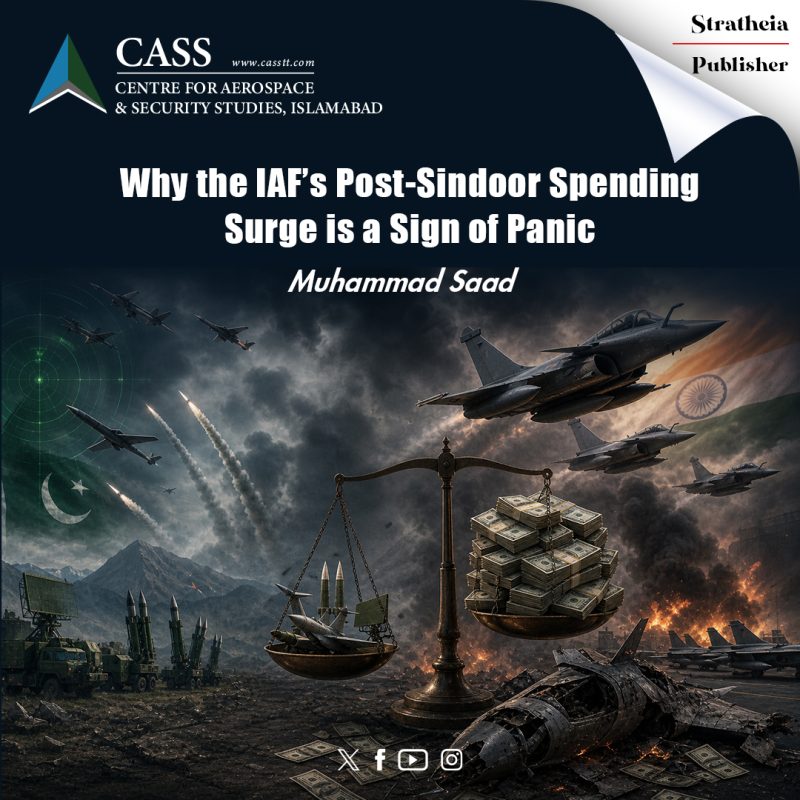
After Operation Sindoor, India is spending billions of dollars on new weapons. This is being taken by many people as an indication of military prowess. It is not. This rush to procure weapons is in fact an acknowledgement that the Air Force in India had failed to do what it was meant to do. The costly jets and missiles that India had purchased over the years failed to yield the promised results.
Sindoor was soon followed by India in sealing the gaps which the operation had exposed. It was reported that Indian Air Force (IAF) is looking to speed up its purchases of more than 7 billion USD. This will involve other Rafale fighter jets with India already ordering 26 more Rafales to the Navy in 2024 at an estimated cost of about 3.9 billion USD. India is also seeking long-range standoff missiles, Israeli loitering munitions and increased drone capabilities. Special financial powers of the Indian military were activated to issue emergency procurement orders. The magnitude and rate of these purchases speak volumes.
Indian media and defence analysts have over the years considered the Rafale as a game changer. When India purchased 36 Rafales aircrafts at an approximate cost of 8.7 billion USD, analysts vowed that the aircraft would provide India with air superiority over Pakistan. Operation Sindoor disproved all those allegations. Indian aircraft did not even fly in Pakistani airspace when the fighting started. India solely depended on standoff weapons that were launched at a safe distance. The air defence system of Pakistan, comprising of the HQ-9 surface-to-air missile system and its own fighters, stood its ground. The line that the defences of Pakistan had drawn was one which India did not want to cross. That is not air dominance which IAF was seeking. That is the deterrence of Pakistan at its best.
The economic price of what India actually accomplished during Sindoor is painful to read. India fired an estimated $100 million worth of missiles and munitions in just a few days of the standoff. Some of these attacks were either intercepted or not able to strike any significant military targets. The PAF had shot down several Indian aircraft, and at least one Rafale jet according to Pakistani sources and some western sources. To a nation which had spent almost $8.7 billion on the same planes, losing at least one to an enemy platform that cost a fraction of its price was a huge embarrassment. The expenditure was colossal but the outcome was not.
The reaction of India to this failure was to spend more. Almost immediately after the ceasefire, new procurement requests were made. This is not the action of a self-confident military force. This is panic. India had taken decades and hundreds of billions of rupees to develop its air force and when the time came it was halted at the border by a nation with a tenth of its defence budget. In 2024, the total defence budget of Pakistan amounted to about 7.7 billion USD, whereas the Indian defence budget was 74 billion USD. Yet despite that enormous gap in spending, Pakistan has performed much better.
The victory of Pakistan in Sindoor was not based on huge budgets but rather on intelligent decisions. The JF-17 Block III, a joint venture with China at a quarter of the price of a Rafale, was a viable frontline fighter. The combination of Chinese and home-grown technology in the form of a layered air defence system enabled Pakistan to counter the costly standoff attacks by India. Pakistan never attempted to keep pace with India, weapon-to-weapon. Rather, it concentrated on creating a defence that was sufficient to deprive India the clean victory it desired. That approach worked.
The moral of the story is straightforward: do not get drawn into an arms race with India. The new wave of expenditure in India is the cost it is incurring as a result of its failure during Sindoor. It is trying to buy back the credibility and the fear factor that the operation failed to deliver. Pakistan needs to keep spending prudently, investing in ability rather than in quantity and not to pursue the numbers that its economy cannot afford. This was won by smart and cost-effective defence. There is no need in altering a strategy that has already been proven.
Muhammad Saad is a Research Assistant at the Centre for Aerospace and Security Studies (CASS), Islamabad. The article was first published in Stratheia. He can be reached at [email protected].