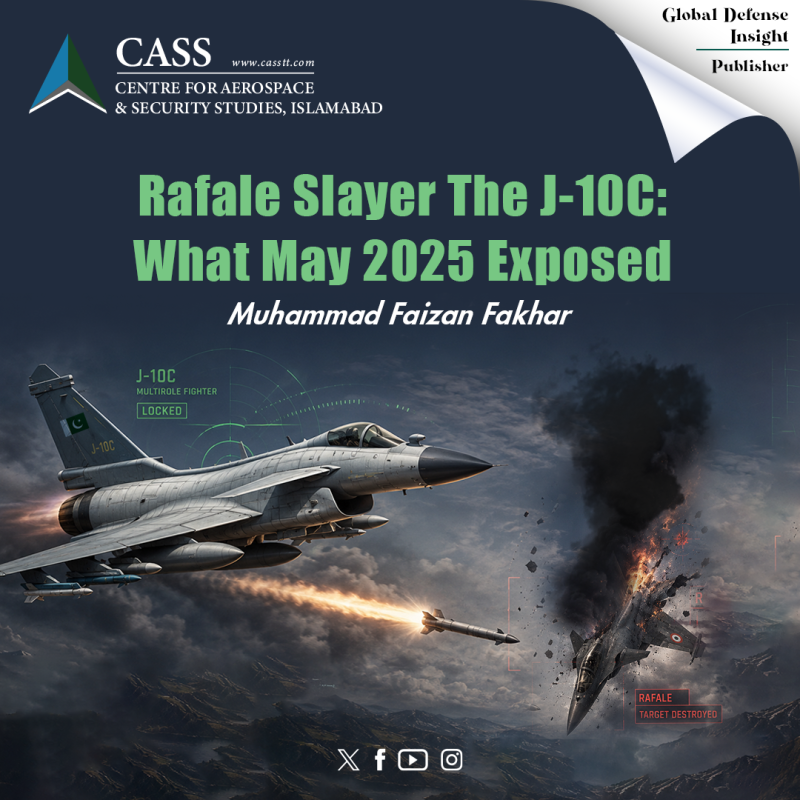
The May 2025 conflict between India and Pakistan fundamentally altered the course of modern aerial warfare. From the very onset of the conflict, the superiority of PAF over its adversary became abundantly clear as it in quick succession it shot down seven Indian aircraft without suffering even a single loss. PAF employed J-10Cs fighter aircraft, and the score of 7-Nil became even more striking since four of the downed Indian aircraft were Rafales. These were the same Rafale fighters that were being presented as a hallmark of armed forces modernisation by Indian politicians, military leaders, and analysts. However, the combat loss of Rafale jets to J-10Cs not only shattered the assumptions about technological superiority in the battlefield but also solidified the critical role played by the, strategy, tactics and training in air combat. Yet this cannot be viewed as an isolated incident as it was a direct outcome of the contrasting training, procurement strategy and platform integration by both sides.
India’s Rafale deal became highly politicised and controversial from the very beginning. The deal was first announced in 2012 when Dassault Rafale secured the Indian Medium Multi-Role Combat Aircraft (MMRCA) tender to supply 126 aircrafts to IAF including partial manufacturing in India by Hindustan Aeronautics Limited (HAL). Soon after the announcement, reports of disagreements between Indian authorities and Dassault started to emerge over cost of acquisition and warranty for the quality of aircrafts produced by HAL under this deal. In 2016, under BJP, the original deal of 126 jets was replaced by an inter-governmental agreement (IGA) with France for buying 36 fully built jets. In 2017, allegations of corruption, kickbacks and favouritism in the Rafale contract started to surface against the Indian government. A major part of the allegations revolved around the replacement of state-owned HAL by a private entity Reliance Defence, which was owned by a business group close to PM Modi. However, the Indian Supreme Court dismissed all petitions seeking investigation into this matter.
India’s push for acquiring Rafale intensified after the 2019 India-Pakistan conflict, fiasco when the PAF shot down two Indian aircraft and captured an Indian pilot. This debacle also exposed the operational limitations of IAF. In the following days, PM Modi publicly admitted these limitations. Speaking at an event in New Delhi PM Modi stated, “The results [of February 27 misadventure] would have been different if we had Rafale jets.” By 2020, India finally started receiving Rafale jets after a wait of almost eight years. These aircrafts were then formally inducted in IAF. The delivery package of all 36 aircrafts was completed in 2022. Therefore, by May 2025 India-Pakistan conflict, IAF’s Rafale jets were fully operationalised and combat ready.
In contrast, the induction of J-10C by PAF was seamless and swift, especially due to its long-standing collaboration with China since the 60’s. In the following decades, Pakistan-China airpower cooperation further deepened with additional platform acquisitions. The year 1999 marked a turning point in this partnership as Pakistan and China signed a formal agreement to co-develop JF-17 thunder. Thus, PAF’s relationship with China grew from platform acquisition to joint development and induction of platforms. Building on this foundation, Pakistan decided to acquire Chengdu J-10C and inducted them in PAF in March 2022. However, unlike IAF’s acquisition of Rafale, PAF’s transition to J-10Cs was backed by decades of familiarity, joint development and operational trust in Chinese platforms. Accordingly, the aircraft was made combat ready in record time.
Integration of PL-15 long-range Beyond Visual Range (BVR) missiles also proved to be a critical factor in the operationalization of J-10C as it equipped PAF with a decisive ‘first-shot’ capability in a combat scenario. Thus, a lethal operational ecosystem was adopted by the PAF coupled with the additional network-centric warfare systems. PAF operationalised J-10C within months of their induction. Thus, by May 2025 conflict with India, J-10C was not just operational but deeply embedded into PAF’s doctrine and fully combat-ready.
On the night of 7th May 2025, India decided to launch its unprovoked aggression against Pakistan led by its Rafale jets. This move was made by India in hopes to gain air dominance and to fulfil the political promise made by PM Modi back in 2019. However, the events that followed dealt a decisive blow to Indian aspirations. Within minutes, PAF J-10C fighters, equipped with advance radar systems and PL-15 missiles, engaged and shot down Indian jets beyond visual range. The combat ended with a record 7-Nil scoreline with no losses suffered by the Pakistani side. What made this victory even more astonishing was the fact that four of the downed Indian aircrafts were the Indian Rafale jets.
The global markets reacted sharply to the loss of IAF’s Rafale jets. In the following days of the India-Pakistan aerial clash, the shares of Dassault Aviation plummeted by 10 percent while the shares of Chengdu Aircraft Corporation (CAC) surged by 20 percent. Moreover, the long-held assumptions about the superiority of Western platforms were also challenged. For many developing countries, this episode also raised questions on the worth of high-cost Western platforms in comparison to the cost-effective and integrated systems made by China.
The performance of J-10C was undoubtedly remarkable; however, it would be misleading to attribute the outcome solely to the platform. What truly played a decisive role in the fall of Indian Rafale at the hands of PAF’s J-10C was the professionalism, combat training, skill, and doctrinal clarity of the PAF. One year on, the short and decisive air battle is viewed as a classic example of air power decisiveness in an intense nuclearized environment and is being taught in leading air powers’ study institutes of the world.
Muhammad Faizan Fakhar is a Senior Research Associate at the Centre for Aerospace & Security Studies (CASS), Islamabad, Pakistan. The article was first pyblished in Global Defense Insight .He can be reached at: [email protected]