May 2025: The Largest BVR Engagement in South Asian Air Warfare

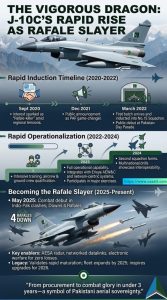
The tale of how the Pakistan Air Force (PAF) and the Indian Air Force (IAF) entered the era of Beyond Visual Range (BVR) air combat spanned decades before it came to its culmination on the night of 7 May 2025. For almost 50 years after partition, the PAF and IAF engaged each other in close-distance dogfights. Pilots would often recognize the tail markings on the fighter aircraft they were attempting to shoot down with their short-range guns and heat-seeking missiles. As such, all aerial engagements during the wars of 1965 and 1971 were conducted within visual range. The technological enablers for BVR engagements and corresponding doctrines did not develop in South Asia until the 2000s. In BVR air combat, the first one to see, lock on, and fire their missiles wins the engagement. Initially, the IAF had the ‘First Look, First Shot’ advantage. PAF’s fighter aircraft were capable but carried missiles with limited range, hindering effective long-range engagements

Continue ReadingMay 2025: The Largest BVR Engagement in South Asian Air Warfare

Four Dimensions of Space Power in the US–Israel War on Iran

At the beginning of Operation Epic Fury, US Space and Cyber Commands launched a coordinated campaign against Iranian satellite communication and navigation systems. Three days later, General Dan Caine, Chairman of the Joint Chiefs of Staff, publicly admitted what analysts suspected; these commands had been the ‘first movers’. Although space has received less media coverage than the air campaign or the naval dimension, it has enabled multi-domain operations. Broadly, there are four major dimensions which have defined the role of space in this war. The first dimension is satellite intelligence, particularly the evolution of commercial Earth observation into what analysts call a "glass battlefield." Accessing satellite

Continue ReadingFour Dimensions of Space Power in the US–Israel War on Iran

CHPM Report: Misreading Operational Outcomes

In modern conflicts, the fog of war does not clear as ceasefires commence; it only gets thicker and becomes a fog of narratives.  It is in this post-conflict situation that military historians have the responsibility of undertaking impartial analysis as they scramble to find coherence in chaos. As a caution, they should avoid prematurely echoing any one side’s narrative and instead endeavour to interrogate all claims with balanced scepticism. The Centre for Military History and Perspective Studies' (CHPM) exploratory note on Operation Sindoor falls short of this mark.

Continue ReadingCHPM Report: Misreading Operational Outcomes

Merger of European Space Industry: Lessons for Emerging Space Nations

The announcement on 23 October that Airbus, Thales and Leonardo will merge their satellite operations was a historic development for the European space industry. The plan aims to establish a new combined entity by 2027. Historically, the European space industry has been a competent but fragmented market in the form of national champions and competing initiatives. However,

Continue ReadingMerger of European Space Industry: Lessons for Emerging Space Nations