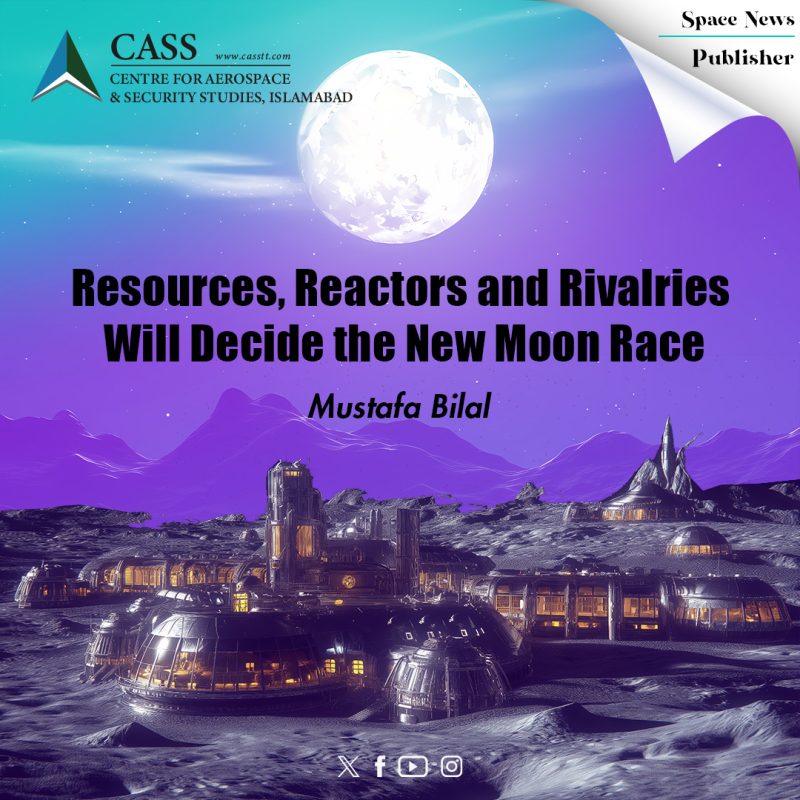
A new race to the moon is underway; not merely to erect flags, but to prospect for and extract water and helium-3, establish nuclear power plants and capitalize on the economic and strategic advantages that will shape the balance of power in space for decades to come.
Private companies are now making serious bets on how to exploit the moon’s resources. Recent developments reveal that the scramble to mine to the moon is no longer confined to the halls of science fiction but is now playing out in boardrooms. Take, for example, helium-3. On Sept. 16th, Bluefors agreed to purchase up to 1,000 liters of lunar helium-3 annually from Interlune in a deal expected to be worth $300 million, showing that helium-3 is in high demand for two reasons: it could be a potential fuel for nuclear power on the moon, and it is indispensable for dilution refrigerators to cool large quantum computers on Earth.
With one quantum data center potentially consuming more helium-3 than exists on Earth, the moon will no longer be exclusive to astronauts as high-tech industrialists bid for mining rights. This exposes a grim reality: the new moon race will not be won by whatever nation plants boots and flags on the lunar surface but by the one building the infrastructure to sustain a long term presence and reaping the economic dividends.
Two weeks after the helium-3 deal, on Sept. 30, Blue Origin announced Project Oasis to identify key resources on the moon by creating ultra-high resolution maps from orbit. In addition to helium-3, water ice on the moon is a critical resource because it can be processed into drinking water, oxygen and rocket fuel. Therefore, against incredible odds due to technical difficulties, a combination of private and state interests is pushing ahead with the commercialization of moon mining. The entity that leads the way in in-situ resource utilization (ISRU) and turns water ice into fuel will significantly reduce the costs of bringing lunar resources back home to Earth. That is why building infrastructure, from ESA’s moonlight communications network to Thales Alenia Space’s contract to provide a human lunar outpost, is vital. These platforms will be the basis of a future space economy. In other words, the company or state that leads in operationalizing ISRU will not only be the first to claim the treasures of the lunar soil all for itself, it will also attain control over the lunar logistics chain. This makes one wonder that the early involvement of the private sector is anything but a commercially motivated drive to capitalize on the future lunar economy.
The commercial imperative makes sense considering that half of the 450 lunar missions planned for 2033 are commercial and are expected to generate $151 billion in revenue. Congress has supported the commercialization of the moon by enacting laws that establish a “first to explore, first to own” principle for space resources, aiming to incentivize private sector involvement. This move initially raised international concerns, but has since been adopted by other countries such as India, Luxembourg and the UAE. Corporations are also already staking out a claim on the lunar radio spectrum, making dozens of applications to the International Telecommunication Union. One of the major technopolitical battlegrounds will be the 2027 World Radio Communication Conference. Over 80% of its agenda will be devoted to space-related subjects. For the attendees, the implication, of course, will be obvious: Engineering prowess is important in the new moon race but so is leading in setting the norms of lunar resource extraction and spectrum utilization for future entrants.
Against this astropolitical backdrop, the moon is moving from being a scientific frontier to a strategic market to exploit. This transition, to a degree, explains the recent rhetoric from Washington. Last month, the acting NASA administrator, Sean Duffy, put the American effort in very competitive terms, announcing a moon race against China and vowing, “I’ll be damned” if China gets there first. He was referring to the south pole of the moon, which is estimated to harbor water and helium-3. Although the rhetoric of territorial acquisition was concealed behind the veneer of lunar exploration, it highlighted that NASA’s mission back to the moon is no longer about just idealistic space exploration, it’s now about building the infrastructure that will build a lasting legacy. This essentially implies that the moon is no longer just to be explored but inhabited. Power, whether soft or hard, will be projected not so much from planting flags, but from sustaining systems, reactors, habitats and refueling stations.
Experts have pointed out the future of the moon will not be decided by the number of flags placed on it but by having a permanent presence there. Nuclear power generation is the key in this race to build the lunar infrastructure. The U.S., China, Russia, Europe and Canada are all developing lunar atomic reactors. The reasoning is straightforward: Solar power is unavailable during the two weeks the moon is on lunar night, and batteries cannot be used to keep the outposts operational. Nuclear energy is, as one scientist told BBC, “not only desirable, it is inevitable.” This inevitability stems from the fact that controlling a reactor on the moon would give states twice the operational duration to carry on with resource extraction and sustainment of human life support systems, compared to those relying on traditional power sources.
For this reason, the first nation with a nuclear power source on the moon would in fact be able to impose de facto if not de jure a “keep out zone” for safety purposes, and thus would set the precedent for the legal environment of lunar operations in which subsequent entrants would operate. We have witnessed this same precedent play out in the South China Sea. This dynamic provides an irresistible first mover advantage, which space law experts consider as an unintended consequence of the Outer Space Treaty (OST). While the OST forbids national appropriation, domestic legislation and lunar infrastructure will allow for de facto exclusionary zones as the requirement to “due regard” to the interests of other nations is legally ambiguous. Hence, the first states to deploy reactors or entire ISRU facilities would be in a position to control the access to local resources on the moon, by way of safety margins and operational control. The ambiguity of “due regard” will become the most fought over phrase in space law among diplomats in the very near future. Every reactor that is built will not only generate power but a precedent: one of either the moon remaining a commons to be accessed by all or becoming a series of demarcated craters de facto belonging to the first movers.
China knows how to play this game of strategic positioning well. The Chang’e 6 mission, which brought back samples from the far side of the moon, displayed a technical expertise that commands respect. Last month, as veterans from NASA cast doubts on America’s chances of putting a human on the moon before the Chinese, China did a systematic test of its Lanyue lander and Long March 10 rocket. Beijing’s lunar strategy follows in the footsteps of its land-based designs, involving massive infrastructure projects to lay the foundations for technological and economic supremacy, while encouraging other countries to join its lunar ambitions. This has given a new dimension to the U.S.-China lunar competition by essentially making it a contest of astropolitical legitimacy on the world stage.
The new moon race will be won not by just engineers building rockets but by politicians who combine technological innovation with political vision and diplomats who will play a key role in establishing guidelines for lunar operations. It remains to be seen if the U.S., through its Artemis program and commercial engagements, is able to influence the norms of this new era in space exploration or if it will have to play by the rules set by Beijing and other states engaged in the International Lunar Research Station. The stakes are quite high as the interplay between resources, nuclear reactors and rivalries determines who leads in the new moon race. Sean Duffy’s categorical statement on the importance of winning this race highlighted the significance of the accompanying implications: “Those who lead in space will lead on Earth.”
Mustafa Bilal is a Research Assistant at the Centre for Aerospace & Security Studies (CASS), Islamabad.