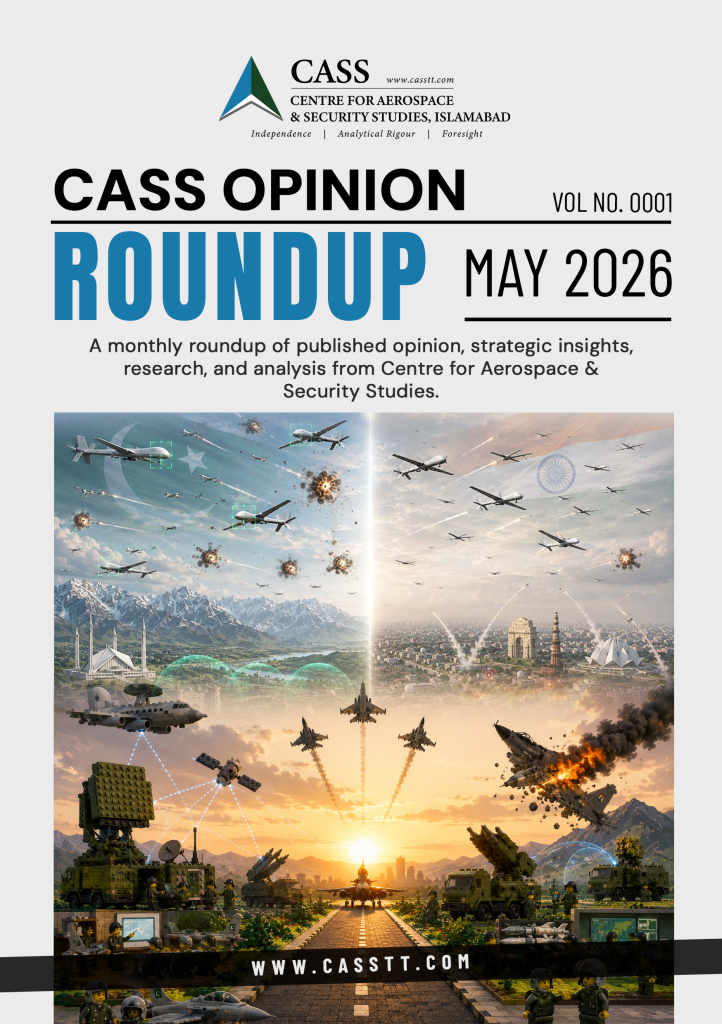
On 7th May 2025, Pakistan’s military forces took the international security community by surprise when it demonstrated operational superiority against its larger belligerent adversary India with its rapid and coordinated response. The Four-Day conflict proved to be a watershed moment for Pakistan, marking its rapid emergence as an important player in the region. In recent years, amidst the ongoing global competition between the United States and China, Islamabad has adopted a position of ’Strategic Balancing,’ where it maintains ties of cooperation with both Beijing and Washington. Deft diplomacy, emphasis on geo-economics, and credible conventional and strategic deterrence have remained the foundational pillars for Pakistan’s ambition as a rising middle power.
Operation Marka-e-Haq was a pivotal moment in Pakistan’s recent rise, establishing its credibility as a peer adversary to India by shooting down seven aircraft and striking 26 targets deep inside enemy territory. The May conflict boosted the stature of PAF and broke the myth of the superiority of western platforms. This provided a unique opportunity for Pakistan to expand its footprint in the global arms market, with JF-17 emerging as one of the major defence platforms in demand. The ‘thunder’ is currently operated in Nigeria and Myanmar, and reportedly Azerbaijan has also signed a deal worth 4.8 billion dollars for 40 aircraft. Pakistan’s defence exports are emerging as a strategic alternative to high-end 4th– and 5th-generation aircraft, which are typically out of reach for developing countries, making Islamabad an important player in the global arms market.
Following Pakistan’s victory in May India found itself isolated, as New Delhi appealed to the international community regarding Islamabad’s alleged complicity in Pahalgam terror attacks. The attempt failed as Congress leader Mani Shankar Aiyar criticised Shashi Tharoor stating that none of the 33 countries including the United Nations (UN) held Pakistan responsible. India’s diplomatic challenges were further exacerbated by Pakistan’s recent strategic partnership with Middle Eastern countries most notably Iran and Saudi Arabia. In August 2025, Prime Minister Shehbaz Sharif supported Tehran’s right to enrich uranium under a peaceful nuclear program. In September 25, the Strategic Mutual Defence Agreement (SMDA) was signed, which deepened Saudi-Pakistan ties as Islamabad became a direct security share holder in the region. Many commentators view this regional alignment as a counter to the India-Middle East Europe Economic Corridor (IMEC), arguing that Pakistan is steadily establishing itself as a net security provider in the region. Apart from these consecutive back to back diplomatic victories, Pakistan has adopted a nuanced approach to its tenuous Western border mixing kinetic and diplomatic solutions against the banned outfit Tehrik-e-Taliban Pakistan (TTP). The failure of the Afghan government to take action prompted the Pakistani military to conduct Operation Ghazab Lil-Haq. The military offensive has reportedly led to the killing of 796 insurgents while simultaneous engaging with Kabul through negotiations held in Urumqi mediated by China. Bolstering its national security, has given Pakistan political space to pivot to the Middle East and act as a regional stabilising force in the region.
Islamabad’s decision to diversify its relations proved prudent and positioned Pakistan to play the role of a mediator between Washington and Tehran. Pakistan emerged as a natural choice not only because it has stable ties with Turkey, Iran, US and the Gulf States, but also because it is capable of providing security for diplomats in Tehran. The Iran-US-Israel war has been particularly deadly for the Iranian officials who have been a victim of systematic decapitation strikes, creating a serious hurdle for negotiations as mutual trust has eroded. To ensure the security of the Iranians, Pakistan reportedly deployed approximately two dozen jets as well its Airborne Warning and Control System (AWECS) to guard against Israeli threats. The dialogue in Islamabad is particularly significant as it signals a shift from Doha and Ankara to Islamabad which have traditionally long been the capitals of international diplomacy in the Middle East. For Pakistan, regional stability is vital as it would provide a unique opportunity to act as a bridge connecting South Asia, Central Asia and Middle East, effectively becoming a fulcrum of the region.
Pakistan has come a long way since the conflict with India last year. Today its rise as a middle power largely rests on two main pillars. Firstly, through strategic balancing, Islamabad attempts to manoeuvre between Washington, Beijing, Moscow, Ankara, Tehran, Riyadh, and London. By having diverse relations, Pakistan has more strategic options for maximising its state autonomy. Secondly, Pakistan has adopted a ‘Hard State Approach.’ This entails no compromise on state sovereignty. This approach is more recently visible in Operation Ghazab Lil-Haq against the Afghan Taliban. With emphasis on state sovereignty and a careful balance of foreign relations, Pakistan is well poised to make its mark in the region.
Syed Ahmed Ali is a Research Assistant at the Centre for Aerospace & Security Studies (CASS), in Islamabad, Pakistan.The article was first published in Pakistan Observer. He can be reached at [email protected]