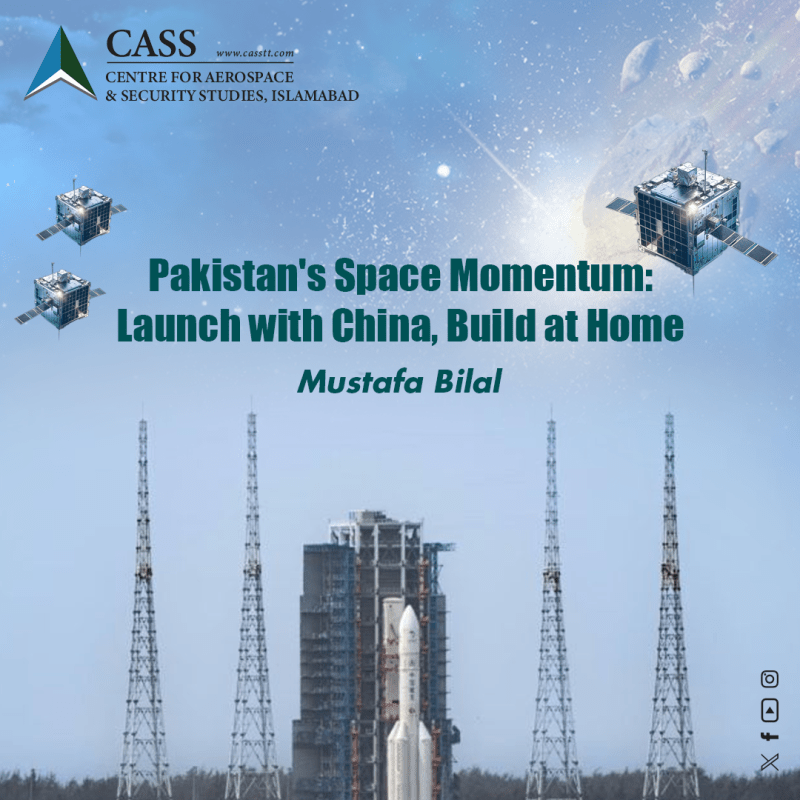
Between May 2024 and July 2025, Pakistan’s space program soared to new heights. Planning Minister Ahsan Iqbal rightly described this shift in Pakistan’s space momentum by stating that Pakistan’s advancements in space are “no longer symbolic, these are functional, practical and central to national development strategy”. His assertion was based on the launch of four satellites under Pakistan’s National Space Programme 2047. Within a year, Pakistan reached lunar orbit, expanded its national broadband capacity by deploying the PakSAT-MM1, while strengthening geospatial sovereignty with China’s assistance through the deployment of its first indigenous electro-optical and SAR remote sensing satellites (PRSC-EO1 and PRSC-S1). The consecutive launches were a historic first for Pakistan’s space programme since the launch of Rehbar-I in 1962.
The frequency of satellite launches was not merely for Pakistan’s prestige, as these will address pressing national challenges faced by Pakistan by incorporating space-derived data into governance, social development, and disaster resilience. For instance, Communication satellites like the PakSAT-MM1 would help to bridge the digital divide in underserved regions of Pakistan, a challenge that has long hindered equitable social development. Similarly, electro-optical (EO) imagery from the PRSC EO1 supports precision farming, irrigation optimisation, crop forecasting, and urban mapping. The PRSC-S1 was launched on 31 July 2025 to complement PRSC-EO1 by penetrating cloud cover and darkness, as the latter relies on sunlight and high visibility conditions. For a state acutely vulnerable to climate-induced flooding, such as the recent devastating floods in Pakistan’s northern regions, PRSC-S1 will be crucial for early flood warning by monitoring melting glaciers and shifting rivers, as well as for post-damage assessment in case of sudden flash floods caused by cloud bursts. Moreover, both satellites will identify geohazard risks, optimise CPEC infrastructure routes, secure food supplies through agricultural monitoring, and help manage scarce water resources.
PRSC-EO1 and PRSC-S1 operate in low-earth-orbit (LEO), whereas PakSAT-MM1 was deployed in geostationary orbit (GEO). However, Pakistan also ventured into deep space exploration by launching its first lunar CubeSat (iCube-Qamar) in May 2024. iCube-Qamar’s journey to the far side of the Moon symbolised Pakistan’s ambition to explore the lunar orbit, a goal few nations have attempted. The launch of iCube-Qamar aboard China’s Chang’e 6 also underscored that Pakistan’s strategic alignment with China was already higher than the Himalayas, and is now reaching into the far depths of space.
The coming years will bolster both ambition and alignment as Beijing assists Islamabad to focus its limited resources on targeted capability absorption, compressing decades of capacity development into just a few years. For instance, by collaborating with China on iCube-Qamar, Pakistani engineers acquired hands-on experience in deep-space mission design, development and operation. Similarly, Pakistan will gain expertise in complex planetary robotics by developing a lunar rover for China’s 2028 Chang’e mission. Pakistani astronauts will also be boarding China’s Tiangong space station next year. These astronauts will be the first foreign crews to perform scientific experiments and learn valuable human spaceflight knowledge from Chinese Taikonauts (astronauts).
The Chinese Space Station and the Moon are not endpoints but waypoints for Pakistan on its journey toward becoming an active participant in the new global space competition. While China will play an integral role in this journey, critics tend to view the strengthening space partnership between Pakistan and China through the lens of dependency. However, this is a misguided narrative that overlooks Pakistan’s dual-track approach toward advancing its space program. Space exploration is extremely cost-prohibitive; instead of remaining grounded by financial and technological constraints, Islamabad leverages space cooperation with China to lift off while rationally allocating resources towards developing home-grown capabilities, including designing, manufacturing, ground infrastructure, and data analysis to turn geospatial data into actionable outcomes. Therefore, while Chinese boosters may be providing the lift, the navigation system is Pakistani. This dual-track approach is aligned with achieving the objectives outlined in Pakistan’s National Space Policy.
However, there is no denying that the indigenous technical expertise behind Pakistan’s recent advances in space must become the norm, not the exception. Setting lofty space ambitions can be inspiring, but only sustained governmental support can foster a pedagogical culture that champions scientific inquiry. To tether ambition to capacity, Pakistan must expand local university degrees in space sciences and facilitate the acquisition of scholarships abroad for PhD programmes. Continued funding of innovation hubs, such as the National Aerospace Science and Technology Parks (NASTPs), will also be essential to ensure a steady supply of skilled aerospace engineers and scientists.
A viable business model for Pakistan’s space industry, aligning with its national space policy, could be a public-private “Space-as-a-Service” partnership, wherein Pakistan’s national space agency could collaborate with Chinese and domestic space-oriented firms offering services such as flood alerts, crop monitoring, and urban mapping. In addition to requiring technology transfer to Pakistan within a few years, the government would lower investor risk by providing tax incentives and minimum revenue guarantees. Through multi-year contracts with provincial governments, disaster authorities, and CPEC projects, the venture could be compensated for results, such as the number of hectares mapped or the speed of disaster warnings (especially in case of floods), rather than just selling satellite data. At the same time, the private partner could sell value-added services directly to telecoms, banks, and insurers, such as logistics tracking or crop risk assessments. This strategy could make Pakistan’s space programme a revenue-generating, service-driven sector that benefits both private markets and public institutions.
A decade from now, when Pakistan’s lunar rover sends back images of the Moon’s surface, just as iCube-Qamar beamed back pictures of the Moon, the seeds being planted today will be recognised for what they are: calculated steps in a strategy that combines Chinese collaboration with indigenous capacity-building, and aspiration with execution. However, while navigating the trajectory in space, the challenge for Pakistani policymakers would be sustaining the current momentum against the gravitational forces of fiscal restraints and systemic underinvestment in aerospace education and industry.
Mustafa Bilal is a Research Assistant at the Centre for Aerospace & Security Studies (CASS), Islamabad. The article was first published in The News International. He can be reached at [email protected]