
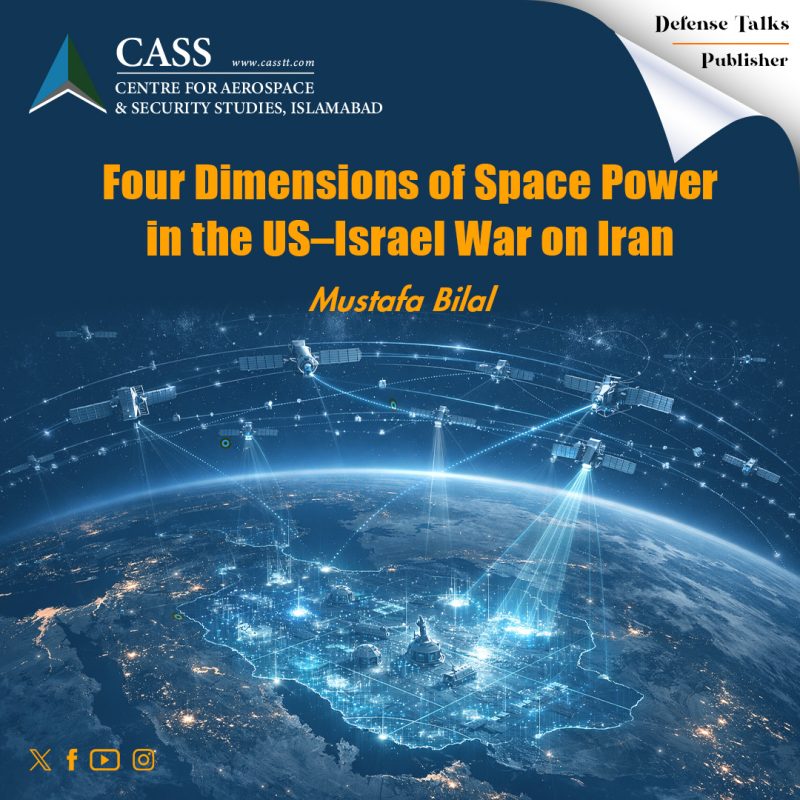
At the beginning of Operation Epic Fury, US Space and Cyber Commands launched a coordinated campaign against Iranian satellite communication and navigation systems. Three days later, General Dan Caine, Chairman of the Joint Chiefs of Staff, publicly admitted what analysts suspected; these commands had been the ‘first movers’. Although space has received less media coverage than the air campaign or the naval dimension, it has enabled multi-domain operations. Broadly, there are four major dimensions which have defined the role of space in this war.
The first dimension is satellite intelligence, particularly the evolution of commercial Earth observation into what analysts call a “glass battlefield.” Accessing satellite intelligence in the 1991 Gulf War took weeks, in 2003, days, and just hours in the ongoing war. This compression is mainly attributed to the proliferation of commercial Earth-observation satellites, which have eroded the monopoly of government-owned satellites over publishing the latest satellite imagery.
The resulting battlefield transparency has offered military utility to both sides: it has been useful to US and Israeli forces for conducting rapid battle damage assessment, but it has also facilitated Iranian military planners in altering their tactics after suffering losses. Moreover, it has allowed Iranian officials to publicly highlight the damage they have inflicted on US bases.
This partly explains why private companies were reportedly pressured by the US government into delaying their release of satellite imagery for users besides the US military. The incident highlighted unresolved tensions at the heart of commercial satellite intelligence. Firms that promote themselves as neutral providers of information in peacetime can be compelled by their host states in wartime to release or withhold satellite imagery for highlighting losses suffered by the adversary while hiding their own.
However, MizarVision, a commercial Chinese company has assisted in providing timely open-source targeting intelligence to Iran which has compensated for the gaps in Tehran’s own satellite reconnaissance capabilities. Several US military facilities in Gulf States featured in the pre-war analyses conducted by MizarVision were targeted in Iranian retaliatory strikes.
The combination of open-source Chinese commercial satellite imagery with Iranian operational planning blurs the boundaries between passive battlefield transparency and active intelligence support, bridging the first dimension of space power directly with the second: the navigation warfare that translates such intelligence into precision strikes.
Israel had reportedly jammed and spoofed Iranian drones during Operation Rising Lion. Since then, Iranian military officials likely realised the vulnerabilities of relying one a single Global Navigation Satellite System (GNSS) and sought alternatives. Therefore, if Iran’s reported switch to China’s military-grade BeiDou-3 is correct, then it is arguably the most operationally significant space-related development. The military version of BeiDou is assessed to be highly resistant to jamming and spoofing.
Moreover, for China, giving Iran access to BeiDou could serve a much broader purpose: each time an Iranian strike is possibly guided by BeiDou, followed by electronic warfare by the US to thwart it, would provide valuable operational data for Chinese military planning in the event of any future conflict with the US in the South China Sea.
The third dimension is the targeting of space-ground systems. An ETH Zurich study documented 237 cyber operations against entities in the space sector between October 2023 and November 2025, one-third of which were focused on the 12-day war last June. International space law does not provide clear provisions for determining the legal status of dual-use infrastructure. This legal grey zone has been widely debated since the Russian cyber-attacks on Ukrainian space ground systems.
However, in the ongoing US–Israel war on Iran, there is a concerning precedent being established that space ground systems are now legitimate military targets. Although no satellites have been kinetically targeted yet, due to the indiscriminate threat of the resulting space debris. Instead, the adversary’s space ground systems have been targeted to deny space intelligence, communication and navigation capabilities.
Israel, in particular, has been systematically targeting Iran’s military space programme: on 8 March, it hit the IRGC Space Force Headquarters; on 14 March, it struck the Iranian Space Research Centre; on 16 March, Israel targeted an Iranian space facility which it claimed was developing anti-satellite weapons.
Meanwhile, Iran has reportedly targeted key surveillance radars and possibly space ground systems across US bases in the Middle East. On 15 and 24 March, Iran claimed to have hit Israel’s Gilat defence satellite communications centre and satellite reception stations serving the Israeli military. Earlier, Hezbollah had also targeted the SES Ha’Ela Teleport on 9 March, which is Israel’s largest satellite ground station.
After observing the tit-for-tat targeting of space-ground systems in this war, it can be argued that spacefaring states will seek to mitigate the inherent vulnerabilities in stationary and centralised space infrastructure. In this context, there might be an increased international interest towards mega-satellite constellations which offer greater redundancy through mobile satellite terminals.
The fourth dimension is the acceleration of a space arms race in the Middle East. The head of Israel’s Space Programme Office has declared that Israel’s goal is to monitor and collect satellite intelligence around the clock and in all weather conditions across the region. Whereas Iran, for its part, has tried to compensate for the regional asymmetry between space capabilities by its apparent strengthening of military space cooperation with China and Russia. Other regional states will now also be tempted to forge or strengthen existing bilateral or multilateral military space partnerships.
Drawing from the four dimensions discussed above, there are four interlinked key takeaways for all spacefaring states. Firstly, this war has intensified the transition of space to a war-fighting domain. Relatedly, the second lesson for military planners is assuring uninterrupted access to satellite imagery in times of heightened tensions while anticipating the outbreak of a conflict. The third is hedging against an adversary’s space superiority by strengthening military space cooperation with established space powers. The fourth and most worrying takeaway is the kinetic targeting of legacy space ground systems that has concerning implications for future inter-state conflicts.
Mustafa Bilal is a research assistant at the Centre for Aerospace & Security Studies (CASS), Islamabad. The article was first published in Defence Talk. He can be reached at: [email protected]

The West: The History of an Idea
The world is witnessing the collapse of the Western order, if not the emergence of an alternative one. The idea of ‘West’ as against the rest is still at the root of contemporary understanding of world politics. Georgios Varouxakis, a remarkable voice on Modernity and Nationalism, has provided the historical origins and modern connotations attached with the idea of ‘West’. In his book ‘The West: The History of an Idea’, Varouxakis has argued that the West is not an eternal entity, rather it is a modern socio-political construct that emerged in the political philosophy of the early 19th century and evolved with the passage of time. The book provides an in-depth historical analysis of the idea to determine the roots of its modern interpretation.

Space-Enabled Warfare in the 21st Century: Pathways for Developing States
Space has emerged as a distinct domain of warfare alongside land, sea, air, and cyber. Developed countries like the United States, Russia, and China possess offensive and support capabilities in space. In the shadowed expanse of Low Earth Orbit (LEO), where satellites operate like silent custodians, the 2022 Russian invasion of Ukraine transformed the nature of modern conflict. As Russian troops marched forward, the commercial satellites like Maxar and Planet, which are operated by Western firms, captured high-resolution imagery of Russian troops, providing real-time intelligence to Ukrainian commanders, unlike ever before.
