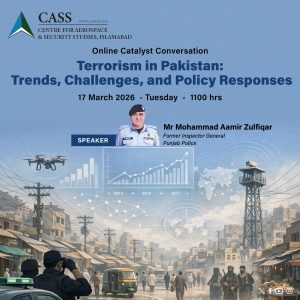
Terrorism in Pakistan: Trends, Challenges, and Policy Responses
Terrorism has remained one of the most persistent security challenges in…

Terrorism has remained one of the most persistent security challenges in…
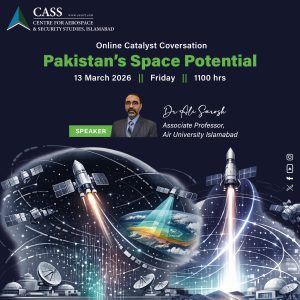
Outer space has emerged as a critical domain shaping national power, economic development, and military effectiveness in the 21st century. Space-based assets today underpin communication networks, navigation systems, disaster management, climate monitoring, intelligence gathering, and modern warfare capabilities.
Artificial Intelligence (AI) has diverse potentials. The increasing use of AI makes it imperative to examine its impact on an important societal aspect — Governance. The paper uses three UN-proposed indicators of good governance: i. transparency, ii. accountability and iii. rule of law to assess the potential impact of AI in future governance. The research uses qualitative research design based on open-ended semi-structured interviews with AI experts to study the expert opinion on the subject.
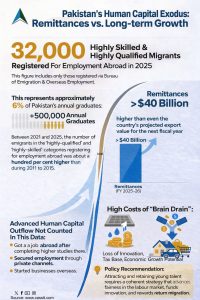
Download PDF KEYWORDS: Remittances, Brain Drain, Middle East

Danish Javeed’s book The Incredible and Shining India! Transition from Secularism to Hindutva Extremism uncovers the gruesome realities that lie beneath India’s projected image as a prosperous nation. It serves as a powerful reminder that human rights atrocities must continue to be documented even long after they have occurred, as the sooner they are forgotten, the greater the risk that they will be normalised.
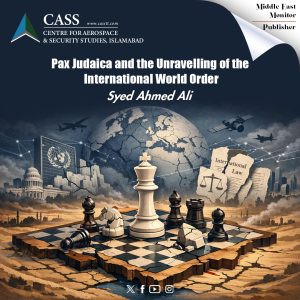
Israel’s aggressive settlement expansion and blatant disregard for international law have contributed towards the fragmentation of the international rules-based order. In the midst of this upheaval, Tel Aviv has cemented itself as the dominant power in the Middle East, creating what commentators term “Pax Judaica”. This regional order is dominated by Israeli perceptions of security threats which it must eliminate for the preservation of the Jewish state.
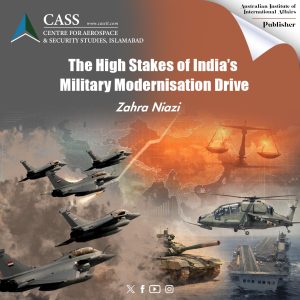
New Delhi’s recent defence budget announcement for fiscal year (FY) 2026-27 represents more than just a budgetary jump; it carries important implications for South Asian stability, warranting closer reflection. The allocation of USD 85 billion to defence, with capital expenditure rising by 22 per cent compared with a 17 per cent increase in revenue expenditure, clearly reflects the government’s prioritisation of accelerated military modernisation over routine operational sustainment.
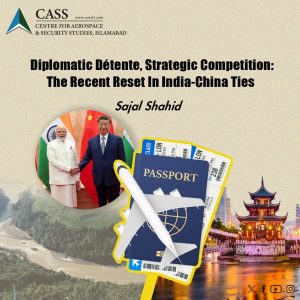
On 1st September, 2025, Chinese President Xi Jinping and Indian Prime Minister Modi met on the sidelines of the Shanghai Cooperation Organisation (SCO) Summit in Tianjin, China, and mutually agreed to forgo their historical rivalry in favour of a partnership. To signal the transition to this new phase, both states announced the resumption of direct flights after a five-year hiatus, as well as the restoration of tourist visas.
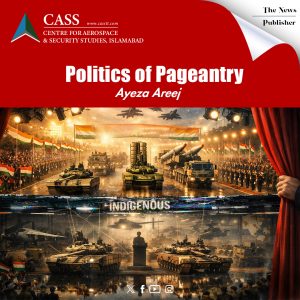
On 26 January 2026, India commemorated its 77th Republic Day, the day when New Delhi officially became a republic through adoption of the constitution. The Republic Day parade was projected as the celebration of India’s progress and national pride. Yet, beyond the spectacle, the parade intended to convey a calibrated strategic and political signal by manufacturing an image of self-reliant and confident India amid regional uncertainty.