
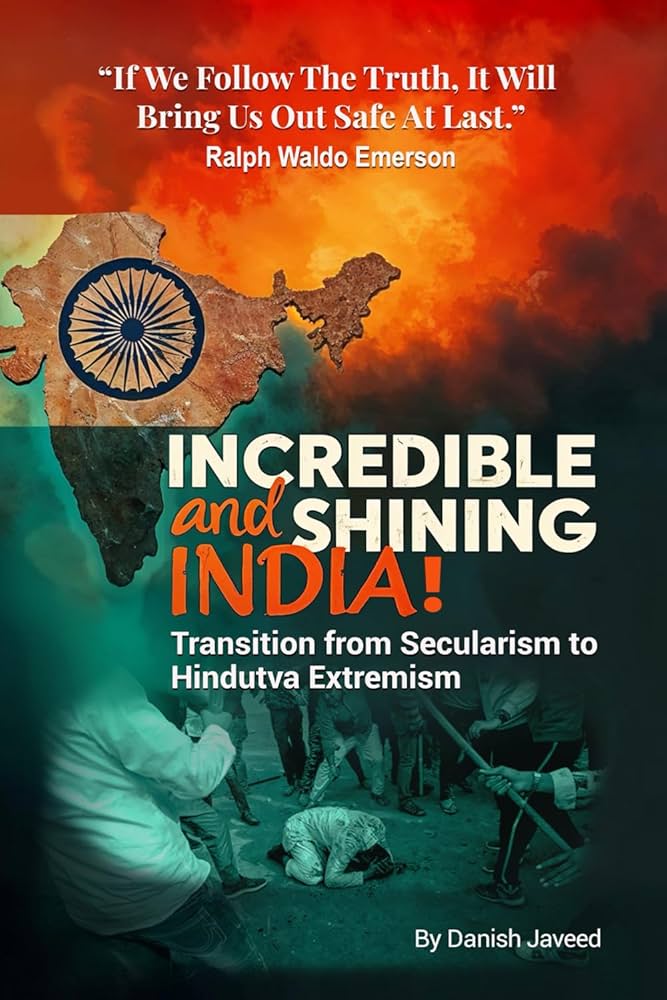
Danish Javeed, The Incredible and Shining India! Transition from Secularism to Hindutva Extremism (Independently published, 2025).
Reviewed by Zahra Niazi
Danish Javeed’s book The Incredible and Shining India! Transition from Secularism to Hindutva Extremism uncovers the gruesome realities that lie beneath India’s projected image as a prosperous nation. It serves as a powerful reminder that human rights atrocities must continue to be documented even long after they have occurred, as the sooner they are forgotten, the greater the risk that they will be normalised.
From the 2002 Gujarat genocide to the 2020 Delhi massacre, Javeed details the painful accounts of the human rights atrocities carried out against minorities, including Muslims and non-Muslims, in India. Such episodes, he shows, have taken a more systematic and sustained character since Modi’s ascent to power in 2014. Devoting a substantial portion of the book to the Gujarat genocide, Javeed convincingly argues that it was a meticulously orchestrated massacre enabled by collusion between the state and its institutional arms, including, but not limited to, the judiciary and the media. His claims of attribution remain well-grounded in evidence and carefully woven into logical reasoning, leaving little doubt in the mind of the reader. He spent seven years researching the subject, which lends further credence to his claims.
Beyond highlighting the atrocities, Javeed also explores the factors that led secular India to transform into a religio-racial supremacist state where grave abuses of minority rights find fertile ground. According to him, Jawaharlal Nehru’s death in 1964 served as a turning point, following which the Indian National Congress, which had long promoted a pluralistic view of India, started using the ‘religion’ card for electoral gains. As a result, Hindu nationalism and extremism were able to carve out a larger space within the social fabric of society and, by extension, the Bharatiya Janata Party (BJP) within the corridors of power. Facilitating this transformation was a constitutional ambiguity; the Constitution of India neither defines a ‘secular Indian state’ nor specifies a separation of religion from state and politics. Hindutva is not just a political ideology but a broader social and cultural mindset of the Hindus.
He further states that unchecked extremism and the war hysteria it generates can be consequential not just for the prosperity of Indian society but also for the peace of the region and the world alike. That said, the book does not leave readers with a sense of despair, but instead offers a message of hope. Javeed’s belief in the potential for transformation in societal beliefs and the power of populations to alter the course of history is reassuring. The Indian population, too, he believes, can become a powerful driver of change.
However, while this transformation is realistically attainable, in making his argument, Javeed appears to overestimate the ease with which such a change could occur. He notes that the BJP failed to secure an outright majority on its own in the 2024 Lok Sabha elections, in contrast to its landslide victories in state-level polls of 2012 in Gujarat and 2017 in Uttar Pradesh, and the Lok Sabha elections of 2014 and 2019. According to him, this shift suggested that Indians had started realising the consequences of hate-ridden BJP-led Hindutva extremism for peace.
This interpretation, however, overlooks the fact that when extremist nationalism is deeply embedded within the social fabric, individual mindsets cannot be easily changed until some actors from within society act as decisive torchbearers. In India’s case, such figures have yet to emerge. Having said that, the analysis of the factors driving the BJP’s relative decline in popularity in the 2024 elections could have been strengthened had Javeed also explored the alternative thesis. For instance, in 2017, Modi capitalised on the claimed 2016 ‘surgical strikes’ inside Azad Jammu and Kashmir and in 2019, on the Pulwama-Balakot episode from earlier that year, which appealed to the population’s militant nationalism. It would have been valuable to examine whether the outcome of the 2024 Lok Sabha elections might have differed had Modi been able to capitalise on a recent military action against Pakistan.
However, while Javeed’s interpretation of the electoral outcome may have differed, influenced by his optimistic outlook, his findings on the trends in the BJP’s electoral performance provide valuable insights for anybody aiming to explore the drivers of India’s military aggression against Pakistan and, more specifically, the India-Pakistan conflict of 2025. An important question these findings raise is: can the electoral results of 2024 help explain the events that unfolded in 2025, including the Pahalgam incident in April and India’s military aggression that followed?
Beyond that, the book provides comprehensive evidence for all those who, like Javeed, have taken up the noble responsibility of bringing attention to human rights atrocities. Additionally, it offers valuable food for thought for those who aim to design peace strategies for South Asia. The book effectively brings attention to the notion of civil peace, i.e., the idea that peace is a byproduct of citizen advocacy. Finally, it is an especially useful guide for those looking for answers to what made India transition from a secular to a religio-racial supremacist state.
Javeed expresses his thoughts with impressive clarity, making the content easy to follow. The book effectively awakens the conscience of readers and encourages them to continue advocating for change, rather than accepting the current extremist trajectory of the Indian government as unchangeable. What is required now is an exploration of the factors that could facilitate such a transformation.
Zahra Niazi is a Research Associate at the Centre for Aerospace & Security Studies (CASS), Islamabad, Pakistan. She can be reached at [email protected].



