
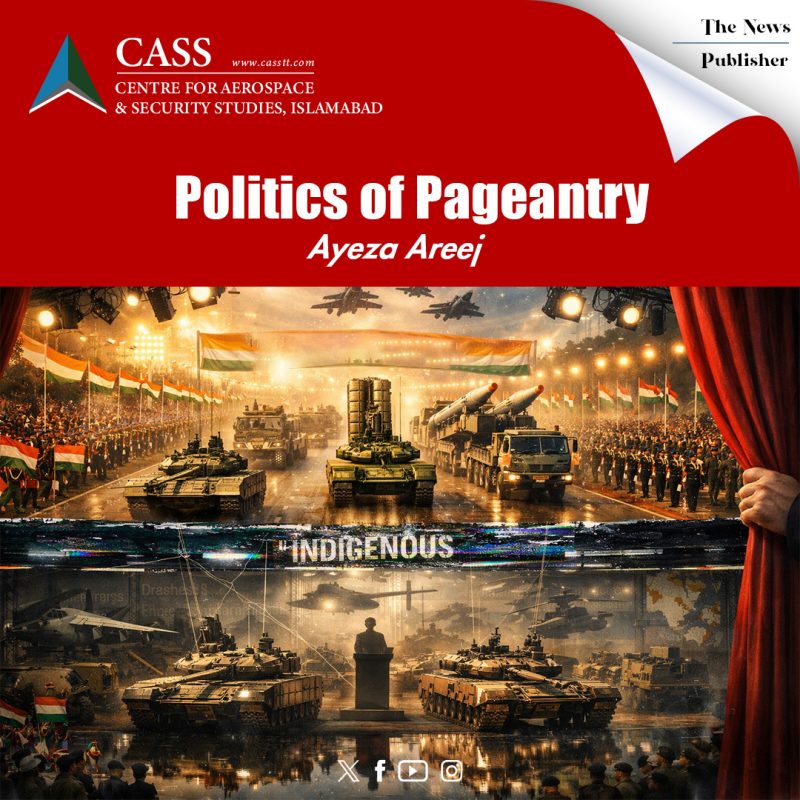
On 26 January 2026, India commemorated its 77th Republic Day, the day when New Delhi officially became a republic through adoption of the constitution. The Republic Day parade was projected as the celebration of India’s progress and national pride. Yet, beyond the spectacle, the parade intended to convey a calibrated strategic and political signal by manufacturing an image of self-reliant and confident India amid regional uncertainty.
The institutionalisation of ‘Operation Sindoor’ was the primary focus of the parade, which was manifested through tri–services tableaux on ‘Victory through Jointness’ and specialised formations involving Rafales and Su-30 MKIs. The parade, under the theme of ‘150 years of Vande Mataram,’ claimed to feature the display of advanced weapon systems. However, ‘scaled models or replicas of key platforms’ were showcased including S-400 air defence units, Akash air defence system, BrahMos cruise missile, T-90 Bhisma and Arjun main battle tanks, which weakened the overall impression.
In addition, robotic dogs, unmanned warhead systems, Armoured Light Specialist Vehicle (ALSV), and loitering munitions were displayed, which attempted to showcase India’s efforts of technological modernisation and operational sophistication. Nevertheless, the absence of Tejas Light Combat Aircraft (LCA), which has always been celebrated as India’s indigenous feat, was quite noticeable. Although the officials explained the omission of Tejas by citing safety concerns associated with single-engine aircrafts, its absence was indicative of deeper problems within India’s aerospace programme. Defense Express, a Ukrainian defence news agency, linked the ‘absence of Tejas’ with the safety and reliability issues. It shows the waning belief of the authorities in the Tejas programme, especially considering the recent crashes, production bottlenecks and long development timelines. Tejas exclusion brought doubts on its performance uncertainty and the effect it might have on India’s export ambition. In order to fill the gap, India had to resort to the induction of 114 Rafale aircrafts, which also indicates the stagnation of India’s indigenisation efforts.
Throughout the parade, the rhetoric of Aatmanirbhar Bharat (self-reliance) and technological independence was promoted as many defence systems were labelled as indigenous platforms. However, this argument is in sharp contrast with the reality because most of the key defence assets are imported. As an example, French Rafale fighter jets, the S-400 air defence system, American Apache helicopters and Russian tanks (T-90) were the order of the day, and this showed a stark contrast between the operational reality and the official narrative of New Delhi. Although India claims many of its weapon platforms to be indigenous, execution remains a major challenge for the Indian Armed Forces.
On the domestic front, the timing of the parade converged well with Modi’s electoral considerations. With the upcoming elections in West Bengal, Kerala, Tamil Nadu and Assam, the Bharatiya Janata Party (BJP) took advantage of the occasion to market itself as a defender of national security and deter dissent and democratic space. The process of militarisation of ceremonial display prompts concerns regarding normalisation of unquestioned loyalty and centralised power, which undermines institutional accountability.
Compared to the Chinese military parade that displayed its determination against its international competitors, the Indian parade was unable to convey its vision in a strategic manner by fusing military power with cultural shows. In the Chinese parade, high-tech weapon were displayed including unmanned underwater vehicles (AJX002 and HSU100), Intercontinental Ballistic Missile (DF-5C), laser weapon systems, hypersonic missiles, unmanned submarines, and anti-ship missiles. The parade was much more than pageantry, demonstrating China’s inter-domain cohesion and intelligentisation of warfare. Conversely, the Republic Day parade of India, 2026, at Kartavya Path was meant to show the world that India is a serious contender to China. However, it did not succeed in converting this vision into a coherent, convincing, and strategically integrated narrative.
Apart from that, while the ceremony did not include overt hostility towards Pakistan, the forces on display reflected India’s aggressive posture. The Lieutenant Governor of Jammu and Kashmir, Manoj Sinha said that ‘with Operation Sindoor ongoing and the Indus Water Treaty suspended, India’s water resources will now be utilised for its own requirements.’ The statement highlights the politicisation of natural resources under international agreements, demonstrating the risk of escalation. At the same time, India also unveiled the Suryastra rocket launcher that will be used in conjunction with ‘Shaktiban’ and ‘Divyastra’ to enhance and communicate Indian kinetic deterrence.
The parade, overall, resembled a Bollywood-style narrative, where grand stages and emotional music tried to create an illusion of unbeatable military strength. However, training standards, institutional stability and strategic coherence define the effectiveness of military power rather than overemphasis on image building.
Ultimately, the Republic Day parade, an illustration of the politics of pageantry, was very carefully choreographed to project India’s image as a global and a self-sustaining power. Yet, the underlying vulnerabilities and preference for appearance over substance only revealed insecurity instead of readiness.
Ayeza Areej is a Research Assistant at the Centre for Aerospace & Security Studies (CASS), Islamabad, Pakistan. The Article was first published by The News. She can be reached at [email protected].



