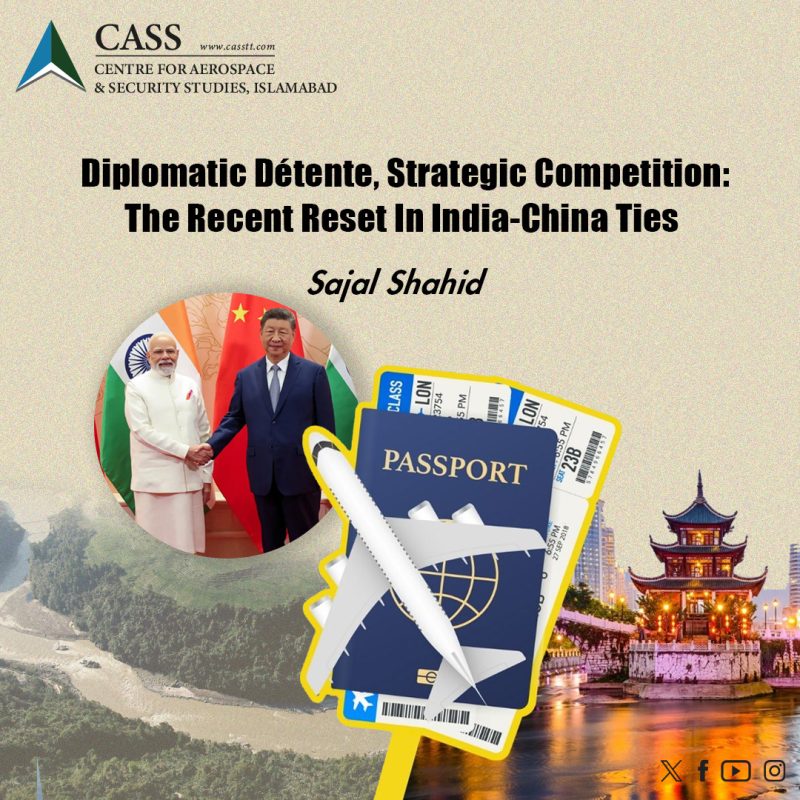
On 1st September, 2025, Chinese President Xi Jinping and Indian Prime Minister Modi met on the sidelines of the Shanghai Cooperation Organisation (SCO) Summit in Tianjin, China, and mutually agreed to forgo their historical rivalry in favour of a partnership. To signal the transition to this new phase, both states announced the resumption of direct flights after a five-year hiatus, as well as the restoration of tourist visas. Although significant, this news was not surprising. Since late 2024, both China and India have engaged in a gradual thaw of diplomatic relations, also referred to as a ‘fragile rapprochement.’ On 23rd October, 2024, President Xi and PM Modi met during the annual BRICS Summit in Russia, which served as a pivotal encounter, allowing for an eventual military disengagement along the Line of Actual Control (LAC).
This reset in relations can be attributed to a variety of factors. India is currently facing ongoing pressure from raised US tariffs that are pushing it towards rebuilding ties with China to prevent a multi-front economic challenge. China also ranks second among India’s trading partners (the first being the US), as well as a major provider of raw materials and industrial components, with bilateral trade exceeding USD 127 billion in the 2025 fiscal year alone. Due to this, both countries remain firmly interlinked. India’s pursuit of ‘strategic autonomy‘ following its failure to gain international support for Operation Sindoor has deepened its tilt towards China. By attempting to repair its relationship with China, India aims to distinguish itself from the traditional US-led bloc in the region and be seen as an independent actor rather than a pawn in the broader US-China rivalry.
China, similarly, benefits from renewed ties with India. India serves as one the largest markets for Chinese products, raw materials, and industrial components, offering Beijing increased opportunities for investment if relations continue to improve. Via reconciliation, China can prevent another Galwan crisis (a 2020 military confrontation over Chinese road constructions in Galwan Valley) from taking place and pull a regional power away from the US’s sphere of influence.
Despite the recent gestures of goodwill, underlying tensions between the two states remain unresolved. Border disengagement has begun at specific points such as Depsang and Demochok, yet both parties have yet to fully withdraw their troops from the LAC. Approximately 60,000 troops (armed with artillery and rocket systems) from each side remain deployed along the border, and several areas, such as the Galwan Valley and Pangong Tso, continue to serve as buffer zones. In addition to this, India recently inaugurated a new military airbase near its border with China to act as ‘a challenge for both of its adversaries.’ This sustained military presence is symptomatic of a wider lack of trust between the two states that has woven itself through all aspects of their relationship.
Despite India’s economic and industrial dependence on China, its engagement with the state remains selective. India repeatedly avoided defence-related trade with China, even cancelling a USD 26 million order for UAVs due to fears of spyware in the Chinese-manufactured components. Chinese social media apps, including WeChat and TikTok, also remain banned for similar reasons, even five years after the Galwan Valley conflict.
This wariness also carries over into the maritime domain. India has conveyed unease regarding China’s naval research vessels operating in the Indian Ocean, referring to them as ‘spy ships’ for Pakistan. This demonstrates that China’s long-held partnership with Pakistan lies at the root of India’s distrust towards Beijing.
Hydropolitics also remains a bone of contention. China’s recent construction of hydropower projects, particularly the Medog Dam north of India has fuelled anxiety in Indian leadership, with some even referring to it as an ‘existential threat’. As the upper riparian state, China has the capacity to divert the flow of water through the dam or release sudden bursts of water, resulting in floods. Though China has made no indication that it would do so, this nonetheless remains a concern for India, which has regularly employed this tactic against its own downstream neighbour, Pakistan.
Beyond these areas of disagreement, the greatest point of dispute between India and China remains an ideological one. India’s ambition to assume the role of the regional hegemon places it directly at odds with China, which remains a major power both regionally and globally. Establishing a mutually beneficial relationship with a rival state is certainly possible, as evidenced by the US and China’s trade ties; however, it by no means erases competition and is thus, often unstable. The same is likely in the case of India and China. Though diplomatic relations are on the path of improvement, underlying tensions and ideological differences still exist. As a result, this period of détente is poised to be short-lived.
Sajal Shahid is a Research Assistant at the Centre for Aerospace & Security Studies (CASS) Islamabad. She can be reached at [email protected]