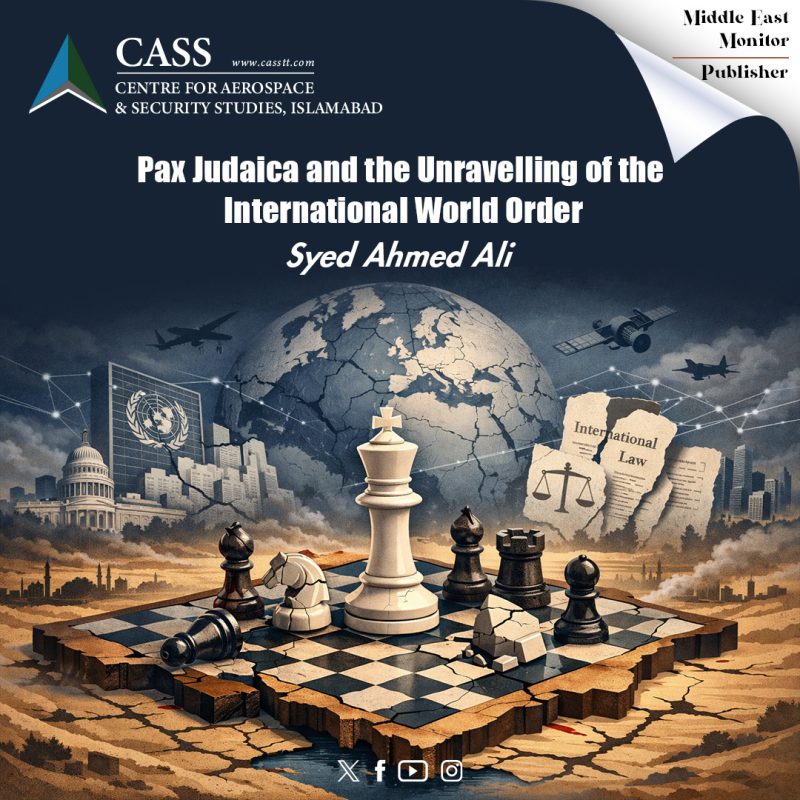
Israel’s aggressive settlement expansion and blatant disregard for international law have contributed towards the fragmentation of the international rules-based order. In the midst of this upheaval, Tel Aviv has cemented itself as the dominant power in the Middle East, creating what commentators term “Pax Judaica”. This regional order is dominated by Israeli perceptions of security threats which it must eliminate for the preservation of the Jewish state. Israel’s limited strategic capacity is compensated by leveraging its political lobbies, intelligence networks and ideological support of the Zionist movement embedded deep within Washington. This allows the Israeli defence forces unmitigated access to technology, financial support and military cooperation with the West. Consequently, the Middle East reflects an asymmetrical security architecture where the rest of the region is vulnerable to Israeli territorial expansion, pre-emptive strikes, regime changes and genocide, all in the garb of self-defence.
Israel’s actions in the Middle East particularly in Gaza, constitutes as a crime against humanity and are in clear violation of the first three article of the 1948 Genocide Convention. The UN commission confirms that Tel Aviv has been responsible for killing at least 64,964 people and the destruction of 90% of civilian infrastructure Israel’s actions have set a dangerous precedent for the global security community in Sudan, the Rapid Support Forces (RSF) adopted the Israeli policy of shrinking civilian space in the battlefield, which allows security personnel to use overwhelming force on residents. According to a report, nearly 500 people have been killed and thousands internally displaced as the RSF had declared Zamzam a military warzone. Similarly, India’s consul general in New York, Sandeep Chakravorty, has signalled to enforce demographic change policies by using Article 35A and 370 as legal instruments, which closely mirrors Israeli policies in Gaza.
The legalisation of international violence has led Israel to challenge international institutions. In 2023, Tel Aviv was brought into question over concerns of genocide during the war in Gaza, which was subject to a trial by the International Court of Justice (ICJ). The court issued a provisional order which directed the Israeli court to ensure humanitarian aid to Gaza and prevent all actions that could lead to genocide. The Israeli government paid no heed to the ICJ’s rule; consequently, on 21 November, 2024, the International Criminal Court (ICC) issued an arrest warrant for Prime Minister Netanyahu and Chief of Defence Yoav Gallant. The Israeli government rejected the jurisdiction of the ICC and openly defied its arrest warrants by travelling to the US, followed by Hungary. The lack of cooperation by states has created political space for the accused to disregard international courts. However, it is important to mention notable exceptions like Turkey, which has also issued an arrest warrant for crimes against humanity.
Israel in a bid to eliminate its perceived threats has blatantly disregarded the international law, which is clearly reflected in its treatment of international bodies. On 16 November, 2025, UN peacekeepers reported heavy artillery firing by Israeli tanks on the United Nations Interim Force in Lebanon (UNIFIL) positions. These forces were tasked to stabilise Southern Lebanon under Security Council Resolution 1701. Israel’s belligerent behaviour has not even respected international protocols and norms. Tel Aviv’s recent strike on Qatar is a violation of the Vienna Convention of 1961, which forbids the attack on diplomats. Such attacks risk the erosion established conventions and sets a dangerous precedent in the international community. The use of deception and the weaponisation of diplomatic negotiations was also seen in the recent Iran-Israel war. Where the Trump administration used the guise of the sixth round of talks as a cover for Israeli led operation ‘Rising Lion.’ This has created a world where there is no trust between international actors, as such conflicts cannot be halted by ceasefire mechanisms or confidence-building measures when each side anticipates bad faith.
Israel’s policies in the Middle Eastern region come at the expense of international norms, which often creates dangerous precedents which are promptly adopted by other states. The destruction of the Arab world is fuelled by an absence of balance of power in the region, which has created a power vacuum, which is filled by the rise of Pax Judiaca. Washington’s partisan behaviour and the absence of any meaningful international body to monitor Tel Aviv’s actions leave Israel with virtually no oversight. As a consequence of the international system’s inability to safeguard sovereignty and basic human rights, regional states may turn to broader alliances to guarantee their security. This reflects a broader trend in the international community where international organisations are replaced by regional and extra-regional alliances. It should be noted that Israel’s behaviour is a product of the relentless pursuit of state interests and extremist ideologies. It has often pushed the soul of humanity to the brink of collapse. The question then arises: have we finally gone too far?
Syed Ahmed Ali is a research assistant at the Centre for Aerospace and Securtiy Studies (CASS), Islamabad, Pakistan. The Article was first published by Middle East Monitor. He writes on technopolitics and can be reached at [email protected]