
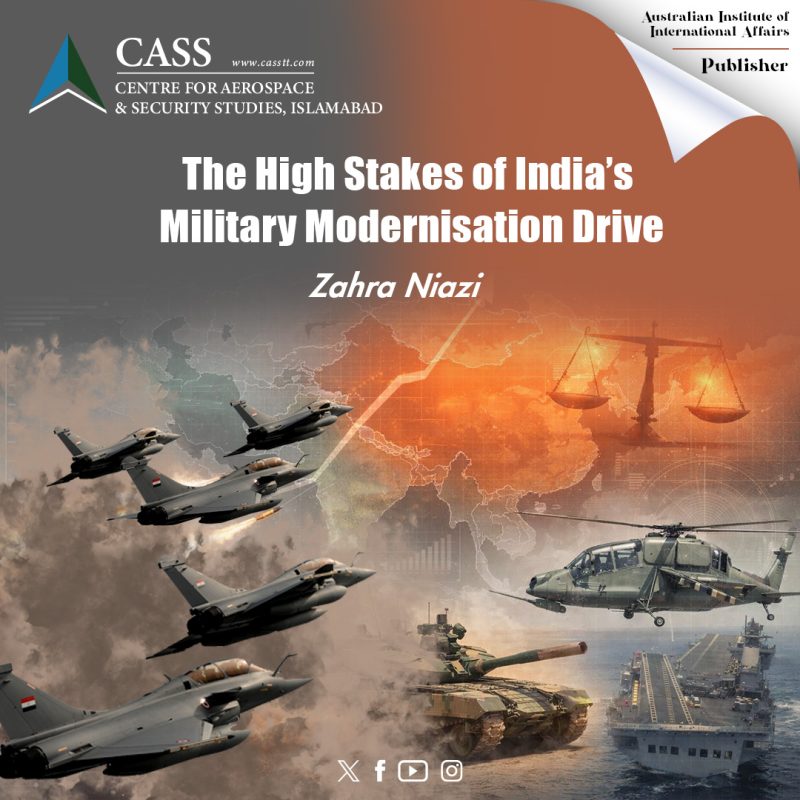
New Delhi’s recent defence budget announcement for fiscal year (FY) 2026-27 represents more than just a budgetary jump; it carries important implications for South Asian stability, warranting closer reflection. The allocation of USD 85 billion to defence, with capital expenditure rising by 22 per cent compared with a 17 per cent increase in revenue expenditure, clearly reflects the government’s prioritisation of accelerated military modernisation over routine operational sustainment.
Within capital expenditure, allocations for naval platforms and aircraft stand out. This is consistent with the government’s enormous spending requirements for the ambitious plans announced in recent months; the deal to purchase 97 Tejas Mk1A light fighters, the plan to acquire 114 Rafale fighter jets, the Navy’s flagship programme, Project-75I to build six modern diesel-electric submarines, are a few examples of India’s broader modernisation efforts. These appear aimed at both addressing shortfalls, especially in fighter squadron strength, as well as advancing conventional military advantage.
In his book The Causes of War, Geoffrey Blainey wrote that anything that increased optimism was a cause of war; conversely, anything which dampened that optimism was a cause of peace. Blainey equated this optimism with the strategic confidence among the initiating state’s decision-making elite that a quick military victory was achievable. While a simple causation between optimism and conflict would be reductionist, sufficient evidence suggests that strategic confidence meaningfully shapes a state’s foreign policy behaviour.
Within the South Asian context, this dynamic is already evident when examining the crisis trajectory between India and Pakistan. Over the past decade, South Asia has experienced recurrent crises between its two nuclear-armed arch-rivals, with each crisis following a broadly similar pattern: a terrorist incident followed by New Delhi’s quick attribution of blame to Pakistan without presenting publicly verifiable evidence and a subsequent military action duly responded forcefully by Pakistan. However, while the pattern has been familiar, the latest crisis in May 2025 marked a significant escalation beyond previous thresholds as India launched missile strikes and drone incursions inside Pakistani cities, demonstrating a reduced restraint on the use of force – a likely consequence of India’s growing perception of technological superiority vis-à-vis Pakistan in recent years.
Drawing on the data from the Stockholm International Peace Research Institute (SIPRI), by 2025, India was spending over eight times as much on defence as Pakistan, compared with 5.7 times in 2018, a year before the Pulwama-Balakot crisis. Consistent with this trend, from FY 2018-19 to FY 2024-25, India’s capital acquisition expenditure within the defence budget showed a compound annual growth rate (CAGR) of roughly 10 per cent compared to around 5 per cent from FY 2016-17 to FY 2018-19. Additionally, in 2020, New Delhi began receiving Rafale fighters under the 2016 agreement with France, which Indian officials regarded as the linchpin of the country’s air power modernisation, and in 2021, India received its first delivery of the S-400 air defence system, widely projected as a game-changer.
As a result, in the years preceding the war, statements by Indian officials increasingly echoed New Delhi’s growing perception of military superiority. For instance, in 2021, India’s then Chief of Air Staff, Air Chief Marshal RKS Bhadauria, stated that India’s air power capabilities had significantly increased since the Balakot strikes and that the country now had an edge in its ability on both the Western and Northern fronts, representing just one of several public assertions reflecting this growing confidence.
The current modernisation momentum is expected only to reinforce these perceptions, sustaining the risk of escalation. Despite New Delhi having faced a major setback in the May war, losing seven aircraft in the very initial strike, subsequent official statements continued to echo themes of military superiority. While these may be interpreted as efforts to boost the population’s morale, India’s rapid military modernisation push, combined with repeated war rhetoric, suggesting readiness to escalate, in itself, indicates the persistence of optimism about the ability to achieve desired outcomes in the event of a war without triggering nuclear escalation. When those in positions of power use war rhetoric, they are cognisant of its consequences, as it shapes expectations among the domestic audience, creating, sooner or later, pressure to act on it.
Any such optimism, however, appears seriously misplaced. Not only did the May war highlight the lack of effective bilateral crisis-management frameworks, which can increase the risk of inadvertent escalation in a crisis, but the conventional military asymmetry, in itself, risks lowering the thresholds. As conventional imbalances widen, the side facing relative disadvantage may rely more heavily on nuclear deterrence, narrowing the space for sustained conventional conflict.
The current trajectory thus demands an urgent reset. Scholars on optimism and conflict suggest that while adverse experiences may not always diminish strategic confidence among decision-making elites, it is when the domestic public, the media, and cabinet meaningfully challenge the decision-makers’ assessments that governments begin to alter their policy trajectories. In India’s case, the outsized role of the government’s foreign policy decisions in the domestic political landscape lends an even greater importance to this thesis. Absent this, the continuation of the current path risks deepening instability in South Asia, where every subsequent crisis may continue to progress in intensity.
The writer is a Research Associate at the Centre for Aerospace & Security Studies (CASS), Islamabad. The Article was first published by Australian Institute of International Affairs. She can be reached at: [email protected].



