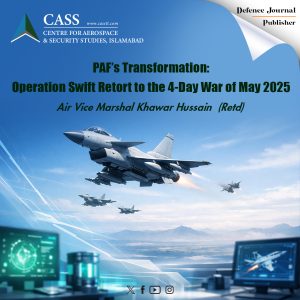
PAF’s Transformation: Operation Swift Retort to the 4-Day War of May 2025
The Air Force is an inherently technology-sensitive force, and without adopting emerging technologies, concepts, and doctrines, it risks falling behind in effectiveness and relevance. Aware of this eventuality, the leadership of Pakistan Air Force (PAF) has always remained open to change and ready to embrace the evolving character of warfare. The PAF’s success in the “4 Day War of May 25” lies in its transformation during the period from Operation Swift Retort in 2019 to the May 25 war. Prior to ‘Operation Swift Retort’ in 2019, the air power balance between the PAF and the Indian Air Force (IAF) was defined by distinct yet comparable capabilities. The IAF operated a technologically diverse fleet that included SU-30 MKI, while the remaining fleet comprised older legacy fighters, such as Mirage-2000, MiG-29, MiG-21, and Jaguars. The PAF, meanwhile, had in its inventory the F-16 Fighting Falcon