How Sanctions Work: Iran and the Impact of Economic Warfare
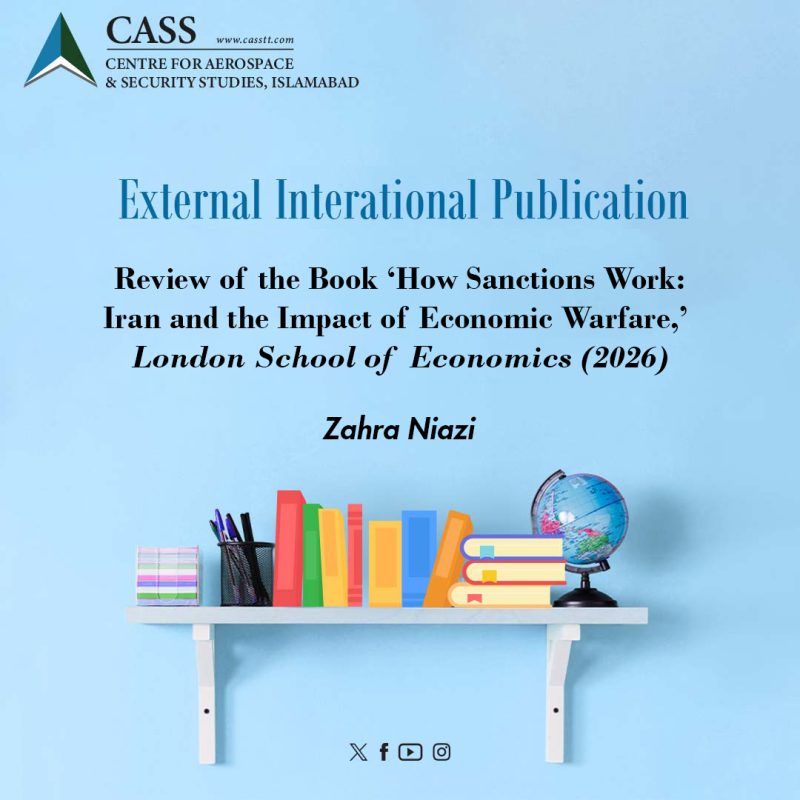
Narges Bajoghli, Vali Nasr, Djavad Salehi-Isfahani, and Ali Vaez, How Sanctions Work: Iran and the Impact of Economic Warfare (Stanford, California: Stanford University Press, 2024).
Reviewed by Zahra Niazi
How has Iran fared under sanctions?
The ongoing war between the United States, Israel, and Iran has brought several critical questions to the fore: What lies at the root of the grievances that triggered a protest movement in Iran earlier this year, exploited by the US and Israel? How widespread are the sentiments of resentment towards the regime among the Iranian population? How did Iranian society not collapse, and what prevented the sanctions from incapacitating the Iranian economy, thereby preserving Tehran’s ability to resist today?
How Sanctions Work: Iran and the Impact of Economic Warfare effectively answers these questions from different angles. It is written by Narges Bajoghli – an anthropologist with expertise in media, power, and military dynamics, Vali Nasr – a political scientist, specialising in international relations, Middle Eastern politics, and Islamic political movements, Djavad Salehi-Isfahani – an economist with interests in demographic and energy economics, with a focus on Iran and the Middle East, and Ali Vaez – a policy analyst who efforts helped bridge gaps during Iran-P5+1 nuclear negotiations. What sets this book apart from other approaches is its balanced take on the subject, enabling readers to form their own opinions. Their multifaceted methodological approach, combining inputs from dozens of leading scholars, discourse analysis, interviews with Iranians, and quantitative analysis based on surveys and official economic data, lends further credence to their work.
Sanctions against Iran predate the expansion of Tehran’s nuclear program, initially imposed after the 1979 Islamic Revolution and the hostage crisis the same year. Over the decades, the sanctions regime became increasingly comprehensive: “no country in the world has been the target of this array of sanctions to the extent experienced by Iran over the past four decades (56).” Beyond the explicit restrictions on Iranian banks, oil revenues, and access to the global financial system also lies an unspoken component of the sanctions regime. The vagueness of the sanctions regulations, particularly in their language, coupled with Iran’s portrayal as a ‘pariah’ state, leads to their overinterpretation, effectively deterring the Western scientific, literary, and academic communities from interacting with their counterparts in Iran.
Impacts of sanctions on the public
On the impact of sanctions on the economy, the book offers compelling evidence. Beginning in 2018, sanctions became increasingly harsh; between 2018 and 2021, healthcare costs in Iran rose by 125 per cent, and food prices increased by a staggering 186 per cent. The resultant hardships inevitably generated frustration among the public and, among some, resentment towards the regime. However, the expression of this resentment was not widespread enough to trigger regime change, one of the sanctions’ key goals. In fact, authors hold that sanctions weakened the middle class and strengthened the regime by increasing the population’s dependency on the state.
To highlight societal resilience, the authors include first-hand accounts of Iranians living through sanctions. Some respondents highlighted coping strategies that included detachment from the capitalist struggle for money and material desires, and finding refuge in nature, music, and art. For instance, Kaveh, an architect in his late thirties recounted, “I quit my job. I began to play music again. I hike and cook and document it all on my Instagram. I’ve found so many others my age who are doing the same thing… We’ve literally downsized our lives to two backpacks. We’ve given up the race of being ‘successful’ and instead have decided to connect with nature and music and art and each other” (26-27). The authors also show that, while the socioeconomic impacts were challenging, they did not become entirely dismal for most Iranians. Unemployment remained contained, as nearly half of all Iranian workers were self-employed, the country’s labour laws discouraged employers from laying off workers, and a large informal economy accommodated the unemployed. Meanwhile, the government’s decision to allow the currency to depreciate, along with the associated rise in the cost of imported goods, enabled domestic businesses to capture a larger market share and grow. Besides government cash transfers, mutual aid networks, run mostly by women, and formal impacts were charities helped the population in dealing with everyday hardships.
How sanctions drove innovation and complicated diplomacy
As with society, so did the economy adapt in meaningful ways, as sanctions forced Iran to innovate. In 2010, the then Iranian Supreme Leader, the martyred Ayatollah Ali Khamenei, formulated the notion of a “resistance economy’” (eghtesad-e moqavemat), calling on economists, scholars, and businessmen to propose and pursue policies to diversify markets and revenue sources. By providing testimonies from Iranian businessmen, the authors show that businesses actively rallied behind these calls, forming economic links with non-Western partners and learning from sanctioned nations, such as Cuba, how they developed their domestic industries despite external embargoes. More importantly, sanctions encouraged Tehran, alongside international actors such as China and Russia, to explore alternatives to the dollar-based cross-border payment system. These adaptations could not fully offset the impact of sanctions, given their scope and magnitude, but they kept Iran from collapsing under pressure.
But while the authors mention the role of “workarounds” in alleviating sanctions-related pressures, at times, readers are left seeking deeper explanations in some cases. For instance, What role did the Iranian shadow fleet of tankers play, and to what extent did it help mitigate the impact of sanctions on oil revenues? What role did barter trade play? Beyond this, an analysis of the role Iran’s high literacy rate, and the employment opportunities this affords, played in helping the country endure sanctions could have enriched the discussion.
The authors contend that sanctions complicated diplomacy, as they were easier to impose than to remove. Congress and domestic politics strongly supported Iranian sanctions, making it difficult for US leaders to lift them even when negotiations required it. However, neither could the sanctions trigger a regime change, nor did they lead Iran to abandon its nuclear program. Instead, while sanctions may have been effective in the short run in bringing Iran to the negotiating table, culminating in the Joint Comprehensive Plan of Action (JCPOA), in the long run, they led Iran to accelerate its nuclear program and pursue a more assertive regional policy.
A partial view of Iran’s nuclear program
One shortcoming of the book is that while the authors treat the acceleration of the Iranian nuclear program as a reactive response to the hardline approach by the West, they do not probe the veracity of dubious claims made about it. It is unknown which direction the Iranian nuclear program will take after the current war ends. At the time of the book’s writing, sufficient evidence suggested that assumptions surrounding the program may have been grossly exaggerated, even if Iran was expanding its uranium enrichment program. For instance, multiple Western intelligence assessments concluded that Iran halted its nuclear weapons program in 2003, while an International Atomic Energy Agency report found no conclusive evidence linking Iran’s undeclared nuclear activities, even prior to 2003, to a weapons program. (The report was published during the tenure of Mohamed ElBaradei, who was widely regarded for his impartiality.)
While the discussion briefly acknowledges Washington’s lack of sustained commitment to diplomacy in compelling Tehran to accelerate its nuclear program, it places an outsized emphasis on the role of sanctions, without adequately exploring other factors. For instance, in 2021, former Iranian President Hassan Rouhani linked Iran’s decision to produce 60 per cent enriched uranium to a suspected Israeli attack on a nuclear site. The limited consideration of other factors results in a somewhat reductionist conclusion.
These limitations aside, the book is a comprehensive and insightful account of Iran’s survival and resilience under sanctions. By incorporating local testimonies and vivid descriptions of Iranian streets and social spaces into the research, the book allows readers to picture everyday life in Iran under sanctions, where hope and vibrancy still existed – characteristics that remain evident even amidst the new war. Despite being a compilation of contributions from four authors, the book maintains coherence and consistency in style throughout. It is a worthwhile read for current and future policymakers, effectively demonstrating why maximum pressure strategies fail to achieve their intended results.
Zahra Niazi is a Research Associate at the Centre for Aerospace & Security Studies (CASS), Islamabad. She can be reached at [email protected].