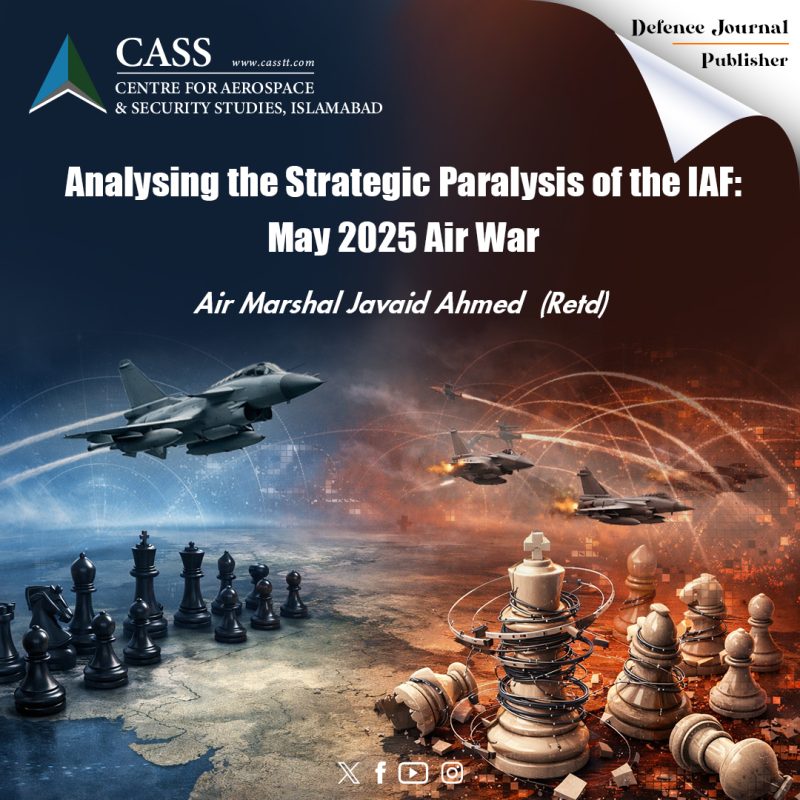
The May 2025 Air War between the PAF and the IAF will go down in history as the largest Beyond Visual Range (BVR) battle between two nuclear-armed neighbours. So too would the consequences of a 7-nil loss for the IAF, which resulted in a ‘strategic paralysis’ of the Indian political and military leadership. This consequential event can be analysed in light of leading air power application theories in conflicts to see how these have been affected by the advent of emerging technologies and concepts.
Historically, the concept of strategic paralysis has been forwarded by leading air power philosophers and put into practice in various air campaigns. However, the theory has revolved around forms of paralysis caused by factors such as territorial loss, industrial degradation, and leadership decapitation. Douhet, the Italian air power theorist, professed victory by directly targeting the enemy’s will and vital centres, while Trenchard believed in offensive air action to undermine the enemy’s morale and war-making capacity. In the early 70’s, Boyd’s disruption of the enemy’s decision cycle, and in the 90’s, Warden’s ‘the enemy as a system’ strategy was practised. Deptula, the US Air Force general and a key player in the Gulf War, advocated parallel and effects-based operations and applied the concept to defeat Iraq.
In June 2025, the Israeli plans against Iran in ‘Operation Rising Lion’ combined most air power strategies, employing pre-emptive counterforce strikes, air superiority, and parallel system-wide targeting. These were integrated with covert and drone operations to induce rapid paralysis of Iran’s military and nuclear architecture. Meeting limited success, the operation came to a halt after 12 days of war amidst serious Iranian retaliation.
In sharp contrast, Operation Epic Fury, the joint US-Israeli air campaign against Iran launched on 28 February 2026, reflected a doctrinal application of Warden’s Five Ring Theory of strategic warfare. However, in this case, the negotiation drama was staged to target and decapitate the entire leadership of Iran, an event which is one of a kind in history. While modern warfare has seen increasingly effective strategic strikes, the simultaneous elimination of both top leadership and its immediate successor tier in a single air strike remains virtually unprecedented. Overall, the campaign adopted the ‘inside-out’ targeting approach. The objective was not merely military degradation but systemic collapse of the Iranian command authority and war-fighting capacity. The fact that the Iranian political and governance system survived the most consequential strike in history is nothing short of a miracle and speaks volumes about the resilience of the Iranian forces and their Mosaic Command Structure.
The IAF Vs PAF case of 2025 is nevertheless different, as the war involved two nuclear neighbours. Accordingly, limitations of thresholds and escalation, which remained directly proportional to the length of the conflict and destruction quotient had to be carefully considered. Both countries had also been there before, but back then the environment was not nuclearized and the conflicts spanned across days: 50 days in 1965 and 13 days in 1971 war. The five kills of Squadron Leader MM Alam is history, achieved in an era without real time media or the internet to broadcast such events. By contrast, the capture of IAF pilot Wing Commander Abhinandan in 2019 was unprecedented in its immediacy; the news spread across the globe within minutes, rapidly intensifying the pressure, and affecting the embarrassment threshold of the Indian leadership.
Since then, both the IAF and the PAF had undergone significant transformation across technology, operational concepts, and employment techniques. These changes were driven by evolving threats, lessons from the 2019 crisis, and advances in warfare technologies such as the ones used in the Ukraine war and Israeli operations in Lebanon, Syria and Gaza. The IAF, with billions allocated in the budget, invested in high-end platforms led by the Rafale, integrated Air Defence through S-400 batteries, expansion of the IACCS (Integrated Air Command and Control System) for real-time battlespace awareness, Phalcon and Netra force multipliers and precision standoff weapons such as the SCALP and BrahMos. The PAF, on the other hand, invested in affordable modernisation by inducting the JF-17 Block III, the J-10 C with PL-15 missiles, HQ-9 air defence systems, EW platforms, and the Erieye AWACS, which was fully data-linked with the PAF fleet. A key factor in the PAF’s modernisation plans was the active involvement of the Air Chief, who had envisioned not only the induction of new capabilities but also their operationalisation and seamless integration into a cohesive, multi-domain operations (MDO)-capable force.
The stage was thus set for the game-changing aerial encounter between the two airforces. Viewing the situation after the Pahalgam incident in April 2025, it was clear to the Pakistani leadership that India would opt for unnecessary military action. Blaming Pakistan and reacting in an offensive manner had gained political mileage for the Modi Government since 2019. As the much-touted rising power, anti-China bulwark and a regional hegemon, India also wanted to show off its military prowess to the world. Predictably, the strikes were to be spearheaded by the IAF, with the Rafales in the lead. The striking formations of the world’s fourth-largest air force were very well equipped, projecting overwhelming airpower never seen before in the sub-continent. The Godi media had already been fed visions of grandeur, while the mass media briefings had been orchestrated in Bollywood style.
Visible to the IAF, the numerically smaller PAF took to the skies with its defensive formations. Having done its homework, it had correctly identified the IAF’s centre of gravity (COG) as its Rafale fleet and its ability to generate and coordinate combat power. The ‘scarlet thread’ in this scheme was the information and connectivity backbone that fused these capabilities into a coherent, functioning system. The tables turned at the launch of weapons as the PAF shifted from a defensive posture to lightning-fast offensive counter-air operations. The IAF’s connectivity, spanning EW, cyber, and satellite communications, was targeted at every node; the ensuing chaos was enough to seriously degrade IAF’s situational awareness.
Aerial battles are quick, lethal surgical affairs affording no recovery to disoriented adversaries. In quick succession, the PAF shot down seven IAF aircraft, including four prized Rafales. As the news of the unprecedented losses reached the Indian command centre, a ‘strategic paralysis’ gripped the Indian leadership. In complete disarray, the IAF was ordered to retreat to rear bases, ceding air superiority to the PAF.
A new paradigm for ‘strategic paralysis’ in the air had been established, ‘a paralysis due to extraordinary unforeseen losses.’ Shocked and disoriented, the IAF could not regain balance for the remainder of the war. As the PAF consolidated its superiority, the aviation world and the military industry took note of the extraordinary air battle, analysing the weaponry, strategies, training, and grit of the PAF, a small but professional force.
One year on, the world acknowledges PAF’s historic feat; however, the Indians continue to forge their own narratives. Tales of ‘Operation Sindoor on pause’, extensive PAF aircraft losses, and destroyed infrastructure are being circulated to carve out a win to retain political support. In parallel, the IAF has been showered with resources to strike expensive deals such as the purchase of 114 Rafales and replenishment of S-400 stocks. For Pakistan, the incredible win by the PAF has reshaped the contours of modern aerial warfare. The air war of 2025 has fundamentally altered the rules of aerial engagement worldwide, signalling a decisive shift in air combat dynamics. Accordingly, in the subcontinent, future conflicts in the skies will unfold under an entirely transformed paradigm.
Air Marshal Javaid Ahmed (Retd) is President of the Centre for Aerospace & Security Studies (CASS), Islamabad and a former Vice Chancellor of Air University.The article was first published in the Defence Journal Magazine. Email: [email protected]