
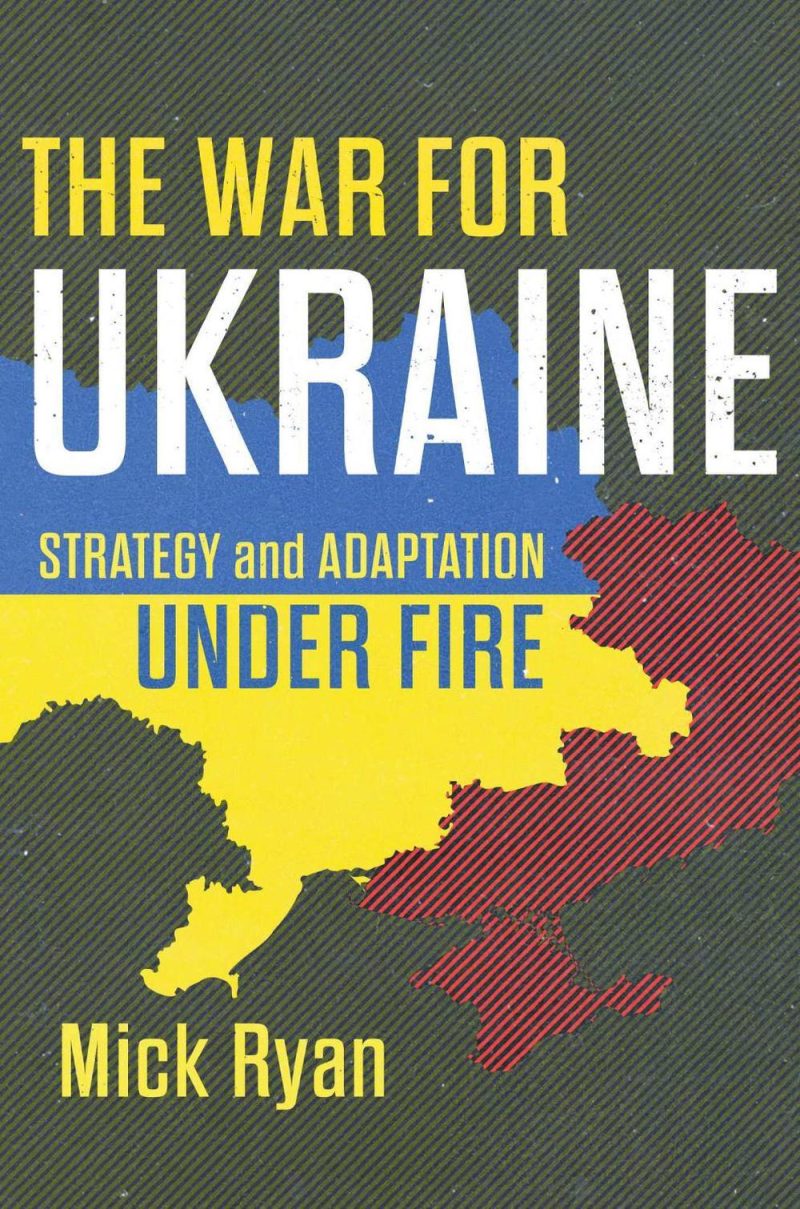
The War for Ukraine: Strategy and Adaptation Under Fire
Mick Ryan, The War for Ukraine: Strategy and Adaptation Under Fire, (Maryland: Naval Institute Press, 2024)
Reviewed by Sajal Shahid
Wars, whether they are slow and protracted or short and intense, seldom end without leaving a mark. Under extreme circumstances, they may be able to redefine geographical boundaries, upset demographics, or break alliances as the world order tries to preserve some facade of balance. The Russia-Ukraine War is no different. As one of the longest-ongoing European wars since World War II, with intensive use of emerging technology in modern history, it has undoubtedly etched itself into history.
The duration and magnitude of the war have made it a special case study, and by observing keenly, one can get more insights into geopolitical dynamics and how military strategies are developed in real-time under pressure. The book, The War for Ukraine: Strategy and Adaptation Under Fire, by Mick Ryan, a retired Australian general and military strategist, explores the initial 18 months of the war, providing insight into how strategists initially thought about war fighting in the conflict and how their strategies evolved over time.
There are 15 chapters in the book, divided into two main parts: the first part, Strategy, examines the strategic basis and styles of leadership of each side to the conflict, whereas the second part, Adaptation, explores institutional and battlefield responsiveness, including future lessons on warfare in the 21st century. The author argues that the course of the war was predetermined by a number of fundamental assumptions made by Russian leadership. In particular, they anticipated that Ukraine would surrender to a swift military action, assuming that Ukrainian forces were still as weak as those they had faced in 2014. Moreover, leadership made the assumption that the West would not act in any meaningful way due to its energy dependence on Russia.
Yet, these expectations were not accurate, and a protracted war of attrition ensued, with Ukraine using a strategy of corrosion to wear down the physical, moral and intellectual fighting strength of the Russian army rather than surrendering. This included targeting Russian logistics, supply lines and command nodes to restrict frontline troop’s fuel, food, and ammunition, and using platforms such as social media to encourage desertion within Russia’s ranks. The author explains this adaptation by the bottom-up learning culture of Ukraine, which effectively assimilated commercial technologies like drones and native digital control systems, including GIS Arta.
However, that is not to say that Russia strategies remained stagnant. In his arguments, Ryan maintains that, despite the significance of pre-war planning, it is actually the adaptability in reaction to the realities of war that determine war fighting ability of a state, and Russia, initially found on the receiving end, learnt to adopt the fluid top-down approach, which entailed industrial mobilisation and heavy reliance on the electronic warfare. After its unsuccessful coup de main, Russia shifted its approach to an artillery-intensive war of attrition in Donbas and, simultaneously, amended its armour use by implementing the usage of tanks as standoff fire support to counter FPV drones. Ukraine, on the other hand, quickly turned small, cheap consumer drones into military resources and digitised its command and control infrastructure, such as Delta and GIS Arta, enabling a kind of democratisation of battlefield information, with even low-level soldiers able to feed data into a common, real-time map of enemy positions.
The author, though admitting that the increased use of technology closes the gap between detection and destruction, posits that human leadership and persistence remain the final determinants. Despite its contribution to lethality, increasing integration of technology has the collateral effect of increasing vulnerability which must be offset by greater dispersion of assets and devising methods of concealment.
Overall the book serves as a detailed and research intensive account of an extensive portion of the on-going Russia-Ukraine war, analysed from the practical real world lens of a military veteran and strategist. It has a logical flow and structure across the book, with chapters alternating between Russia and Ukraine, and divided into clear, readable parts, enabling readers to quickly find specific details or jump forward to others. It is also well-bibliographed, which proves the dedication of the author to academic rigour.
However, the book has some limitations. While the author evidently made an effort to consult Russian sources as well in attempts of offering a balanced narrative, it often fell short of achieving this goal and instead reverted to the conventional western pro-Ukrainian narrative. While this may in part be a result of the limited accessibility of Russian military literature, the likelihood of an underlying bias cannot be entirely discounted. Moreover, the lack of mention of internal conscription issues in Ukraine as well as the blatant optimism about the Ukrainian strategy also hints at the Ukraine-focused lens.
Nevertheless, the book serves as a useful addition to the existing scholarly corpus surrounding the military and technical aspects of the Russia-Ukraine War, making it a vital resource for both seasoned and novice practitioners within the defence industry seeking to understand the lasting impact of this war on the mechanics of modern warfare.
Sajal Shahid is a Research Assistant at the Centre for Aerospace & Security Studies (CASS) Islamabad. She can be reached at [email protected]



