Pakistan–India Relation: Fractured Past, Uncertain Future
The complex and often turbulent relationship between Pakistan and India remains one of South Asia’s most enduring and consequential realities.

The complex and often turbulent relationship between Pakistan and India remains one of South Asia’s most enduring and consequential realities.
The year 2025 has redrawn the geopolitical map in many ways. The year witnessed a series of conflicts — including the recent India–Pakistan war, the Israel–Iran confrontation, and renewed instability along the Pakistan–Afghanistan border.
Pakistan has successfully stabilized its economy after mustering considerable effort during a grueling three-year period, which followed the multilayered crisis of 2022-23 that had causal factors ranging from domestic political friction to the global fallout of the Russo-Ukrainian War.
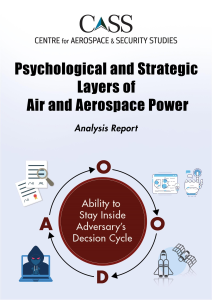
The contemporary era of warfare has transformed air and aerospace power into far more than a matter of aircraft and missiles. It now represents a comprehensive instrument of national strength — combining doctrine, technology, leadership, and psychology into a single continuum of influence.

Darhsan Singh Sahsi was shot dead outside his residence on the 29th of October 2025. He was not only a prominent name in the recycled-textile industry of Canada, but a popular Sikh philanthropist back home in Ludhiana, Indian Punjab.
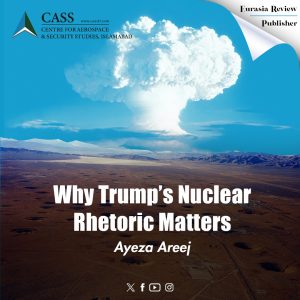
On 30th October 2025, President Donald Trump announced resuming nuclear testing, stating, ‘Because of other countries' testing programs, I have instructed the Department of War to start testing our Nuclear Weapons on an equal basis.

On the cusp of the Bihar state elections, India has once again ramped up its belligerent rhetoric with Defence Minister, Rajnath Singh threatening to target Sindh through Sir Creek, and the Chief of Army Staff Dwivedi claiming that preparations for Operation Sindoor 2.0 have already begun.
Every year, the announcement of the Nobel Prize opens new doors for discovery and advancement.
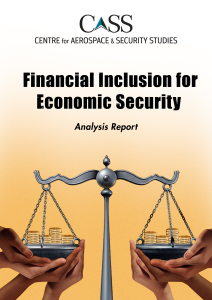
Financial inclusion, the access and use of affordable financial services by all citizens, is an essential pillar of economic security and national stability.
The modern era has redefined the nature of power, where aerospace capabilities have become pivotal not only in national defence but also in economic and technological advancement. In an age where technological innovation is reshaping global competition, aerospace power serves as both a measure of national strength and a driver of strategic influence.
