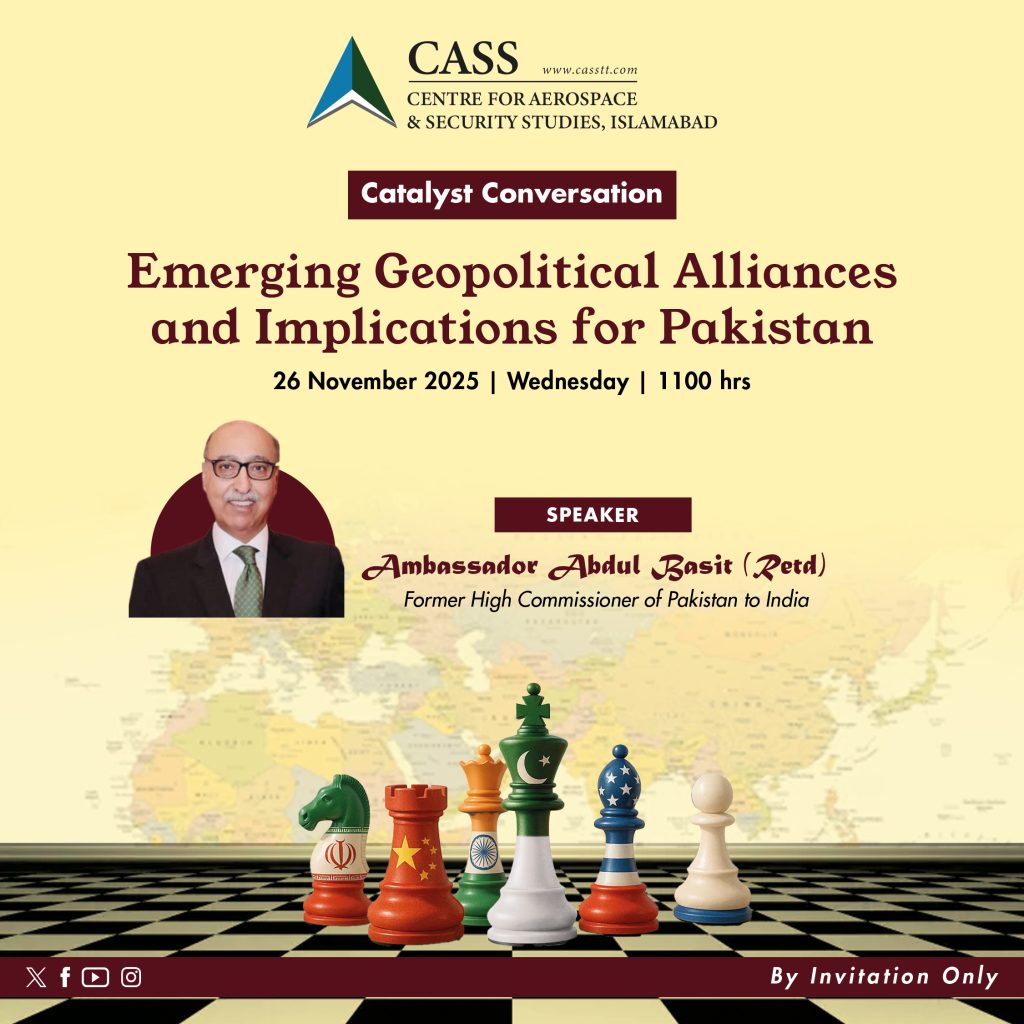
The year 2025 has redrawn the geopolitical map in many ways. The year witnessed a series of conflicts — including the recent India–Pakistan war, the Israel–Iran confrontation, and renewed instability along the Pakistan–Afghanistan border. These crises have not occurred in isolation; rather, they reflect deeper structural shifts within the international system and mark a critical juncture in South Asia’s strategic trajectory.
One of the most striking developments has been the setback in India–United States relations, long considered the cornerstone of Washington’s Indo-Pacific strategy. The imposition of trade tariffs by the U.S. on Indian exports, coupled with frictions over New Delhi’s energy cooperation with Russia and its performance during the 2025 Pakistan-India conflict, have strained what was once viewed as a steady strategic partnership. This rift has reverberated across the region, opening limited but notable diplomatic space for Pakistan to re-engage with Washington while consolidating ties with Beijing and regional partners such as Saudi Arabia.
Simultaneously, the Israel–Iran war has fractured Middle Eastern alignments and forced regional actors — including Pakistan — to rethink their security and diplomatic postures. Islamabad finds itself navigating a rapidly evolving landscape where great power rivalries intersect with regional fault lines. The Pakistan–Afghanistan conflict, marked by cross-border militancy and shifting Taliban dynamics, adds an additional layer of complexity, further testing Pakistan’s internal resilience and external balancing capacity.
In this changing environment, Pakistan must formulate a coherent strategy that safeguards its interests without being drawn too deeply into any singular bloc. This roundtable seeks to unpack these multi-layered transformations — understanding how the emerging geopolitical alignments are reshaping Pakistan’s regional environment, and what policy responses can best serve its national interests in this new era of uncertainty and opportunity.