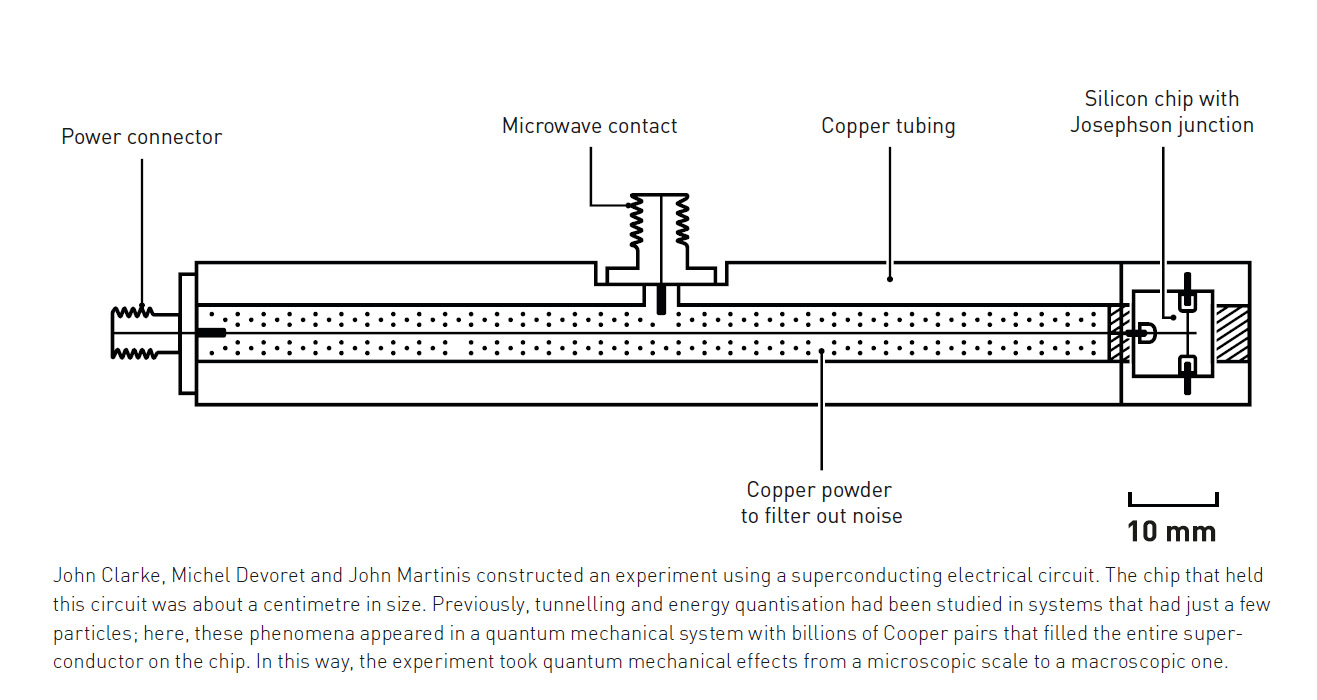
Every year, the announcement of the Nobel Prize opens new doors for discovery and advancement. Back in 1895, Alfred Nobel established the Nobel Foundation, which distributes prizes to the discoveries in the fields of Physics, Chemistry, Physiology/Medicine, Peace, and Economics for conferring the greatest benefit to mankind. On 7th October 2025, one such award was granted to John Clarke, Michel H. Devoret, and John M. Martin, for their discovery of the macroscopic exhibition of quantum tunnelling and energy quantisation. The discovery has ground breaking prospects for the future of technology and national security.
The phenomena of quantum tunnelling and energy quantization can translate into speedier, accurate, and efficient results. A quantum computer, unlike a regular computer, not only offers solutions to undefined problems but it can also explore all the possible solutions at once and suggest the best-suited option at a much higher pace.
The 2025 Nobel-winning discovery has magnified the microscopic marvels of energy quantization and quantum tunnelling on a programmable macroscopic chip. It has opened avenues for research and experimentation on the relatively mysterious sub-atomic phenomena, at a scale visible to the naked human eye. Even though the vulnerability of the circuit to temperature, noise, and interception persists, it cannot downplay the scope of its application.
The macro-quantum effect has the potential to offer a wide range of applications in strategic, commercial, and scientific realms.
Quantum clocks and quantum sensors can revolutionize the future of aerospace. Quantum clocks can measure time up to the 19th decimal place and quantum sensors can detect any arbitrary frequency without loss of their ability to measure nanometre-scale features. Overall, both of these technologies can enable aircraft and spacecraft to navigate and measure the distance with atomic precision without the assistance of GPS or ground contact. Before the discoveries of macroscopic quantum chips, these realities were confined to lab spaces. Now, it has made practical applications possible.
A quantum computer, with its existing potential, can decode all the existing encryption mechanisms. As a result, national security infrastructure, like cyber defence and intelligence systems, can be compromised. The only safeguard mechanism against this quantum threat is the post-quantum encryption system. Post-quantum cryptography operates on such algorithms that can act as a shield against quantum breaches.
On the other hand, Quantum Key Distribution (QKD) is the quantum-enabled future of encryption. In this mechanism, information is transmitted in the form of individual sub-atomic particles called photons. The sender and receiver have a Quantum key, which not only allows them access to the information but also warns them against any interception attempt. At the same time, QKD will automatically block the interceptor, unlike conventional cybersecurity models.
Moreover, Quantum optimization can enhance the safety of supply chains in the future. It can streamline computation, enhance accuracy, and reduce energy costs. It can also act more vigilantly for risk prediction, in a faster and accurate manner.
To sum up, the cumulative effect of this technological upgradation will enhance the Intelligence Surveillance Reconnaissance (ISR) capabilities of states. Quantum sensors and radars will augment the detection of hostile intrusion, whereas quantum material will enhance the structural stability of the aircraft and satellites.
The wide scope of application that the macro-quantum effect can bring about implies that it is a ground breaking discovery not just for the future of technology but for national security as well. Geopolitics of the tech-race is driven by adaptation, instead of invention. Therefore, it is crucial for states like Pakistan to keep up with the pace of development.
Pakistan has taken certain significant moves to maintain relevance in the domain of quantum physics, for instance establishment of the National Centre for Quantum Computing, the Centre for Excellence Technology Quantum and Artificial Intelligence Pakistan (CETQAP), Quantum Valley Pakistan, and the faculty of Quantum physics at certain universities like NUST, GIKI, and NET. CETQAP has taken the initiative to develop Pakistan’s first quantum computer called “Quaid’s Quantum 1” (QQ1), with Pakistan’s first quantum development software ‘BARQ’ However, these initiatives face certain challenges, as the existing infrastructure of quantum technology in Pakistan is fragmented in nature. The lack of coordination among the isolated efforts is due to the lack of an overarching policy and strategy.
As a way forward, Pakistan needs to consider quantum technology as major determinant of National Security Policy, provided its criticality for the future of warfare. Moreover, Pakistan should focus on development of a National Quantum Research and Development hub, which can bring together industrial and academic stakeholders, for a coordinated future-oriented approach.
This year’s Nobel Prize in quantum physics is promising for the future of technological evolution as well as national security. The post-quantum future belongs to the nations that are prepared for it.
Ayesha Shaikh is a Research Assistant at the Centre for Aerospace & Security Studies (CASS), Islamabad, Pakistan. She can be reached at [email protected]