
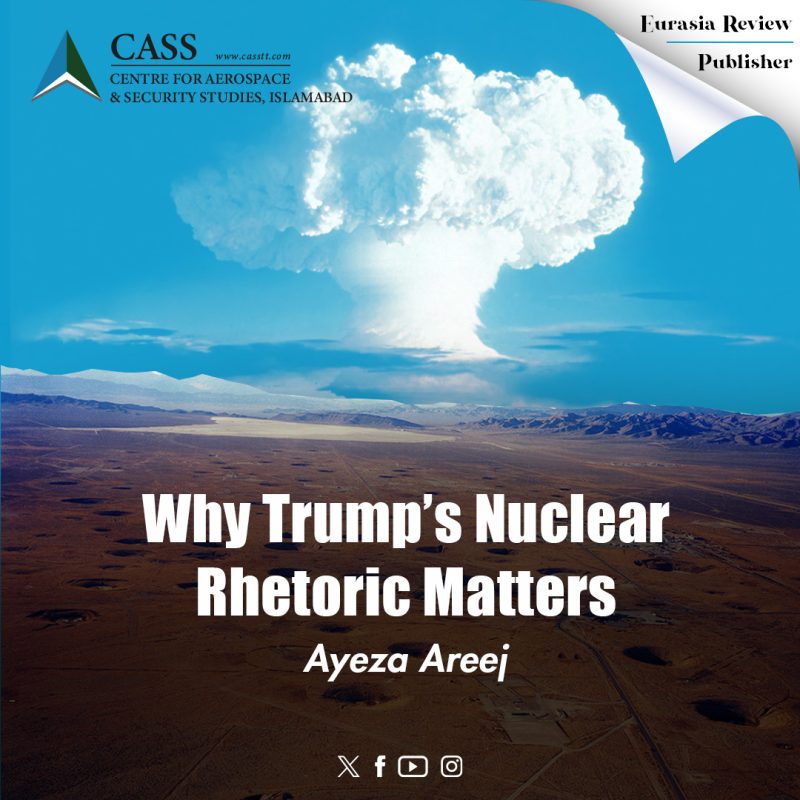
On 30th October 2025, President Donald Trump announced resuming nuclear testing, stating, ‘Because of other countries’ testing programs, I have instructed the Department of War to start testing our Nuclear Weapons on an equal basis. That process will begin immediately’. His announcement of the immediate resumption of nuclear testing reverses a three-decade old moratorium. This moratorium was enforced after the U.S first detonated the atomic bomb in 1992 at Nevada Security Site. Subsequently, the U.S signed the Comprehensive Test Ban Treaty (CTBT) in 1996, setting a strong norm against nuclear testing. However, the U.S did not ratify the treaty, and the U.S Senate rejected it in 1999. Ever since, the U.S has focused solely on the modernisation of nuclear stockpiles. Nevertheless, the current nuclear rhetoric by President Trump marks a historical and dramatic shift in policy with global ramifications.
While it may only seem a diversion from U.S.’ enduring policy, in essence, it is a blend of strategic signalling and personal branding. The announcement came at a critical time, just before President Trump’s meeting with Chinese President Xi Jinping in South Korea, which highlights the strategic intent behind the move. President Trump highlighted in his statement, ‘The U.S has more nuclear weapons than any other country’ and this goal was already achieved during his first tenure. He warned that China’s growing nuclear arsenal would come at parity with the U.S and Russia stockpiles in the coming five years. According to Mr. Trump, recent nuclear developments by Moscow and Beijing necessitated this response on equal basis. Prior to this declaration, President Putin announced that Russia has tested a nuclear-powered underwater drone named Poseidon and a nuclear-powered cruise missile with a range of 14000 km. Meanwhile, China has expanded its nuclear stockpiles and missile silos.
Apart from strategic motives, the move also appears to serve as a means to attain political ends. It reinforces Trump’s image as a decisive leader of a superpower, taking a bold stance on nuclear testing, which is a key element of his political narrative. Such a notion appeals to a wider audience who believe Trump would secure U.S interests globally vis-à-vis his ‘America First’ policy. Concurrently, this confidence emboldens the president to act with impunity and directly challenge other states without any hesitation. The move highlights his willingness to act unilaterally and break the old international norms to counter any perceived threat to U.S national security.
The new nuclear rhetoric has prompted global concern, leaving the world to question what the U.S truly intends to do next. Although the controversy over the type of nuclear testing was clarified by the U.S Energy Secretary, Chris Wright, who claimed that there would only be non-critical explosions. The mere order of resumption of nuclear testing raises global concerns about President Trump’s policy.
Other states, especially Russia, North Korea, China, and India, could consider it as an opportunity to further their own nuclear programs. The statement by Mr. Trump has serious repercussions for the world as it may reinvigorate an intensified arms race among nuclear states, challenging norms of deterrence. The step could also revitalise the Cold War mentality among global powers. As Senator Mark Kelly has stated that nuclear testing may provoke Beijing and result into a global arms race. Apart from that, Washington is assisting South Korea to develop nuclear-propelled submarines, which sets a dangerous precedent as other states can capitalise on this development to expedite their own programs.
President Trump’s unpredictability in decision making reshapes global nuclear balance and portrays a message of coercive signalling and strategic defiance. Major Powers have imposed a voluntary moratorium upon themselves for over three decades, abiding by the global norms set by the CTBT. Mr. Trump’s declaration not only erodes the U.S’ image as a frontrunner of arms control agendas, but also challenges the international consensus on nuclear test ban. The U.S has not only criticised the nuclear aspirations of North Korea and Iran, but has also attacked Iranian nuclear facilities. This mind-set reversal reveals policy contradictions, which resumes own nuclear testing but strongly condemns other states’ nuclear pursuits. This also gives a message to the world that strategic dominance can now undermine diplomatic restraint.
Another important aspect is that Washington currently does not possess the infrastructural and operational capacity to test nuclear weapons. It would be a complex task to revive the nuclear installations into working condition. Moreover, the preparation for regulated underground testing would necessitate professional experts and a lengthy period of at least 18 months. This suggests that the notion of nuclear testing may solely be based on symbolism. Nevertheless, a crucial risk lies in the fact that even these symbolic gestures can alter defence strategies and strain diplomatic relations among states.
Presidents Trump’s nuclear rhetoric risks culminating into a volatile international order in which any faulty communication and disproportionate reaction by a state could escalate into a crisis. The statement, in essence, reflects a strategic theatre driven by the intent to shape perceptions and project power. It also indicates strategic signalling and political showmanship, which obscures the boundary between provocation and strength. Irrespective of whether this move would lead to substantive policy action or is just a rhetorical posture to attain political goals, the implications for the international security environment and international trust would be profound.
Ayeza Areej is a Research Assistant at the Centre for Aerospace & Security Studies (CASS), Islamabad, Pakistan. She can be reached at [email protected]



