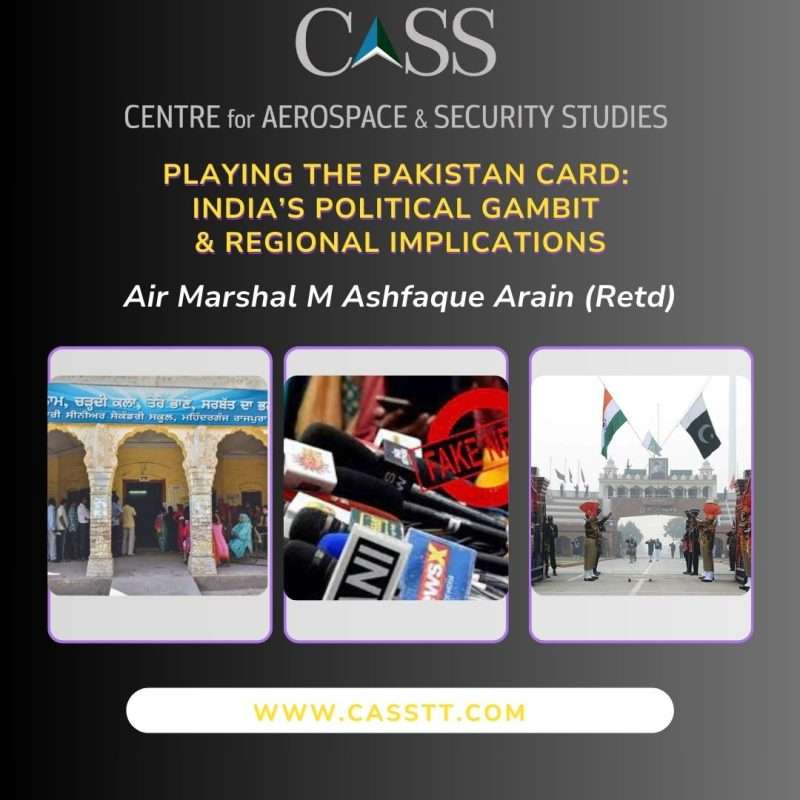
The Indian domestic political system remains incomplete without exploitation of anti-Pakistan sentiment. Historically, anti-Pakistan stance has repeatedly been a recipe for success, especially in the general, and some critical state elections. The party which takes the lead in Pakistan bashing, is assured of success. The Bharatiya Janata Party (BJP) has transformed anti-Pakistan narrative for political gains into an art.
During the tumultuous period leading up to the 1985 Indian General Elections, geopolitical tensions between India and Pakistan escalated. Indira Gandhi securing of her second term was influenced by her strong stance on Pakistan. The heightened tensions persisted throughout her tenure and only de-escalated in the aftermath of her assassination in December 1984. The BJP won a significant number of seats in the 1993 elections after a BJP and Vishva Hindu Parishad (VHP)-organised mob turned violent and tore down the Babri Masjid in December 1992. BJP victory in the 1999 elections is attributed to the Pokhran-II nuclear tests in May 1998 and subsequent threatening tone against Pakistan. The BJP lost the 2004 elections for its reliance on the ‘Shining India’ slogan. In 2009, Congress won its second term in office in the wake of December 2008 Mumbai attacks for which Pakistan was blamed. Modi’s second term as Chief Minister and rise to national stature was a result of the Godhra train massacre. He won the 2019 elections for his anti-Pakistan rhetoric and Balakot strike.
The next round of Indian General Elections is scheduled for April-May 2024. Based on historic evidence, there is a strong possibility of the BJP-led government once again resorting to the national security card for political mileage. The calm in terrorist activities while India prepared and hosted the third G-20 Tourism Working Group meeting in IIOJ&K in May and the G-20 Summit in September in New Delhi has, as expected, been disturbed by new acts of terrorism in the IIOJ&K. Within days after the conclusion of the G-20 Summit on 13th September, a colonel, a major and a police officer were killed in an anti-terrorist operation. According to the Times of India, the General Officer Commanding (GOC) and Inspector-General of Police (IGP) rushed to the area while the combing operation was still in progress, something very strange and unusual.
The BJP’s ascent to power, historically tied to inexplicable incidents, suggests that the number of terrorist occurrences will continue to increase culminating in a major episode involving either law enforcement personnel in large numbers or an attack on a religious gathering. This would surely be followed by media hype and threatening statements from the government with Pakistan being blamed for all such acts.
While such tactics are anticipated, the current geopolitical and geoeconomic landscape, combined with global expectations of India, sets this situation apart from the past. After hosting the G-20 Summit and announcing many projects including the India-Middle East-Europe corridor, India is in a state of euphoria. This is also partly attributable to the world being more receptive to the Indian narrative. Additionally, India being a key country in the United States’ China containment policy also provides it with a special status.
Pakistan, on the other hand, is mired in serious issues, including political polarisation, uncertainty about its general elections, poor economic conditions and uncontrolled inflation. Increasing incidents of terrorism inside the country and ongoing rift with Afghanistan further complicate the situation.
The BJP leadership in India may consider this to be an opportune moment for military adventurism for political advantage as well as image building of its Armed Forces by avenging the humiliation it faced in February 2019. This may also offer India an opportunity to position itself as the undisputed leader in the region. Consequently, India might once again consider taking limited military action under the pretext of retaliating against those responsible for a major terrorist act within its borders, along with their abettors. The plan could materialise as an air strike, a UAV attack, some ground action or an act against a Pakistani naval vessel. However, any military action would be preceded by flurry of diplomatic activity, media hype and strong statements from Indian government officials.
As India rises with aspirations of becoming a dominant economy, it recognises the risks any disruption poses to its economic trajectory. While this may inherently act as a restraint against aggressive endeavours, Pakistan must not be complacent. It is essential for Pakistan’s defence forces, especially the Pakistan Air Force, to maintain vigilance and readiness. The strength of Pakistan’s position lies not only in its preparedness but also in the collective support of its citizenry. No response is not an option as this will permanently change the power dynamics in the region.
The author is a retired Air Marshal of the PAF who served as Pakistan’s Air Advisor at New Delhi from 2002-2006, presently working as Director Technologies and International Coordination at Centre for Aerospace & Security Studies, Islamabad, Pakistan. The article was first published in Asia Today. He can be reached at [email protected]
Design Credit: Mysha Dua Salman