
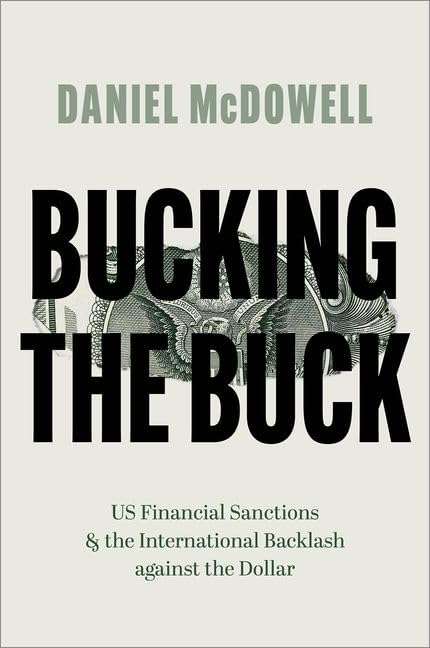
Daniel McDowell, Bucking the Buck: US Financial Sanctions and the International Backlash against the Dollar (New York, NY: Oxford University Press, 2023)
Reviewed by Zahra Niazi
Daniel McDowell’s book Bucking the Buck: US Financial Sanctions and the International Backlash against the Dollar is a notable addition to the literature on the de-dollarisation trend and its underlying motives. In it, McDowell critically analyses the influence of the overuse of economic sanctions by the United States (US) on the dollar’s preeminent global status and the future efficacy of sanctions as a foreign policy tool. The book’s central thesis is that ‘US financial sanctions generate political risk, provoke anti-dollar policies among targets, and, in some cases, correlate with de-dollarisation,’ (p. 33).
In the opening chapters, the author reiterates how the dollar’s dominance as the international store of value and a medium of cross-border trade and transactions offers the US the unrivalled capacity to exercise influence against adversaries, including through financial sanctions (pp. 36-7). However, the overuse of sanctions as a tool of economic statecraft has implications for the dollar’s international attractiveness as both a cross-border medium of exchange and a reserve currency.
The ensuing chapters provide empirical evidence to corroborate the interrelation between US sanctions and the anti-dollar policies implemented by the targeted governments (pp. 95-242). By citing Russian and Turkish case studies, the author shows that US financial sanctions can contribute to not just the de-dollarisation of foreign exchange reserves but also a shift in the geographic distribution of financial assets (p. 131). The case study evidence is bolstered further by statistical models showing that gold reserves increase at a higher pace among the countries targeted by sanctions and those at risk of sanctions compared to low-risk or non-sanctioned states. Likewise, an association exists between sanctions and the reduction in foreign holdings of US Treasury bonds. In terms of the dollar’s role in cross-border payments, the author cites examples from Russia, Venezuela, and Turkey to show that sanctions can provoke targeted governments to lessen dependence on the dollar as a payment and trade settlement currency (pp. 184-242). The associated statistical evidence reveals that countries targeted by sanctions or those at risk of sanctions are more likely to reduce their dependence on the dollar as a trade settlement currency. Sanctioned countries also have a higher propensity to sign currency swap agreements, allowing cross-border trade settlement in currencies other than the dollar.
However, the author emphasises that the world is still far from a wholesale migration away from the dollar (p. 284). Reducing reliance on the dollar is not synonymous with decoupling from the currency, and no country can fully ‘sanction proof’ its economy. The dollar remains the ‘king’ of all currencies and will likely continue to hail its dominant status in the coming decades. One of its greatest strengths is the lack of a true rival to it. Beijing has attempted to establish an alternative payment system based on the Renminbi, i.e., the Cross-border Interbank Payment System. However, for this system to be able to insulate the world from Washington’s coercive tools effectively, China will have to disconnect it from the dollar and the existing communication and financial networks, which, McDowell asserts, is challenging (p. 42). Nevertheless, the persistent overuse of financial sanctions by the US could provoke China and the European Union (EU) to design a more robust set of policies to bring about a more significant change in the international monetary system’s competitive landscape. Towards the end of the book, he advises that Washington should consider a long-term view when designing or implementing sanctions policies, as overuse of sanctions can reduce their efficacy (pp. 362-3).
Bucking the Buck effectively answers some of the now frequently asked questions about the dollar’s role in the international trade and monetary system and where it may be headed. However, it would have been preferable had the author, while discussing the dollar’s rivals, deliberated more on the potential challenge to the dollar that the BRICS (Brazil, Russia, India, China, South Africa) bloc could pose. The BRICS nations have an aggregate GDP that surpasses the G7’s (Canada, United States, Japan, France, Germany, the United Kingdom, and Italy) and account for more than 40 percent of the world population. While accelerated efforts to introduce a new reserve currency by the BRICS took place after the book’s publication at the beginning of 2023, some noteworthy developments occurred in the preceding period. Notably, during the 2022 BRICS Summit, Russian President Vladimir Putin categorically announced that the bloc was working to develop an international reserve currency. Additionally, talks between Riyadh and Beijing to price Saudi oil sales to China in yuan were also actively underway before the book’s publication. Hence, a detailed discussion on the petroyuan as a competitor to the petrodollar and its potential impact on shielding countries from Western sanctions would have been a worthwhile addition to the book.
McDowell’s pointed critique of the US government’s excessive reliance on sanctions as a diplomatic tool, coupled with his skilful organisation of the book’s content and the use of comprehensive statistical models to support his arguments, make this work both commendable and insightful. The book effectively challenges prevalent assumptions that are often uncritically accepted, such as the rapid decline of the US dollar’s dominance or the immediate readiness of viable alternatives. It provides a nuanced exploration of de-dollarisation and its underlying dynamics, making it an essential read for those seeking a balanced and well-informed perspective on this complex issue.
Zahra Niazi is a Research Assistant at the Centre for Aerospace & Security Studies (CASS), Islamabad, Pakistan. She can be reached at [email protected].



