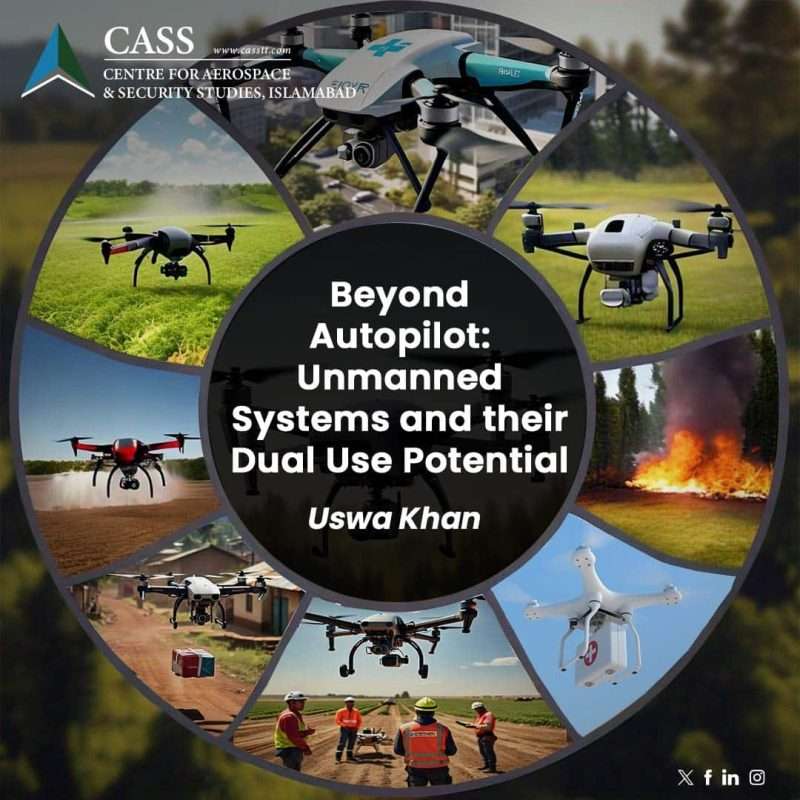
Unmanned systems, driven by rapid technological advancements, have become pivotal not only in the military domain but in civilian arenas also because of their dual nature. So far, most of the available literature looks at the military utility of unmanned systems only. However, this article sheds light on the usefulness of unmanned systems in the commercial sector ranging from agriculture and healthcare applications to logistics. Currently, Unmanned Aerial Vehicles (UAVs), and Unmanned Ground Vehicles (UGVs) are the two most commonly used unmanned systems in the civilian sector.
Nowadays, for example, these systems are increasingly being used for cargo deliveries. Particularly for this purpose, UAVs are dominating this area as companies increasingly rely on UAV technology over UGVs and Unmanned Underwater Vehicles (UUVs) for such services. For example, Walmart, a leading American grocery chain, initiated unmanned deliveries with Zipline this year, completing around 600,000 commercial deliveries. Its partners, DroneUp and Flytrex, have also conducted 110,000 and 6,000 drone deliveries in the United States, respectively.
Additionally, the employment of UAVs in agriculture is also underway. Unmanned systems are enabling farmers to monitor crops effectively and make timely decisions with data on growth and weather conditions. These systems support pest control, crop spraying, and mapping, helping in identifying and addressing potential issues quickly. In Pakistan, the adoption of unmanned systems for fulfilling various commercial endeavours is also on the rise. For instance, in 2019, Pakistan faced a massive invasion of desert locusts in 61 districts in all four provinces. The locust crises were timely catered with the help of indigenous agricultural drones produced by a startup called ABM-SATUMA. Currently, farmers are using UAVs acquired from private firms to enhance crop yields. Led by a female entrepreneur, Kalam4Solutions, offers farmers an opportunity to utilise their UAVs for spraying pesticides and performing other agriculture-related tasks. The company charges PKR 2,000 per hectare which is not only cost-effective but also reduces human exposure to pesticides. The young start-up has been supported by the Ministry of IT & Telecom’s Ignite National Technology Fund based at the National Aerospace Science and Technology Park (NASTP). Other firms such as Syngenta Pakistan Limited are also performing similar tasks. This shows how these unmanned systems can be utilised to achieve optimum results in the agriculture sector.
In the healthcare sector worldwide, medical delivery UAVs transport essential supplies such as vaccines, laboratory samples, organs, and medicines to remote areas. For example, in 2016, Zipline became the national blood delivery service provider in Rwanda, where approximately 80% of the population lives in rural areas. Currently, Zipline UAVs deliver around 70% of the blood supply. Similarly, the World Economic Forum is facilitating healthcare supply chains through its ‘Medicine from the Sky’ project by delivering vaccines, diagnostic samples to India and Ghana, respectively. Moreover, in Canada, Drone Delivery Canada (DDC) and Halton Healthcare partnered together to deliver nuclear medical isotopes to the Oakville Trafalgar Memorial Hospital in Ontario through their ‘Care by Air’ initiative.
There are significant applications of these systems in weather forecasting as well. NASA has also chipped in this endeavour, especially to deal with wildfires from spreading on a large scale. In this regard, NASA recently introduced a new concept to restrict wildfires. It works on the notion of ‘Autonomous Biodegradable Self-sacrificing’ (ABS) for deploying fire retardants around the affected area. These fire retardants hover around the area in swarms and then self-destruct in a circle around the fire repeatedly to limit its spread, till the fire is encircled. This will be a game changer because swarms of UAVs can quickly mobilise and effectively drop their payload.
Furthermore, these technologies have demonstrated their effectiveness in rescue operations as well. For example, in October 2023, more than 100 cars were inside a three-story parking garage when it collapsed, requiring the response of the Fire and Rescue Department in Florida. Inspection was not humanly possible, so a UAV was deployed which was able to manoeuvre through the collapsed site and inside the damaged vehicles.
Although unmanned systems provide numerous benefits, there are also some noteworthy considerations regarding training and data management. Data generated by UAVs is usually time sensitive and needs to be processed and analysed efficiently. For this farmers and healthcare professionals may require additional training and skills, which is a resource-driven and time taking process. Similarly, for instance, in case of any adversarial attack or algorithmic failure, unmanned systems may perform contrary to what they were tasked to do.
In sum, the civilian utility of unmanned systems is set to expand as they increasingly infiltrate the market with cost-effective, 24/7 services vital for consumers. Their development and widespread adoption underscore a significant impact on both state welfare and security. Given their durability and versatility, these systems thrive in environments too challenging for human operation and hence, will continue to drive a surge in demand across both military and civilian sectors.
Uswa Khan is a Research Assistant at the Centre for Aerospace & Security Studies (CASS), Islamabad, Pakistan. She can be reached at [email protected].