Air combat has come a long way from traditional visual based kinetic manoeuvre warfare. Modern aerial combat relies heavily on technological sophistication which has given the birth to new concepts such as Beyond Visual Range (BVR) capability, multi domain operations, systems and network centric warfare. This complex web of intertwined capabilities, platforms and domains culminates into a single kill chain providing a firing solution. On 7 May 2025, Pakistan Air Force (PAF) demonstrated its superiority over its archival India by shooting down seven of its aircraft. The PAF achieved this feat by compressing its kill chain while simultaneously disrupting the adversary’s targeting cycle.
The Air & Space Forces Magazine defines Kill Chain as a process used to put munitions on a specified target. This complex process is broken into five different parts, first is ‘finding’ which revolves around Intelligence, Surveillance and Reconnaissance (ISR) capabilities. This process is crucial as it helps map the battle space and identify the target. ‘Fixing’ helps locate the exact location of the target; ‘tracking’ guides the munitions to the target adjusting to the relative change in location and the last step is ‘targeting’ which engages the hostile. After the munitions have successfully hit the target, operators ‘assess’ the damage to the objective to determine if any additional strikes are necessary.
Amateur commentators often credit an air force capability to superior fighting jets: this represents an erroneous judgment and a lack of understanding of the complexities of air warfare. The composition of modern airpower is a product of its supply chain, superior pilot training, information architecture (data links), satellite network, Air Defence Ground Environment (ADGE), electronic warfare (EWs) and cyber capabilities. The integration of these systems represent the essential infrastructure for an air force to develop its kill solution. In modern air warfare the speed of the kill chain determines the winner, the combatant that develops its kill solution first, wins the engagement.
The basic foundation of a reliable kill chain is situational awareness, which encompasses the ability to perceive, analyse and anticipate the movement of an adversary. Without this capability, the command and pilots are likely to develop operational blind spots, which can be exploited by adversaries. Situational awareness includes Command and Control (C2) architecture, ground based radars like the YLC-8E, Airborne Early Warning and Control (AEW&C) aircraft such as Saab 2000 Erieye, radars for Surface to Air Missiles (SAM) which includes HQ – 9BE and HQ-16FE. Collectively, these platforms detect, track and provide early warning capability, without which an air force would be operationally blind.
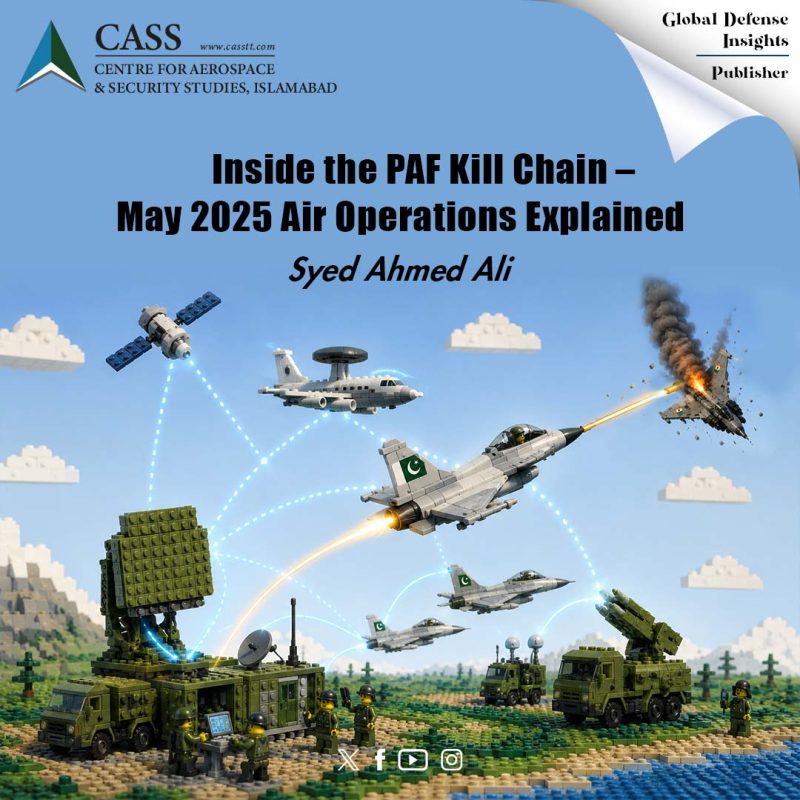
If Early Warning systems and radars are the eyes and ears of an air force, the data link systems are the nervous system that connects it to the shooters. The function of a data link is to connect sensors to shooters and provide a connectivity to different platforms. Based on NATO’s Link-16, Pakistan has indigenously developed ‘Link-17 system,’ which comprises of several Tactical data links that are jam resistant and protected against electronic counter measures (ECMs). This communication architecture that allows PAF to engage in real time information network protected through layered encryption systems. This network connects all air to air and air to ground systems providing a near seamless battlefield situational awareness, communication and coordination.
On 7th May, PAF put all these concepts and capabilities into action and developed operational superiority over its arch nemesis the Indian Air Force (IAF). In an interview, Micheal Dahm, senior fellow at Mitchell Institute for Aerospace Studies stated that the kill chain may have been started by ground radar (or possibly an AEW&C such as Saab 2000). The radar system had the capability to detect the hostile platform at a longer distances, while Pakistani aircraft kept radar and radio silence to minimise electronic signature. The information from the radar was relayed to a J-10 C fighter which launched its missiles at the designated target, which could have been guided by an AEW&C through a midcourse data link to update its trajectory. With a seamless network Link 17 and advanced PL-15 BVR missiles, PAF had demonstrated technical and technological edge over its adversaries in both range and detection capabilities.
PAF’s victory over IAF cannot be credited solely to a faster kill chain but also its capability to disrupt its adversary’s targeting cycle. Modern conflict operates under the framework of Systems warfare, this strategy focuses on destroying systems rather than individual platforms which operate under them. Targeting in this doctrine focuses on functional systems which includes command structure, logistic nodes and early warning systems rather than military attrition. In the context of May war, PAF systematically disrupted the enemy’s kill chain by jamming its sensors, spoofing radar systems and deploying decoys. Through these efforts the IAF was unable to complete its kill chain, rendering their targeting capability useless in a fast paced dynamic combat. This ensured not only the safety of PAF but also enabled a psychological supremacy over its adversaries.
By understanding the nature and operational requirement of modern air combat, PAF had demonstrated strategic foresight and an acute understanding of modern warfare. Though many commentators may praise the J-10 C and PL-15 missiles for its victory over in IAF, it was in fact Pakistan’s superior networks, resolve, fast kill chains and its leadership which won the May 2025 war.
Syed Ahmed Ali is a Research Assistant at the Centre for Aerospace & Security Studies (CASS), in Islamabad, Pakistan. The article was first published in Global Defense Insights. He can be reached at [email protected]