Eventpage-WEB Banner-RT-Syria-13 Dec2024-AP


Share this event

Facebook
Twitter
LinkedIn

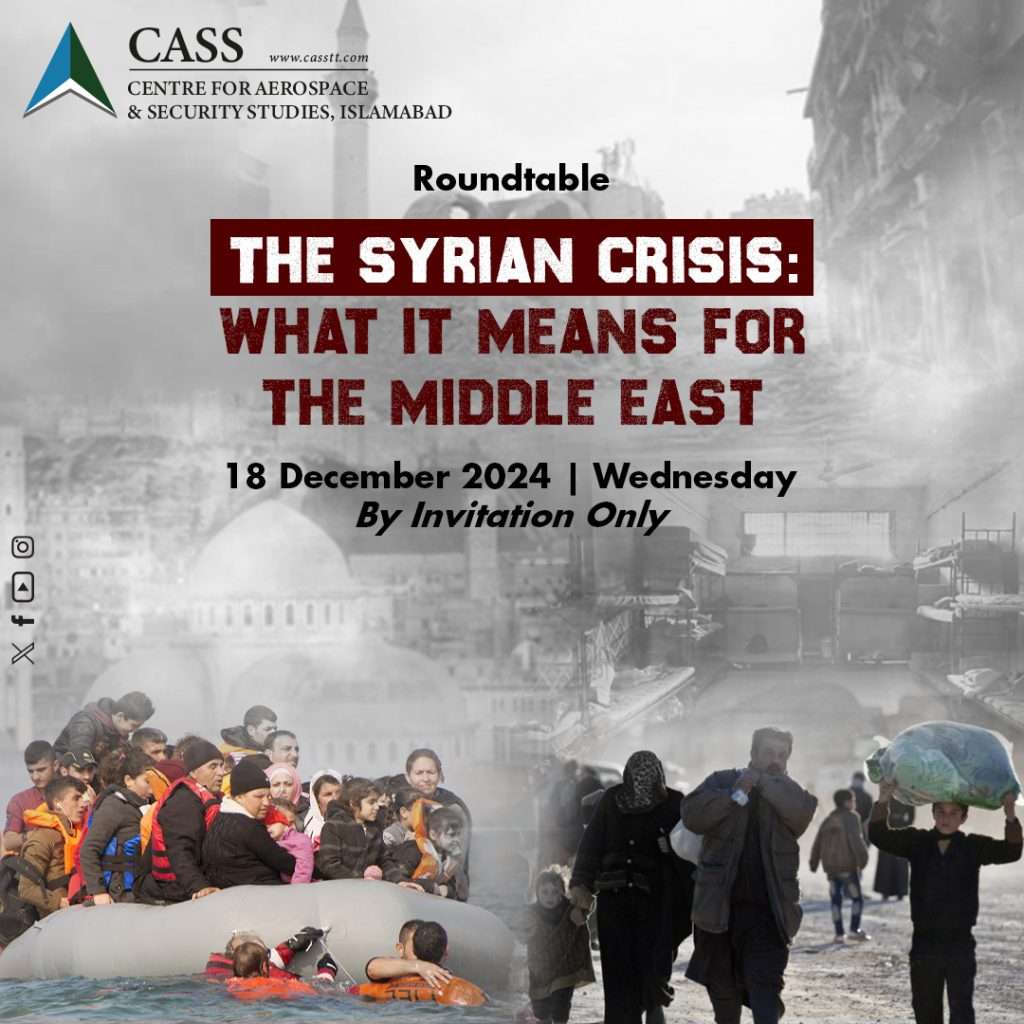
The dramatic sequence of events in Syria leading to the sudden collapse of Bashar Al-Assad’s regime has taken political analysts worldwide by surprise. The unexpected fall of Damascus is poised to reshape the geopolitical and socio-political landscape of the Middle East and beyond, with ripples already being felt and more likely to emerge in the coming months. Pakistan, while not geographically a part of the Middle East, may inevitably get affected by the developments unfolding in Syria.

In an effort to analyse the Syrian crisis comprehensively and anticipate its regional and global implications, the Centre for Aerospace & Security Studies (CASS) is organising a Roundtable Conference with three former Pakistani Ambassadors to the Syrian Arab Republic, who will share their unique perspectives on the current crisis and its broader impacts. Building on a prior in-house discussion that explored the historical context of Syria’s turmoil, this RTC will focus on forward-looking insights on the following questions:

  • What were the immediate factors behind the unexpected success of Hay’at Tahrir al-Sham (HTS) and the collapse of the Syrian army?
  • What are the political and military implications of these events for the Middle East?
  • What are the potential future scenarios for Syria and the broader region?
  • How might these developments impact Pakistan, and what lessons can be drawn?
  • What should be the way forward for regional and international stakeholders?
Other Events

THE FUTURE OF THE INDUS WATER TREATY

For more than six decades, the Indus Water Treaty (IWT), signed in 1960 between Pakistan and India, remained as one of the most enduring transboundary water-sharing agreements in the world. Despite multiple wars, political crises, and prolonged periods of bilateral hostility, the treaty largely continued to govern the allocation and management of the waters of the Indus Basin

Read More »

Fiscal Survival or Economic Reform? Decoding Pakistan’s Budget Priorities

Pakistan’s annual budget is more than a fiscal document; it is a reflection of the country’s structural economic constraints, political choices, and shifting development priorities. The tension between fiscal survival and meaningful economic reform has become increasingly pronounced amid rising debt servicing obligations, limited fiscal space, and recurring dependence on external financing. In this context, budget-making often appears reactive—focused on stabilisation and compliance with short-term macroeconomic targets—rather than transformative, aimed at broad-based productivity, institutional reform, and sustainable growth.

Read More »

Nuclear Capability: Balancing Global Security and Energy Needs

Recent global developments—including geopolitical tensions, energy crises, and shifting power dynamics—have intensified discussions around nuclear capability. After the Russia-Ukraine conflict and the US-Israel-Iran war, nations are increasingly evaluating nuclear technology not only as a strategic defense mechanism but also as a reliable and large-scale energy source. These developments have brought nuclear capability back to the forefront of international debate.
The dual-use nature of nuclear capability—serving both military and civilian purposes—makes it a critical area of analysis. The ongoing war on Iran has introduced significant uncertainty into the future of Iran’s nuclear trajectory, particularly regarding

Read More »