
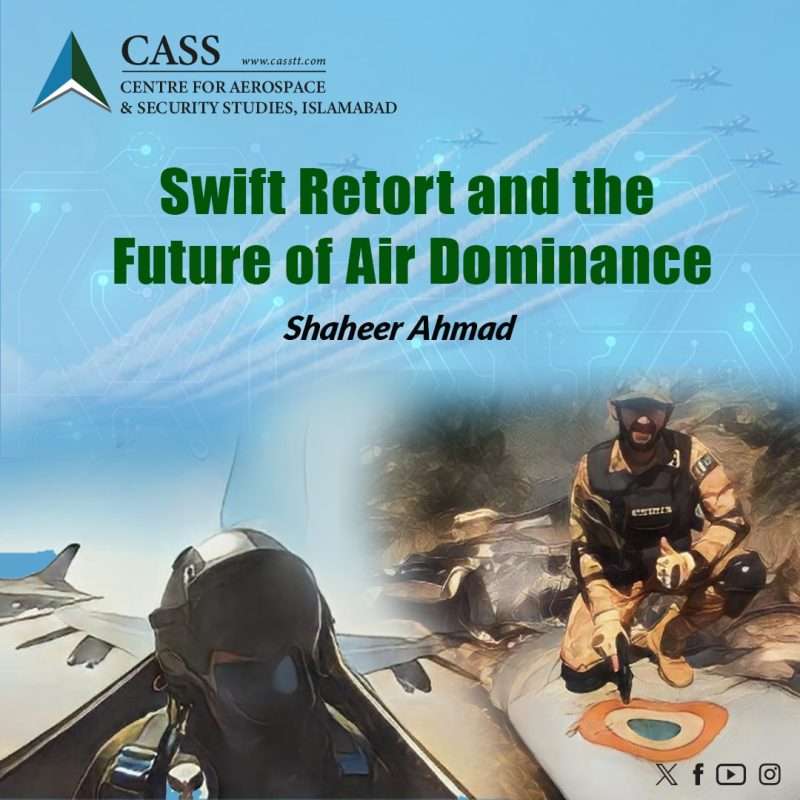
‘What all could have happened if we had Rafale?’ This statement by India’s Prime Minister Narendra Modi surfaced after the Pakistan Air Force (PAF) downed two Indian fighter jets in riposte to the Indian Air Force (IAF)’s failed airstrikes near Balakot on this day in 2019. However, even after receiving the consignment of 36 Rafale combat aircraft, the IAF has been unable to keep pace with regional peer air forces. The retaliatory counterstrike dubbed ‘Operation Swift Retort’ by the PAF demonstrated how a capable air force can turn the tides of battle by employing effective strategy, superior tactics, and advanced technology.
The IAF currently operates an aging fleet of 31 fighter squadrons, unable to meet its sanctioned strength of 42. To plug this numerical gap, India currently harbours an ambitious plan to field 500 fighter jets, most of them indigenously designed and manufactured. For this purpose, Hindustan Aeronautics Limited (HAL) is working on the Indigenous Advanced Medium Combat Aircraft (AMCA) project and Light Combat Aircraft (LCA).
However, to date, the IAF has struggled to reap the benefits of LCA MK1 and MK2. This is evident in the Indian Air Chief’s statement where he slammed HAL for delayed production of Tejas fighter jets. While 60% of the Tejas fighter MK1 jet is indigenous, its critical components including the GE404 engine are procured from foreign retailers. This casts doubts on the credibility of India’s aircraft manufacturing sector to achieve Modi’s proclaimed goal of ‘Atma Nirbharta’ or self-reliance. Furthermore, the delayed deliveries of the Tejas MK1 and MK2, now expected between 2028 and 2030, risk rendering these aircraft obsolete in the face of fifth-generation combat platforms and emerging manned-unmanned teaming (MUM-T) systems.
Likewise, sustaining the AMCA project remains a formidable challenge for the IAF due to the absence of a self-sufficient aerospace ecosystem essential for developing a fifth-generation fighter. The lack of advanced design, development, and manufacturing capabilities, coupled with insufficient expertise in optimising weapons bays and integrating optical and electronic subsystems, presents a significant hurdle. These deficiencies not only heighten the risk of project failure but also threaten to push its induction timeline well beyond 2035. Such technological bottlenecks, prolonged production timelines, and the IAF’s growing demand for advanced fighter jets have placed immense strain on India’s aerospace industry, making the realisation of its self-reliance ambitions increasingly difficult.
In contrast, the PAF swiftly recognised the strategic importance of self-reliance and technological advancement in the aftermath of ‘Swift Retort.’ Capitalising on its first-mover advantage, it has pursued a dual-pronged modernisation strategy, combining advanced procurements with a strong push for indigenisation. As part of this initiative, the PAF has developed and acquired a range of combat aircraft and drones to enhance its operational capabilities. Notable among them are JF-17 Thunder and J-10C Vigorous Dragon. More recently, PAF has green-lighted acquisition of J-31 aircraft—a multirole stealth fifth generation fighter jet—from China which will grant Pakistan a technological edge over its IAF counterparts.
The JF-17 Thunder stands as a testament to Pakistan’s progress in self-reliance. In contrast to LCA’s commencement in 1984, the JF-17 programme was launched in 1998, and currently, more than 150 aircraft are operational. Its recent version Block-III is equipped with state-of-the-art AESA radar, advanced electronic warfare systems, and Beyond-Visual-Range (BVR) weapons.
As part of its commitment to self-reliance in research and development, the PAF has also established a nationwide network of National Aerospace Science & Technology Parks. This cluster serves as a comprehensive ecosystem designed to advance research, design, and innovation in the aviation and aerospace sectors.
Mindful of the growing importance of unmanned aerial systems (UAS) in future warfare, the PAF has accelerated induction of advanced UAVs to enhance its operational capabilities. These systems are designed for both kinetic strikes and intelligence, surveillance, and reconnaissance (ISR) missions. Furthermore, PAF aims to develop AI-based drones that could serve as a loyal wingman to assist manned aircraft in MUM-T capacity.
Since ‘Swift Retort’, the PAF has remained ahead of the curve, rapidly integrating cutting-edge technologies to sustain a psychological and operational edge over the IAF. PAF’s commitment to indigenisation, self-reliance, and strategic partnerships has reinforced a robust defence posture, enabling seamless multi-domain operations. With an evolving arsenal of next-generation fighter jets and unmanned systems, the PAF is not just keeping pace—it is actively shaping the future battlespace. It is fair to say that tea for future IAF pilots remains fantastic.
Shaheer Ahmad is a Research Assistant at the Centre for Aerospace & Security Studies, Islamabad. He can be reached at [email protected].



