
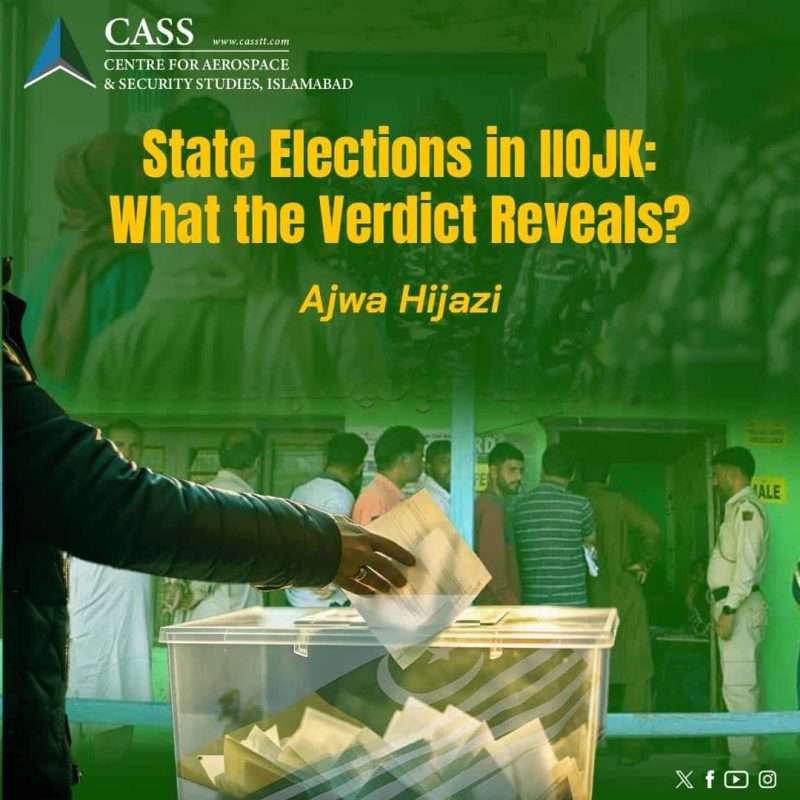
After a decade, state polls were conducted in Indian Illegally Occupied Jammu and Kashmir (IIOJK) in three phases on September 18, September 25, and October 1, with results announced on October 8. In these elections, the major electoral battle was between two alliances: the National Congress (NC) and Congress versus the Peoples Democratic Party (PDP) and the Bharatiya Janata Party (BJP). Out of 90 seats, the NC-Congress alliance secured 49, with the PDP-BJP alliance trailing behind. Moreover, NC, one of the oldest political entity of the disputed region, emerged as the largest party defying predictions of a hung assembly. It won 42 seats and ultimately formed the government. Omar Abdullah, who four months ago was defeated with over 2 lac votes in Lok Sabha polls 2024, was sworn in as the Chief Minister. Although the government in IIOJK has been formulated, the verdict of these elections points towards a few glaring realities that define the political horizon of disputed territory.
Over the past decade, the people of IIOJK have faced relentless suppression of fundamental rights under the BJP government. This crackdown intensified after the revocation of Articles 370 and 35-A, centralising power in New Delhi and reshaping the demographic and administrative structure of the disputed territory.
Against this backdrop, these assembly elections served as a referendum on the BJP’s Hindutva policies imposed on the disputed region. Despite electoral manipulation through unjust delimitation of assembly segments, repression of dissenters, and false assertions of ‘development,’ the people overwhelmingly voted against them. Plus, the electoral mandate they attained does not comprehensively represent all sections of the disputed territory. Out of 29 seats won by the BJP, the majority were from the Hindu-dominated Jammu region, where the Delimitation Commission added six seats in 2022. Moreover, even political factions aligned with the BJP faced public disapproval. For instance, the BJP’s ally PDP ranked in the bottom half of the seat tally, while many independent candidates were defeated, as they were widely perceived to be BJP proxies.
On the other hand, after saying ‘No to BJP’ (as noted by Ambassador Maleeha Lodhi), the people of the disputed territory have handed the mandate of governance to the NC. The National Conference effectively harnessed the prevailing anti-Delhi sentiment. However, the real challenge for Omar Abdullah and his government will be steering governance in IIOJK while contending with the power firmly centralised in New Delhi. Fearing electoral defeat – which they ultimately suffered – the BJP preemptively curtailed powers of the Chief Minister in July by amending the ‘Transaction of Business of the Government of Union Territory Act, 2024’, shifting authority to the Lieutenant Governor. This power transfer strips the CM of control over key bureaucratic appointments essential for effective governance. Many analysts predicted that the relationship between the CM of IIOJK and the LG could mirror the contentious dynamics observed in Delhi’s governance model. However, events following the NC’s rise to power suggest that Omar Abdullah has adopted a conciliatory approach toward the BJP government, opting for engagement rather than directly confronting New Delhi.
During the electoral campaign, the National Congress defended the region’s autonomy by including restoration of Article 370 in its manifesto. However, right after assuming power, the unambiguous stance on revival of statehood of the disputed territory was replaced with a pacified tone. In his first Cabinet meeting, the CM passed a resolution on the statehood of IIOJK while leaving the restoration issue of Articles 370 and 35-A untouched. This move garnered a lot of criticism from opposition parties, who termed the resolution as ‘nothing less than a ratification’ of BJP’s move of August 5, 2019.
Given this initial stance of Omar Abdullah’s government, it is likely that it will continue fostering cordial relations with the BJP-led Union government, despite the limited governance and authority granted to it.
The emergence of a powerless government will do little to alleviate the suffering of the people of IIOJK. This election result symbolizes the Kashmiri peoples’ defiance against oppression more than the political success of any faction. True relief for Kashmiris lies in granting them the right to self-determination, as prescribed by the United Nations Security Council, not through electoral exercises overshadowed by the Indian government’s decades-long repression of the disputed region.
Ajwa Hijazi is a Research Assistant at the Centre for Aerospace & Security Studies (CASS), Islamabad, Pakistan. She can be reached at [email protected].



