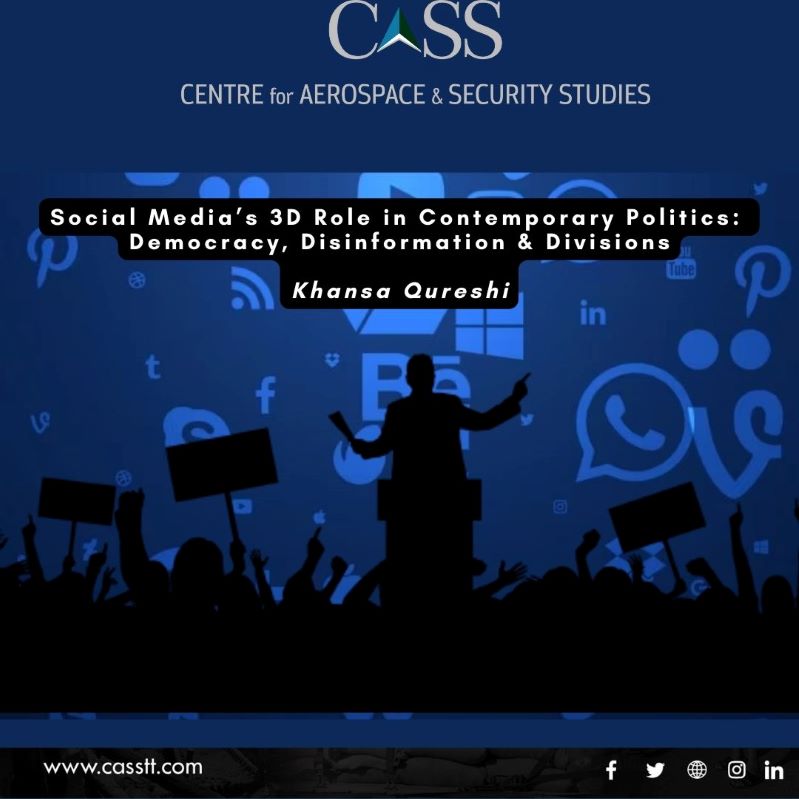
Over the years, digital advancements have transformed the manner in which political processes are carried out across the world. In today’s age of social media, online platforms are employed for shaping, amplifying, snubbing, and questioning various political practises and ideologies. Especially in societies where civic participation encounters nuanced obstacles, the increasing accessibility of online platforms to the public has led to a rise in the magnitude and diversification of original voices and narratives, exerting a growing influence on the contemporary political landscape. For more than a decade, social media has been responsible for catalysing revolutions (e.g., the Arab Spring), and fuelling and sustaining massive protests across the world. It has also been responsible for converting online discourses like the #MeToo movement into tangible changes in real life igniting legal, political and social responses.
The impact of social media on politics is leading to a comprehensive transformation of traditional practices and strategies. This encompasses the rejection of narrative monopolies; diversification of narratives; amplification of voices previously marginalised in political processes; circumvention of dissent; suppression; freedom constraints; and even influencing elections. Previously, traditional mass media, such as TV channels, was believed to hold substantial power and enjoy almost monopolistic sway when it came to informing public opinions and political narratives. However, with the advent and widespread use of social media, monopoly on both narratives and narrative-building centres has been shifted significantly. Unrestricted and cheaper access to social media sites enables the dissemination of multiple and diversified narratives, as well as hosting opposition and rebuttals to previously prevailing ideas. In this process, it allows the voices of non-dominant actors in politics to be relayed and reach the public without the interruptions of gatekeeping, manipulation or spinning which otherwise riddles the electronic media. This, on the one hand, ends the perpetual sway of electronic media and its controllers, while on the other hand, it widens the spectrum of political ideologies in a society.
The process of exploring multiple options, with minimal chances of exploitation compared to being subjected to only choosing from what is being presented on TV screens, generates an ideologically diverse political discourse in society. It also equips the public with an opportunity to better and freely choose a political idea to subscribe to. This works both in the interest of political stakeholders with lesser power as well as the general public, ultimately contributing towards the democratisation of political processes.
Social media emerges to be an important primary avenue to express and register dissent, anger, displeasure, and distrust in political affairs. But if the public continues to feel unheard, the online anger can culminate into physical agitations too. While being an avenue for igniting political agitations, social media can simultaneously play a role in facilitating the protests as well particularly in galvanizing support, coordinating protests, and mobilising masses via online platforms.
On the other hand, although there are many constructive roles of social media in the sphere of politics, it also remains pertinent to bear in mind that the very aspect making it a boon can also convert it into a bane. For example, social media has been called a double-edged sword given its potential to spread misinformation and disinformation leading to fissures and political polarisation. First, as social media algorithms tend to connect people with similar views, it creates echo chambers. This causes the introduction or discussion of novel, differing, or newer ideas extremely difficult. Resultantly, it can intensify partisanship, promote intolerance and fanaticism fuelled by validation from like-minded accounts, leading to an even divisive society. Second, another risk is that social media companies are able to manipulate their sites’ algorithms to influence users to favour a certain actor. For example, it is believed that content on Twitter may have persuaded the independents or moderates to vote against Donald Trump in the 2016 US Presidential Election.
Given the tremendous and growing impact of social media on ground politics, it is then little wonder that authorities, particularly in societies with curbs on civil liberties, readily resort to banning such platforms. Governments have been involved in imposing blanket internet and communication blockades (a glaring and longest case in point is Indian Illegally Occupied Jammu & Kashmir) at the slightest chance of political uprisings against state injustices.
Looking ahead, despite social media’s negative impact on politics and blanket curbs, as the world makes technological advances, its role in informing the public, shaping views, and impacting political processes will only grow. Therefore, it is important to adopt approaches that may work to capitalise on the positive potentials that these platforms have to offer while mitigating the negative impacts. Involved stakeholders such as political actors, governments, and social media companies must work towards developing strategies to counter misinformation, promote algorithm transparency, and fostering digital literacy among users. It must also be ensured that responsible and ethical guidelines are created that are adhered to by all stakeholders in order to uphold the integrity of political discourse on such sites, while also ensuring freedom of expression and political participation.
Khansa Qureshi is a Research Assistant at the Centre for Aerospace & Security Studies (CASS), Islamabad, Pakistan. The article was first published in Pakistan Observer. She can be reached at [email protected].
Design Credit: Mysha Dua Salman