Share this event

Facebook
Twitter
LinkedIn

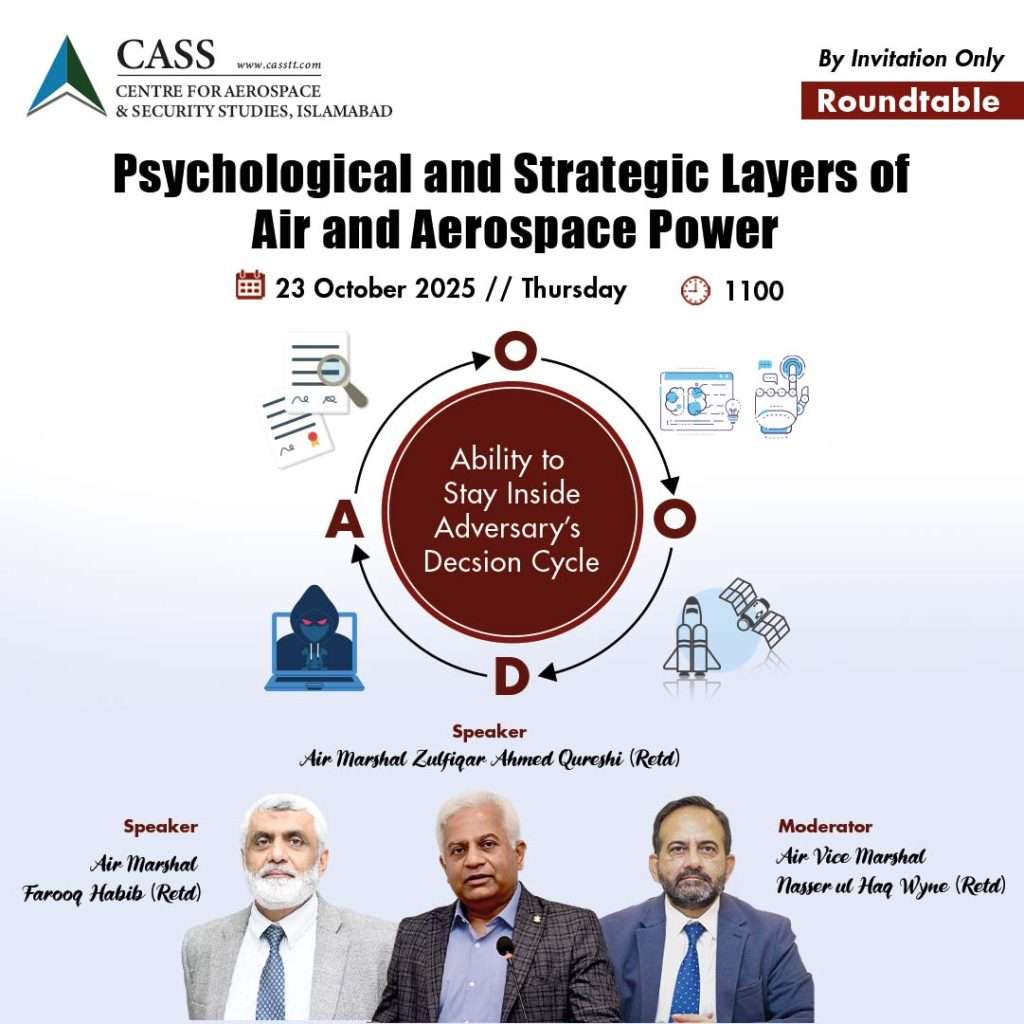
1.         Air and aerospace power today extends far beyond aircraft and missiles. The decisive advantage lies in ‘doctrine, employment strategy, training and clarity of leadership’, reinforced by new domains of ‘space, cyber, electronic warfare (EW), and artificial intelligence’ (AI). These elements compress the OODA loop (Observe–Orient–Decide–Act), enabling a force with sharper doctrine and quicker decision-making to dominate an opponent that may possess larger numbers or advanced capabilities.

2.         South Asia offers one of the clearest demonstrations of this reality. Both the Pakistan Air Force (PAF) and the Indian Air Force (IAF) operate diverse fleets and increasingly integrate satellites, cyber capabilities, and AI-enabled decision aids. Operation Swift Retort (2019) and May 2025 conflict, show that psychological and strategic effects often outweigh hardware.

3.         This Round Table will explore how air and aerospace power functions as both a strategic instrument and a psychological lever in the Indo-Pak setting. The speakers will examine: –

(a)       The strategic drivers of superiority.

(b)       The psychological mechanisms that shape public opinion and political decision-making, drawing lessons for doctrine, training, and leadership in a multi-domain environment.
Other Events

Nuclear Capability: Balancing Global Security and Energy Needs

Recent global developments—including geopolitical tensions, energy crises, and shifting power dynamics—have intensified discussions around nuclear capability. After the Russia-Ukraine conflict and the US-Israel-Iran war, nations are increasingly evaluating nuclear technology not only as a strategic defense mechanism but also as a reliable and large-scale energy source. These developments have brought nuclear capability back to the forefront of international debate.
The dual-use nature of nuclear capability—serving both military and civilian purposes—makes it a critical area of analysis. The ongoing war on Iran has introduced significant uncertainty into the future of Iran’s nuclear trajectory, particularly regarding

Read More »

Catalyst Conversation : The US–Israel–Iran War and the Role of Gulf and Arab States

The ongoing war between the United States-Israel, and Iran has emerged as a defining crisis of the modern world, with significant implications for regional security, global energy markets, and the evolving geopolitical order. While the primary confrontation involves direct and indirect exchanges between these actors, Gulf and Arab states have become increasingly central to the conflict’s dynamics.
Hosting U.S. military assets and located in close proximity to key theatres of escalation, these states face growing security risks, including spillover

Read More »