Pakistan’s economy has faced persistent challenges, including high inflation, weak growth, and external imbalances. In FY 2023, growth turned negative due to international geopolitical turmoil, domestic political instability, and natural disasters (floods). To stabilise the situation, Pakistan entered its 24th International Monetary Fund (IMF) programme—a Stand-By Arrangement (SBA)—which set the stage for a modicum of stability to return; and Pakistan and the IMF then agreed to a 37-month Extended Fund Facility (EFF) in September 2024, worth around USD 7 billion, that is still underway. The programme is nestled within a severe austerity paradigm that prioritises tight macroeconomic controls and tax base expansion. Although Pakistan passed the first review, and is faring well for the second review, continued fiscal discipline and structural reforms remain essential to the programme’s strictures.
At the same time, the country must reposition itself away from austerity at some point and aim for growth with enhanced productive capacity. A purely austerity-driven approach risks ‘stabilisation fatigue,’ economic stagnation, and further public immiseration.
The global economic environment remains precarious due to the volatile and ongoing ‘tariff saga’ of the Trump administration and geopolitical uncertainties in the world (US-China, Middle East, etc.). In the midst of such global uncertainty, the key challenge for Pakistan is how to pursue pro-growth policies without breaching IMF commitments.
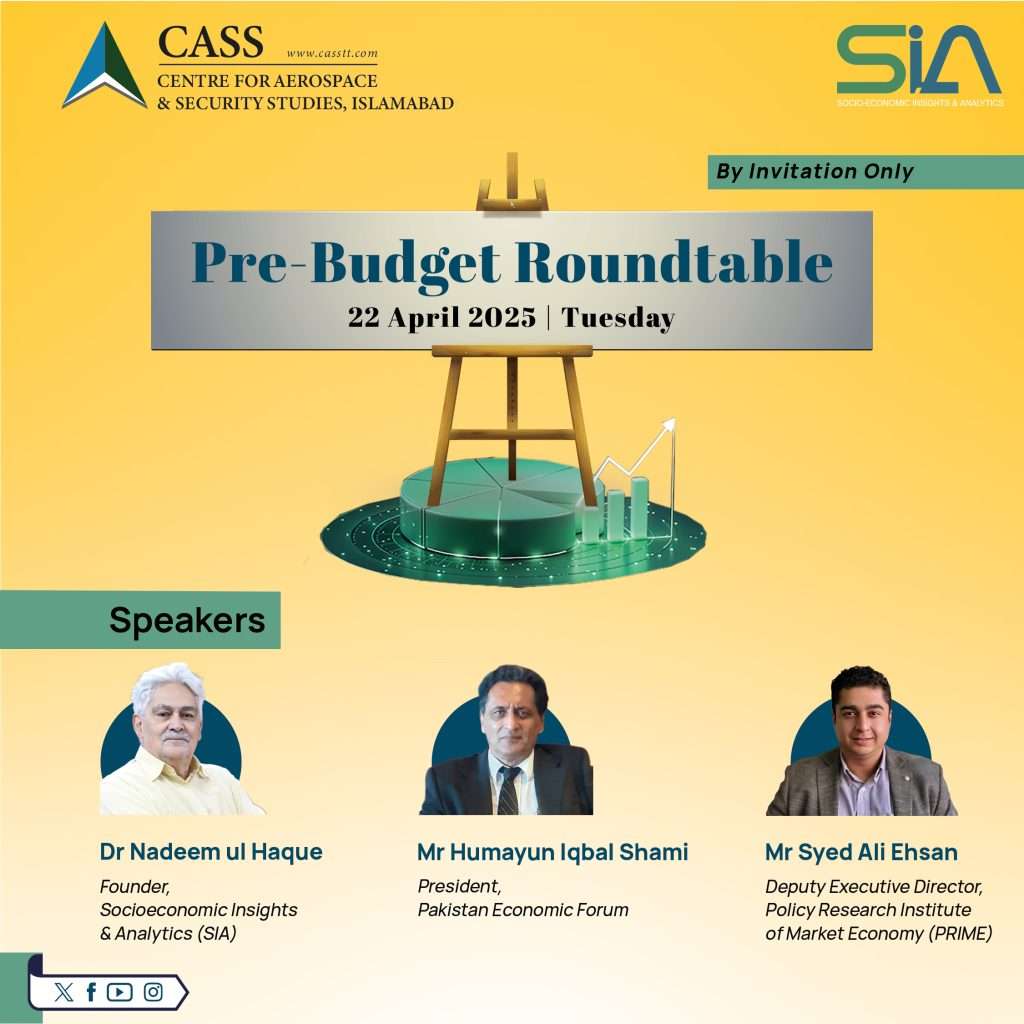
This CASS-SIA collaborative roundtable will examine Pakistan’s FY 2025-26 fiscal strategy under the EFF, bringing together leading economic experts to address the most pressing questions pertaining to the upcoming budget. The five most important areas for discussion will include:
- Structural components and policy priorities of Pakistan’s forthcoming federal budget for FY 2026.
- Moving beyond austerity: how to pursue pro-growth policies without breaching IMF commitments.
- Addressing the issues of taxation, the excess focus on this side of the fiscal equation, and how to effectuate meaningful tax policies in the budget.
- Fixing and reforming tariff policy, both from an indigenous perspective and in terms of the Trump administration’s global tariff agenda.
- Recommendations to rationalise public expenditures and subsidies in the FY 2026 budget.
Press Release
Newspaper Links