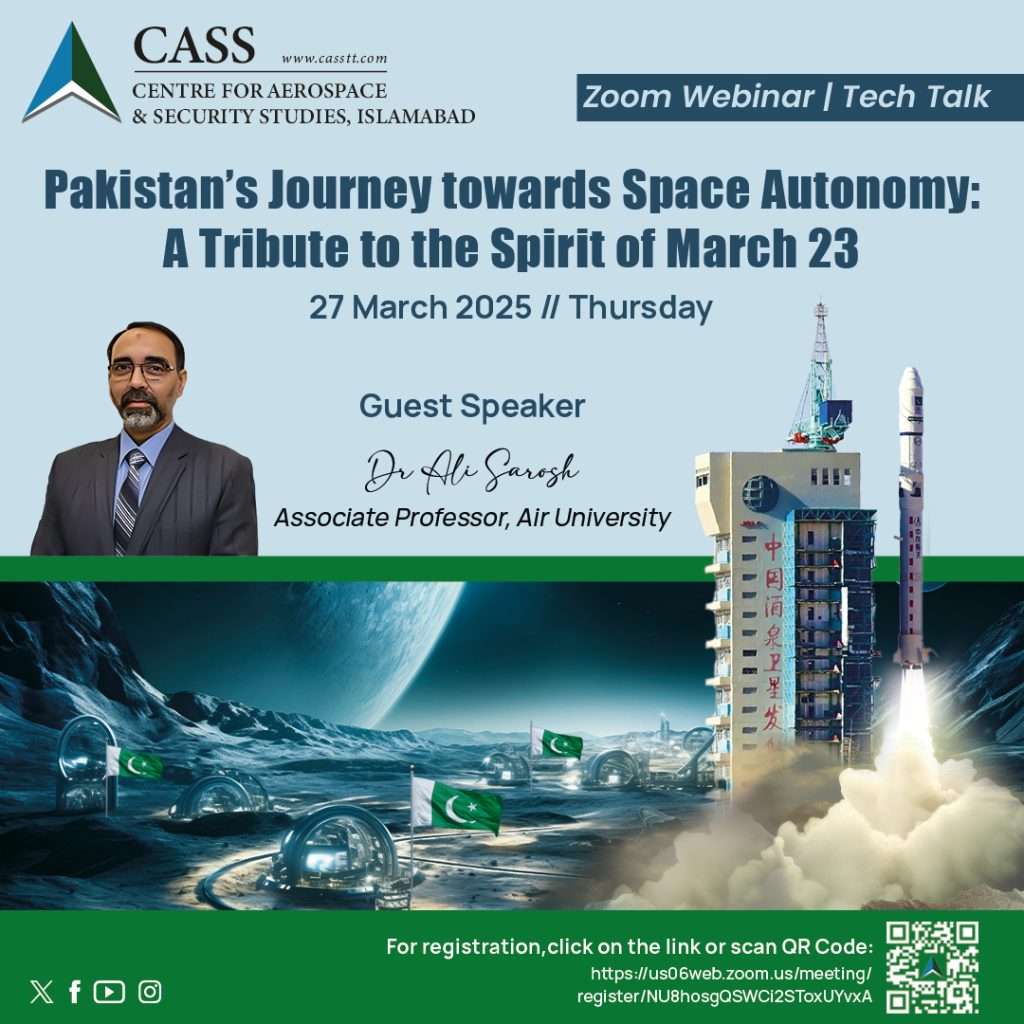
In an era where the frontiers of innovation extend beyond the Earth’s surface, space autonomy is emerging as a strategic imperative. For Pakistan, the journey to space autonomy is not just a technological pursuit—it is a reaffirmation of Pakistan’s founding ideals of sovereignty, resilience, and self-reliance as envisioned on 23rd March, 1940. Pakistan’s space journey began with commendable strides.
The Space & Upper Atmosphere Research Commission, commonly referred to as SUPARCO, established in 1961, was among the pioneers of space programmes in the developing world, launching Pakistan’s first rocket, Rehbar-I, in 1962 — a remarkable achievement that positioned Pakistan as the third country in Asia to reach space. However, despite this promising start, the programme faced stagnation in subsequent decades. Meanwhile, regional counterparts made progress at a constant pace and they have achieved breakthroughs in satellite technology, lunar missions, and space exploration.
As modern geopolitics increasingly revolves around technological dominance, space capability has become a vital determinant of national power, economic resilience, and strategic leverage. Learning from international space efforts is crucial. The United States’ space model, leaning more towards private enterprise, has demonstrated how innovation flourishes through market competition and technological breakthroughs. In contrast, China’s state-led space programme, characterised by long-term planning and heavy investment in infrastructure, has propelled the nation to the forefront of lunar and Mars exploration.
For Pakistan, the ambition to become self-sufficient in aerospace technology would not only serve strategic and defence interests but could also accelerate the country’s economic growth and technological innovation. At the same time, integration of space-based assets into national security frameworks could redefine defence and operational readiness. Enhanced communications and advanced data analytics can empower decision-makers with real-time insights, ensuring that the nation is better prepared to address modern challenges.
The road to complete space autonomy is not without its challenges. Limited resources, the need for sustained investment in Research and Development (R&D), and the complexities of integrating cutting-edge technology into existing systems present significant hurdles. The journey involves navigating complex technical and economic hurdles. In this spirit, this webinar at CASS will provide a forum for thoughtful discussion on how Pakistan can harmonise its economic ambitions, technological prowess, and defence capabilities through a focused push for achieving space autonomy. The discussion will explore the strategic significance of establishing a robust aerospace sector while reflecting on the lessons and legacy of March 23—a day that continues to inspire our commitment to sovereignty and progress. The following questions will be addressed:
- How can Pakistan balance the need for sustained investment with the demands of establishing a world-class aerospace industry?
- In what ways can technological innovation in the aerospace sector contribute to enhancing national security?
- What strategic collaborations or policy measures are most critical for transforming Pakistan’s ambitions in space into a sustainable reality?