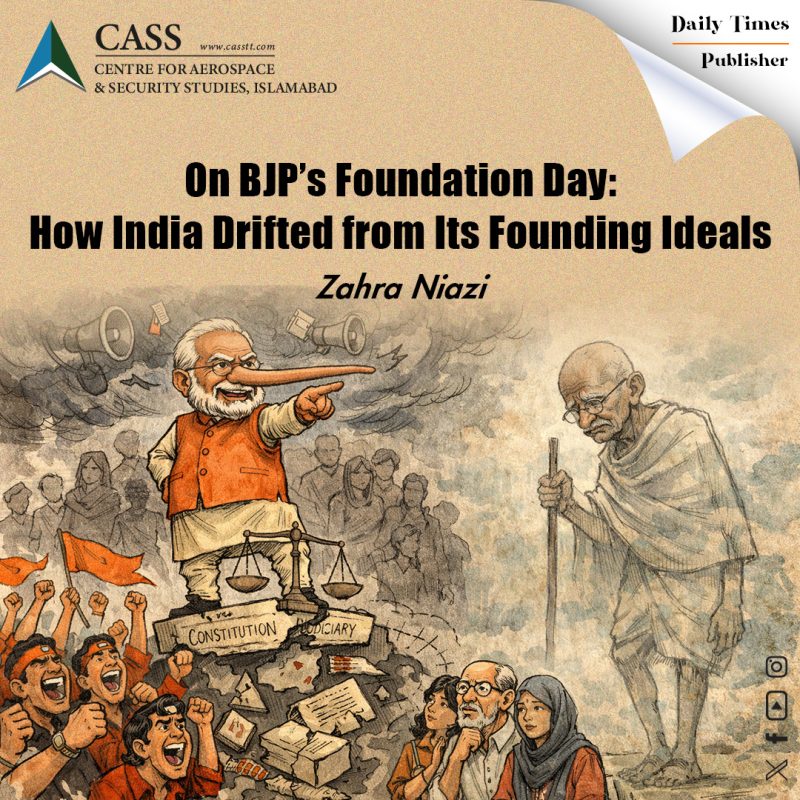
India projects itself as one of the most vibrant democracies in the world, but its rankings in global risk indices present a fundamentally different picture. Notably, in 2025, India ranked fourth among 168 countries at risk of future mass killings of civilians, behind Myanmar, Chad, and Sudan.
One is compelled to ask: How did a country, founded on the Gandhian principles of non-violence and the welfare of all, lose its moral direction? And how, if at all, can these ideals be rebuilt?
6 April, the foundation day of the Bharatiya Janata Party (BJP), offers an opportunity to reflect on these questions.
The BJP was established in 1980, evolving from the political arm of Rashtriya Swayamsevak Sangh (RSS). While RSS was founded in 1925 as a Hindu nationalist volunteer organisation, its ideological foundations were laid more than a decade earlier inside a prison cell. V.D. Savarkar developed the ideology of Hindutva, conceptualising India as a Hindu dominion and a Hindu as an individual who considered India as both their fatherland and holy land.
However, the popular appeal of any ideology depends on the relative strength of its countervailing force/s. By the time Hindutva was crystallised and the RSS was founded, Mahatma Gandhi, a staunch advocate of cultural harmony, had already built a stronghold in the hearts and minds of the masses, having transformed the Indian National Congress into a mass organisation. Although Gandhi was assassinated soon after independence, Jawaharlal Nehru, the then Indian Prime Minister, sustained Gandhi’s legacy.
The turning point arguably came with Nehru’s death in 1964. Indira Gandhi, who assumed office two years later, pursued centralisation of power, gradually weakening the party’s grassroots support base and enabling a coalition of opposition parties, including the RSS’s political arm, to break its nearly three-decade-long rule in 1977. While Indira Gandhi was able to reassume the premiership in 1980, the coalition’s RSS-affiliated group capitalised on the legitimacy gained during the brief rule, establishing the BJP the same year. As Congress increasingly resorted to religious politics, it inadvertently expanded the BJP’s ideological space. By 2000, the BJP was leading a coalition at the centre, although it lacked leaders with Nehru-Gandhi-level mass appeal, and was replaced by a Congress-led coalition in 2004.
But in the background, Narendra Modi, an RSS member who was sent to the BJP in 1987, was already building his profile to fill this void. After establishing a reputation within the party, he was appointed Chief Minister of Gujarat in 2001 following a crisis in the BJP-led state government. Modi quickly built his appeal by connecting directly with the masses, aided by his powerful oratory and the coinciding events, allowing him to mobilise Hindu nationalist sentiment.
Notably, in 2002, a train burning incident occurred in Gujarat, resulting in the death of dozens of Hindus. The state government quickly blamed a Muslim mob, triggering riots and leading to a mass massacre of Muslims. A later central government’s investigation described the train incident as an accident originating within the coach, while overwhelming evidence points to the Modi government’s involvement in the massacre that followed.
Modi went on to win successive Gujarat elections by projecting himself as an unapologetic Hindu nationalist and a pro-business reformer, was nominated as the BJP’s prime ministerial candidate in 2013, and secured a decisive majority in the 2014 Lok Sabha elections. He was re-elected with an even stronger mandate in 2019.
With polarisation politics having paid consistent political dividends, and the BJP’s Muslim representation in the parliament already having declined sharply, the Modi government, following 2019, systematically invisibilised Muslims, despite the latter constituting around 14 per cent of the Indian population. Notably, the abrogation of Article 370 in 2019 removed the autonomy of the Indian Illegally Occupied Jammu and Kashmir (IIOJK), India’s only Muslim-majority state, while the Citizenship Amendment Act (CAA) fast-tracked Indian citizenship for non-Muslim migrants from neighbouring countries, disregarding Muslims. In making Muslims irrelevant, the BJP also aimed to sideline a potential voter base for the Congress, thus consolidating its hold on power.
In 2024, however, while Modi won a third consecutive term, he failed to secure an outright majority. Although some tend to suggest that this pointed to a realisation among the Indians of the consequences of the BJP’s hate-ridden policies, there exists another dynamic warranting a deeper look.
From 2014 onwards, Modi intensified the anti-Pakistan posture to amplify the population’s nationalist sentiments. The BJP actively used tensions with Pakistan, including in 2016 and 2019, to bolster its electoral appeal. The 2024 elections, on the other hand, were held without a preceding military escalation against Pakistan. The tragedy of tying political stakes to such discourses is that, when consistently repeated, they are internalised by populations, thereby shaping their expectations. This not just raises questions about the timing of India’s subsequent 2025 escalation with Pakistan but also explains the ever-increasing use of anti-Pakistan rhetoric by both Indian civilian leaders and military officials in recent months.
While these extremist tendencies presently show no signs of abating, they are certainly not irreversible. The path to reversal is challenging, but history shows that populations can change the course of nations, provided they are steered in the right direction by torchbearers who can win popular appeal by disseminating a clear and principled alternative narrative. Modi’s relative decline in popularity in the 2024 national elections, and the impact that these Hindutva policies have already been having on the Hindu population, without many being cognisant of it, suggest that the political space for such alternatives exists but must be actively claimed.
The writer is a Research Associate at the Centre for Aerospace & Security Studies (CASS), Islamabad. The article was first published in Daily Times. She can be reached at: [email protected].