
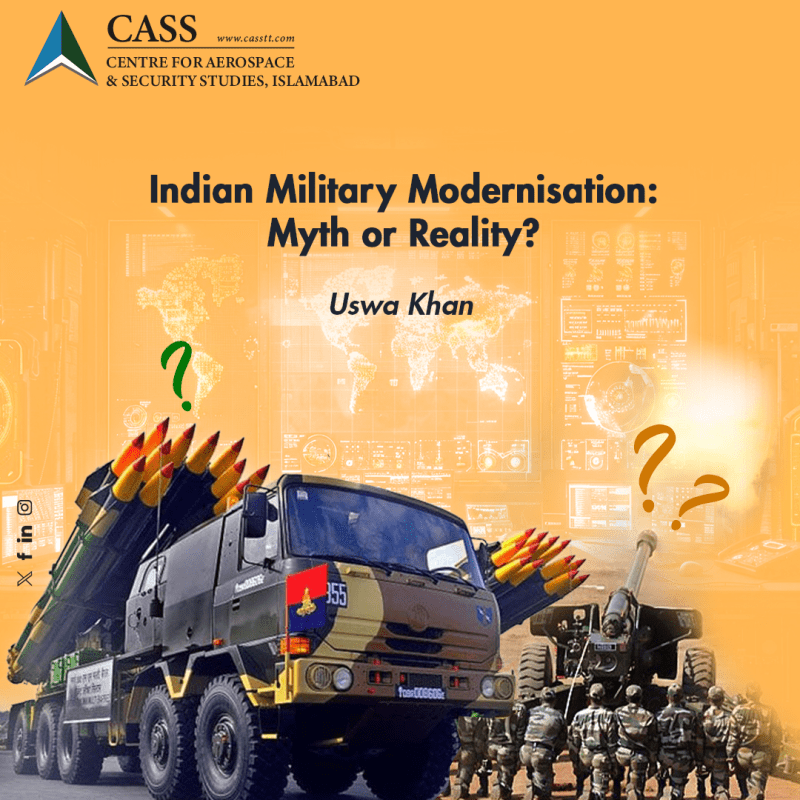
The Indian military has been making concerted efforts to improve its war-fighting capabilities since Mr Narendra Modi came to power in 2014. PM Modi was able to augment these capabilities by overcoming bureaucratic hurdles, which ultimately enabled advanced weaponry acquisitions from the United States (US), Israel, France, and Russia. Besides various defence agreements such as LEMOA, COMCASA, and BECA with the US, Modi also supported indigenisation efforts and launched the Aatmanirbharta campaign promoting domestic defence industries.
While India has portrayed a rosy picture of its military modernisation programme and indigenisation drive likely continuing under Modi’s third term, the real question remains whether this vision is myth or reality.
The Modi 3.0 government has emphasised structural changes within the Indian Armed Forces to enhance their competency. While doing so, the policy of establishing ‘Integrated Theatre Commands (ITC)’ and the ‘Agnipath Scheme’ (military recruitment scheme) are among their top priorities.
The idea of ITC was the result of recommendations made by the Shekatkar Committee in 2016 to enhance jointness, operational effectiveness and interoperability among tri-services. The committee suggested reducing number of operational commands from 17 to three – two of which would be for countering land-border threats, and one for maritime domain. According to new developments in ITC, these commands will have their headquarters in Jaipur, Lucknow and Korwar. All three ITCs are to be headed by the Chief of Defence Staff (CDS) but the government is also establishing two additional posts – Vice CDS and Deputy CDS. The Vice CDS and Deputy CDS will become operational in-charge of ITCs looking after planning, weapons procurement, and enlisting personnel and material across theatres, respectively. However, on an operational level, ITC will be commanded by a senior three-star officer from any of the three forces.
Amidst these new initiatives, it is important to assess practical implications and distinguish between projected outcomes and actual reality. New Delhi appears to be signalling that administrative coordination among the services has been streamlined under the sole supervision of CDS despite lingering grave concerns within the forces. To address the grievances of the Indian Air Force and Indian Navy, General Anil Chauhan was appointed due to the overwhelming inclination of previous CDS General Bipin Rawat towards the Indian Army. However, given historic mistrust between the services, resolving these power dynamics may not be straightforward.
Moreover, the recently passed ‘Tri-Service Act’ by the Lok Sabha, which grants additional powers to future theatre commanders to penalise personnel from all three armed forces, illustrates a significant legislative move. But, the Indian government has yet to finalise how these theatre commands will exercise control. Furthermore, establishing joint logistical nodes is anticipated to take considerable time, potentially impacting their operational efficacy in combat. This raises questions about the feasibility of these reforms and the gap between legislative intent and operational reality.
Modi’s administration is also facing scrutiny over the ‘Agnipath Scheme’ – a recruitment strategy that enlists young individuals as ‘Agniveers’ into the Armed Forces for a short-term four-year period, with potential extensions based on performance. Aimed at reducing traditional military tenure from 17 years to 4 years, this initiative seeks to enhance technological adaptability, lower operational costs and alleviate pension burdens. However, it has sparked significant criticism from the public and even BJP allies, as well as with key opposition figures like Akhilesh Yadav (president of the Samajwadi Party and a key member of the INDIA alliance) pledging to dismantle the scheme.
Integration of military equipment from multiple foreign defence firms has also brought to fore many issues within Indian military’s procurement strategy, affecting interoperability across different platforms. This scenario points to a longstanding weakness in procurement that will impact the military’s force structure and operational readiness. Recent incidents involving the Navy and Air Force, resulting in strategic asset losses, also suggest deficiencies in training and technical skills, thus challenging the perceived ‘clout’ of India’s military capabilities.
Despite India being the world’s largest democracy with aspirations of achieving global supremacy, it continues to struggle with effectively addressing its internal fault lines. Being a global power demands strategic foresight which India has not been able to exercise due to crash military modernisation. Hence, massive spending on military hardware is irrational. The Modi government’s strategy of procuring multidomain military weapons across different operating platforms also raises serious concerns about interoperability, platform integration, and combat readiness of the tri-services in crisis scenarios. This state of affairs indicates that the Indian administration is pushing institutional changes without considering existing gaps between their projected global ambitions and ground realities which are poles apart.
Uswa Khan is a Research Assistant at the Centre for Aerospace & Security Studies (CASS), Islamabad, Pakistan. She can be reached at [email protected].



