
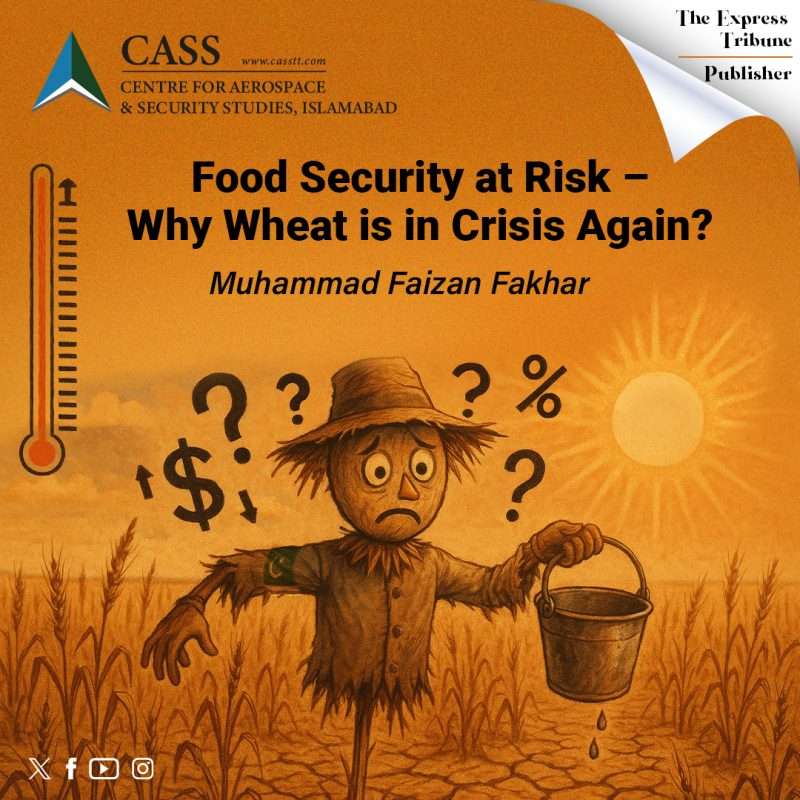
Wheat always seems to be under some scandal or crisis in Pakistan – from unnecessary imports and rampant smuggling to even the bizarre claims of stocks getting devoured by rats. Yet, little to no serious efforts can be seen to find sustainable solutions. Wheat is the primary staple food for millions in Pakistan and its shortage not only threatens national food security but also socioeconomic stability.
According to the recent projections by the Ministry of Finance, Pakistan’s wheat output in 2025 is expected to drop to 27.9 million metric tonnes (MMT) as compared to the record output of 31.4 MMT in the previous year, accounting for an overall 11 percent decline. One of the primary reasons behind this shortfall is the prolonged dry spell that has led to water shortages in both rain-fed and irrigated areas. However, there are other compounding factors as well such as the lack of a clear policy on pricing and procurement of yield, uncertain market trends and deregulation of the wheat market. As a result of these developments, the incentives for farmers to grow wheat are diminishing, ultimately leading to domestic shortage, high bread prices and increased import bills.
The leading driver of this year’s yield deficit is an acute water shortage created by a protracted dry spell and depleting reservoirs. In February 2025, the Ministry of Finance had given a warning about the dropping yield of Rabi crops in Pakistan due to delayed winter rainfall and increasing temperatures. Recently, the Pakistan Meteorological Department (PMD) has placed three provinces of Pakistan, Punjab, Sindh, Balochistan, on a drought alert. PMD has further identified the districts within each province, which will be most affected by drought conditions. In Punjab, the most vulnerable districts include Bahawalnagar, Bahawalpur and Rahim Yar Khan, all of which are high wheat producing areas. Water reservoirs in Tarbela and Mangla, both considered key sources of irrigation in the country, are also nearing depletion.
In addition to the challenges posed by climatic conditions, absence of a clear policy on pricing and procurement of wheat has also contributed to a diminishing trust of farmers. To meet the conditions of deregulated markets placed by International Monetary Fund (IMF), the government abandoned the traditional approach of announcing Minimum Support Price (MSP) in 2025. Thus, farmers did not have any advance guarantees about the procurement of their produce. Moreover, provincial governments also place restrictions on the free movement of wheat to achieve procurement targets. As a result, farmers cannot access competitive markets and thus are further discouraged from growing wheat. The government of Punjab has recently lifted this ban; however, such incentives are more effective in the planting months (October-December) rather than the harvesting season (April-June).
Shortage in the domestic supply of wheat directly impacts Pakistan’s food security as the crop constitutes around 60 percent of the population’s daily diet. Moreover, wheat is also cultivated on around 36 percent of the fertile land in Pakistan. Therefore, sustainable and affordable supply of this grain is of paramount importance for food security as 82 percent of households in the country struggle to afford a healthy diet and half of their monthly expenditures are dedicated to food. In addition, per capita annual wheat consumption in Pakistan declined from 112 kg to 84 kg in 2023-2024, which is indicative of the dietary compromises being made by the population. Pakistan ranks 109 out of 127 countries in the Global Hunger Index (GHI), reflecting severe undernutrition that will only exacerbate due to this unfolding crisis.
According to United States Department of Agriculture (USDA), Pakistan is projected to import 1.7 MMT of wheat this year due to the fall in domestic supply, which would further burden the national exchequer. Moreover, farmers across Punjab have held demonstrations demanding profitable and timely procurement prices. Last year, the price per 40 kg was PKR 2900-3500, which has now dropped to PKR 2200-2390. These socioeconomic woes would only escalate in the absence of swift and sustainable remedial efforts.
There is a need to understand that deregulation of the wheat market without safety nets would only exacerbate the crisis. Punjab government has announced a PKR 15 billion relief package for wheat farmers that includes direct financial support through Kisan Cards, irrigation tax relief, subsidised loans and free access to warehouse facilities. While this package could be helpful in stabilising the market and addressing the immediate concerns of small and medium farmers, there is a need to adopt long-term measures to ensure sustainable food and socioeconomic security. These long-term measures include a shift from MSP to targeted subsidies to wheat farmers on seeds, fertilizers and water supply. Moreover, research and development of climate-resilient crops is also a need of the hour. Lastly, Pakistan needs to gradually decrease its nutritional overreliance on wheat to improve soil fertility, public health and economic sustainability.
Muhammad Faizan Fakhar is a Senior Research Associate at the Centre for Aerospace & Security Studies (CASS), Islamabad, Pakistan. The Article was first published in The Express Tribune. He can be reached at: [email protected].



