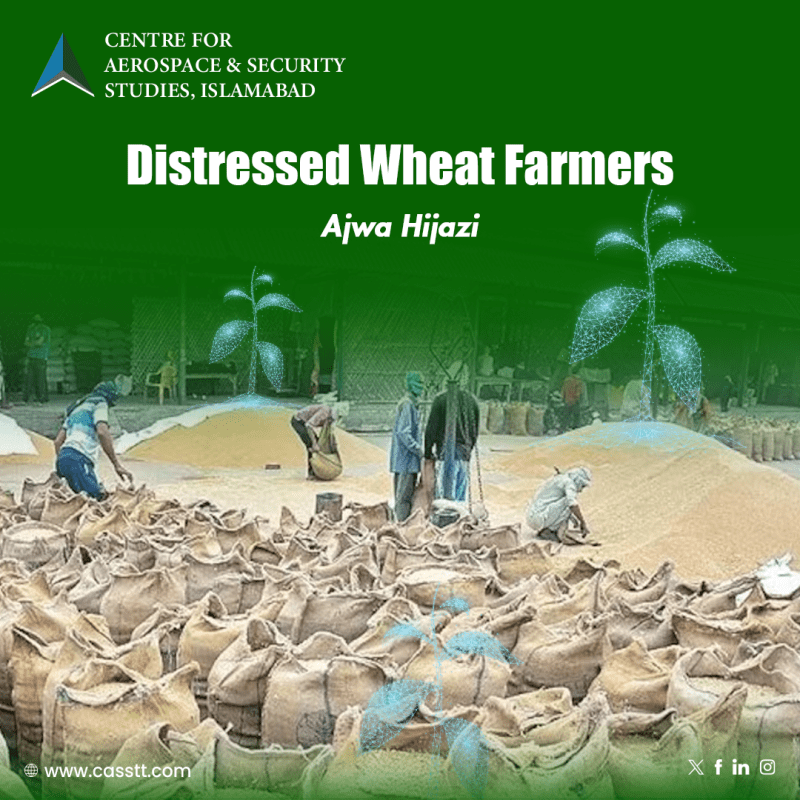
Wheat, due to its widespread consumption and its nutritious value, is considered a staple food in Pakistan. Its cultivation is done on a large scale throughout the country, with Punjab being the largest wheat-producing province. However, for several weeks, the country has witnessed distressed wheat farmers protesting on the streets. They started protesting against excessive delay in wheat purchase by the government and the reduction of the provincial procurement target from 4 million tonnes to 2.3 million tonnes. The government reduced the wheat procurement targets by stating that it has carryover stock (already available wheat in storage facilities). Consequently, this led to market price being slashed from its Minimum Support Price (MSP) of PKR 3900 per 40kg (set for the 2024-25 season) to between PKR 3000-3100 per 40kg in various regions of Punjab, leading to a precarious situation for the farmers.
The devastating floods of 2022 impacted the production of wheat in the country. Pakistan’s per-year wheat consumption is 30 million tonnes, but it produced 26.2 million tonnes for the upcoming season. The government allowed the private sector to import wheat to mitigate the shortfall. According to the Ministry of National Food Security & Research (MoNFS&R), around 3.6 million metric tonnes of grain were imported between September 2023 and March 2024. MoNFSR estimated a shortfall of 2.4 million tonnes, but Pakistan imported around 3.6 million tonnes which caused a surplus of around 1.2 million. This surplus, combined with wheat harvest during the peak domestic season, disrupted the government’s wheat procurement targets. The prevailing uncertainty regarding the fate of local farmers’ crops has made them vulnerable to exploitation by the middlemen in the market, forcing them to sell at lower rates than the MSP.
Amidst this struggle, farmers also faced another issue on the digital front. The Punjab government launched the ‘Bardana App’ to purchase wheat from farmers. Instead of submitting paper applications to the food department, farmers can now procure gunny bags to pack and transfer wheat to the procurement centres using this app. Although this step reflects the agricultural sector’s digitalisation, many farmers are not tech-aware to navigate this mobile application.
In response to the farmers’ protests, the Prime Minister announced an inquiry into wheat imports. The inquiry concluded with the suspension of several government officials for 120 days. Besides, he also ordered the government to increase its procurement target along with directing the Pakistan Agricultural Storage & Services Corporation (PASSCO) to ensure immediate wheat procurement. However, according to the President of Pakistan Kissan Ittehad (PKI), the government should arrest the culprits of this wheat import scandal. He also lamented that wheat was imported into the country even though ‘everybody knew that the crop had been planted in more acres in the current season than in the past.’ The farming community of Pakistan is also facing the challenge of high crop production costs that have doubled since 2023. The government has not been facilitating the availability of Urea at retail prices.
Despite such challenges, farmers increased the area for wheat cultivation and per-acre productivity to ensure national food security. It resulted in record-high production of around 29 million tonnes. But instead of getting relief from the government, the latter’s flawed procurement policy, characterised by delays and avoidance of buying wheat, has incurred heavy losses to the farmers.
Thus, there is an immediate need for the government to compensate the farmers by speeding up a more transparent wheat procurement process. Otherwise, farmers would be compelled to sell their wheat to the local market at lower prices, which, according to one farmer from South Punjab, is equivalent to ruining their crop. Moreover, the government must ensure inclusive digitalisation of this process. It should establish proper training and awareness facilities for the farmers before introducing any mobile/digital applications to avoid any situation that may leave many farmers disgruntled.
In the long run, the government should focus on data-driven decision-making. By efficiently employing data analytics, the government can conduct regular, state-specific wheat needs assessments. This will provide a vivid picture of provincial requirements to aid targeted wheat procurement. Additionally, data can be used to analyse wheat consumption patterns of various regions to ensure an efficient crop supply as per requirement. This strategy can help avoid any situation of scarcity or surplus, eventually enhancing national food security.
Given the existing trust deficit, it is crucial for the government to actively demonstrate its commitment to the farmers by addressing their demands constructively, rather than resorting to coercion or force. Failure to engage positively could demoralise the farming community, potentially leading to a significant decline in wheat production and critically endangering the nation’s food security.
Ajwa Hijazi is a Research Assistant at the Centre for Aerospace & Security Studies (CASS), Islamabad, Pakistan. The article was published in Pakistan Today. She can be reached at [email protected].