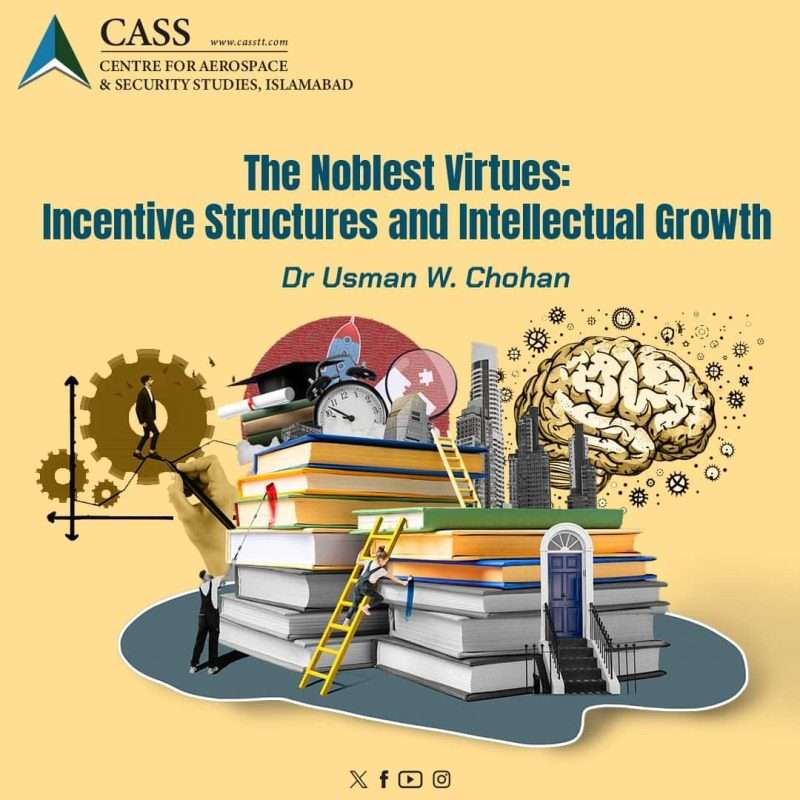
The discussion surrounding education in Pakistan is often framed as if it were the primary solution to the country’s socioeconomic challenges, where education is posited as a universal remedy, a panacea that can drive economic growth, societal progress, and national stability all at the same time. The assumption that greater education, by itself, will transform the country in one fell swoop underlies much of the discourse in policy circles, but this presupposition ignores a critical flaw in Pakistan’s incentive structure: there are exceedingly few economic incentives that reward broad-based, general knowledge within the country’s job market. As such, the cultivation of well-rounded intellectual citizens is not encouraged or supported by economic or professional frameworks, save for a limited number of roles within the civil service.
In this regard, it is critical to note that while education is important, its purpose must be defined in alignment with the realities of the labor market. Pakistan, a nation of over 240 million people, only has about 400 positions annually—those offered through the Central Superior Services (CSS) exam—that truly demand a broad knowledge base and general education. These roles within the civil service are the sole professional avenue that rewards a diverse intellectual capacity and a generalist approach to knowledge, rather than technical specialisation. The fact that only 1% of applicants secure one of these jobs is telling of the limited scope that exists for rewarding intellectual curiosity. Therefore, the focus on promoting education in Pakistan rings hollow if it does not address the fundamental lack of incentives for broad-based learning.
The CSS exam is unique in that it rewards a broad knowledge of multiple disciplines, ranging from political science to history, economics, and current affairs. The 100,000 young people who apply annually for the CSS exam, and the 40,000 who show up to take it, are chasing one of the few opportunities where a wide-ranging intellectual repertoire is valuable. Yet with only 400 positions available each year, this avenue is accessible to a mere fraction of the population, and for the rest, general knowledge is economically irrelevant. Outside the civil service, there is a narrow focus on technical specialisation. The majority of professional roles require deep expertise in a single discipline, often to the detriment of developing a wider intellectual base. Specialisation is, of course, important and necessary in many fields, but its primacy in Pakistan’s labor market sidelines the cultivation of intellectual breadth. This focus on specialisation discourages young people from engaging in a more comprehensive self-educational experience. Consequently, the lack of economic incentives to pursue general knowledge results in a society where intellectual curiosity is undervalued and rarely nurtured.
This structural issue points to a deeper design flaw in Pakistan’s economic and educational systems: they are misaligned with the broader goal of cultivating a well-read, intellectually engaged society. Pakistan’s per capita expenditure on books, for instance, remains abysmally low, reflecting the broader societal disinterest in reading for pleasure or self-improvement. This low demand for books mirrors the economic reality that there are few opportunities to monetise or reward broad intellectual engagement. In essence, young people in Pakistan have no strong incentive to develop an expansive understanding of the world, unless they are among the small percentage pursuing civil service careers.
Given the limited number of CSS positions and the overwhelming focus on specialisation, it becomes clear that the existing system does not foster the kind of intellectual growth necessary for a vibrant, well-informed society. Rather, the current structure is designed to produce narrow specialists who may excel in their particular fields but are disconnected from the larger societal context. This is particularly concerning in an Islamic context, where knowledge and intellectual engagement are deeply valued as moral and social goods. In a truly Islamic society, there would be a greater emphasis on both the depth and breadth of knowledge, fostering well-rounded individuals who are equipped to navigate the complexities of the modern world.
To address this issue, it is essential to introduce policy changes that realign the incentives within both the public and private sectors to promote broad-based intellectual engagement. First, the criteria for hiring in all sectors should be expanded to include assessments of general knowledge and intellectual curiosity. Interviews for professional roles should not merely test specialised knowledge but also evaluate a candidate’s awareness of broader societal, historical, and global issues. This would encourage young people to invest in a wider education, knowing that it would be rewarded in the job market.
Second, the media plays a crucial role in shaping societal values, and it is vital that it contributes to promoting the virtues of intellectual engagement. Popular media, particularly drama serials and television programs, should portray well-read, intellectually curious characters in positive light, emphasising the value of knowledge beyond its economic utility. Currently, much of Pakistan’s media content glorifies passive or simplistic characters, reinforcing the notion that intellectual engagement is unnecessary. By shifting the narrative towards a celebration of intellectual virtues, the media can play a significant role in fostering a culture of curiosity.
Third, leadership positions in both the public and private sectors should be awarded on the basis of meritocratic principles that emphasise not only technical expertise but also a broad intellectual foundation. Promoting individuals who embody the values of intellectual curiosity and knowledge-based leadership will send a strong signal to society about what is valued. Such leaders can set an example for the next generation, demonstrating that intellectual engagement is not only a personal virtue but a key determinant of professional success.
These policy shifts are crucial if Pakistan is to transition towards a more intellectually engaged and well-read society. While the civil service remains an important avenue for rewarding broad knowledge, it is not enough. To truly cultivate a society that values intellectual engagement, the incentive structures within the economy must be transformed. Otherwise, the small percentage of individuals who pursue general knowledge will remain anomalies in a system that overwhelmingly rewards narrow specialisation.
As such, while education is often heralded as the solution to Pakistan’s challenges, it is important to recognise that the current economic incentives do not support broad-based intellectual growth. The CSS exam may offer one pathway for those with a diverse knowledge base, but for the vast majority, there are no rewards for cultivating intellectual curiosity. To build a more informed and well-read society, policymakers must address this misalignment by creating new incentives that value general knowledge in both the public and private sectors. Only then can Pakistan hope to foster a society where intellectual engagement is not merely an anomaly but a widespread virtue.
Dr Usman W. Chohan is Advisor (Economic Affairs and National Development) at the Centre for Aerospace & Security Studies, Islamabad, Pakistan. He can be reached at [email protected].