1. Financial inclusion, which entails the use and access of affordable financial services by the masses, is a necessary component of economic security and national stability. As more citizens have a stake in the economy, they not only improve their lives but also become stakeholders in the country’s development, peace, and prosperity. In order to transform its economy and ensure societal stability, Pakistan must expand the reach of its formal financial inclusion.
2. There have been promising initiatives to accelerate financial inclusion in Pakistan in the recent past, such as the latest initiative by the State Bank of Pakistan (SBP) to simplify the account opening process for both individuals and businesses. Under National Financial Inclusion Strategy 2024-28, SBP aims to enhance financial inclusion to reach 75 percent by 2028, from 64 percent in 2023. Likewise, the SBP’s Banking on Equality policy aims to improve access and usage of financial accounts by women, and its strategic Vision 2028 plan explicitly aims to foster financial innovations ‘while ensuring consumer protection and financial stability.’ However, despite these improvements, multiple challenges persist. Women and other underserved groups (such as low-income rural communities) continue to face high barriers to financial access, while trust and confidence in using digital services is an ongoing concern.
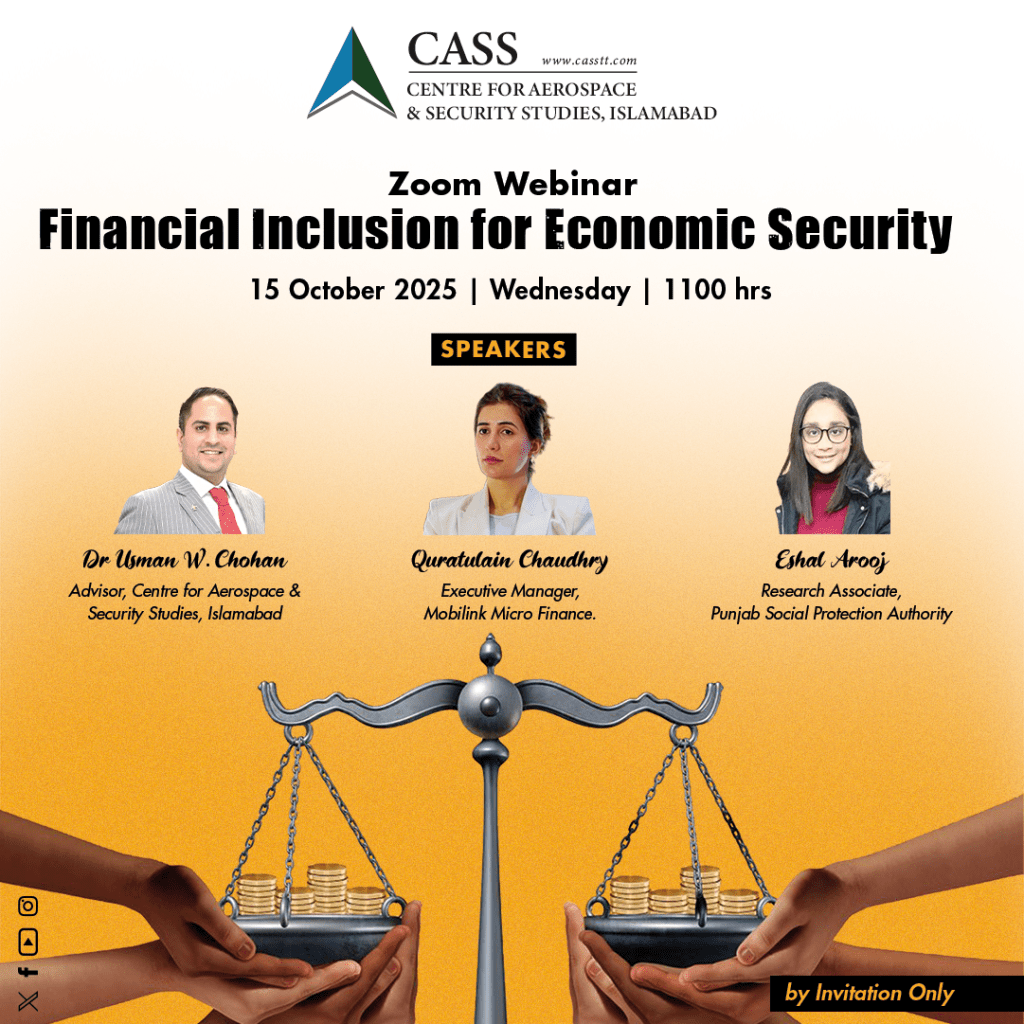
3. To promote financial inclusion as a pillar of economic security and chart a way forward to accelerate financial inclusion in Pakistan, the Centre for Aerospace and Security Studies (CASS) is organizing a roundtable to gather expert insights. The discussion will focus on three key areas: –
- Financial Inclusion as a Pillar of Economic Security. How, by expanding financial inclusion in a fair and informed way, can Pakistan strengthen its economic security and ensure that every citizen feels invested in a shared future?
- Inclusive Finance for Women and Marginalized Groups: Barriers and Way Forward. What are the main barriers that prevent women, low-income workers, small farmers, youth, remote communities, and other marginalised groups from accessing formal financial services, and how can those barriers be overcome?
- Consumer Protection and Enabling Policies for Users of Financial Services. In what ways can consumer protection frameworks be strengthened as financial inclusion expands? What policy measures can the government and SBP implement to foster an enabling environment for inclusion?