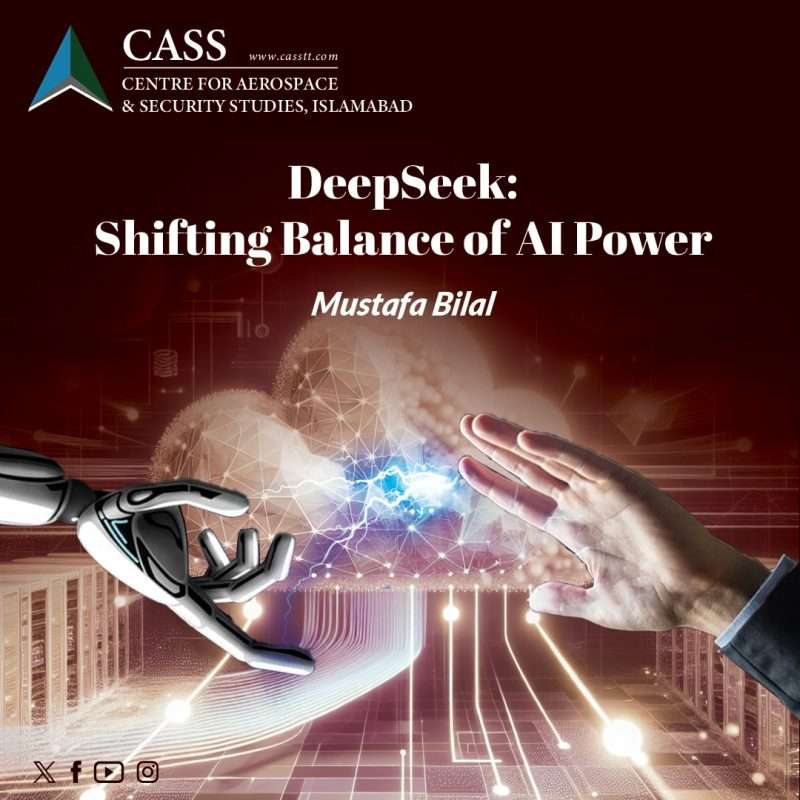
Since its release two months ago, DeepSeek has prompted a reassessment of several assumptions regarding AI development, the United States’ technological dominance and the effectiveness of high-tech export controls.
To begin with, in June 2023, Sam Altman claimed that it was pretty hopeless to train an advanced AI model with USD10 million. However, his assumption would soon be challenged by a small startup in China. Liang Wenfeng founded DeepSeek in December 2023, which reportedly trained an open-source AI model with USD6 million in just over a year.
DeepSeek achieved performance comparable to OpenAI’s ChatGPT and undermined the assumption of US tech exceptionalism by plummeting the stocks of leading US tech and energy firms. The latter were affected because it was assumed that AI energy requirements would progressively increase. Consequently, the carbon emissions and water usage of AI infrastructure were projected to reach alarming levels in the coming years. However, DeepSeek’s reported energy efficiency raises doubts about the assumption that AI development requires a significant expansion of data centres and power plants.
While contrasting assessments of DeepSeek’s efficiency and performance initially complicated efforts to draw reliable conclusions, a turning point came on March 7 when the Center for Strategic and International Studies (CSIS) published a comprehensive report that offered novel insights on DeepSeek and its implications for the Sino-US AI competition. The report’s findings underscored that the hype surrounding DeepSeek being a ‘Sputnik moment’ for the US in the field of AI was justified, as Western researchers had verified its technological innovations.
Earlier, US President Trump stated that DeepSeek should serve as a wake-up call for the US AI industry and vowed to ensure the country’s AI dominance with initiatives such as Stargate. In response, US tech firms voiced their support for ‘winning the AI war’ with China. Meanwhile, Sam Altman initially conceded to being on the ‘wrong side of history’ as DeepSeek was ironically advancing OpenAI’s original altruistic goal of promoting AI adoption globally. However, on March 13, OpenAI submitted a proposal to President Trump’s AI Action Plan, calling for bans on DeepSeek and other Chinese AI models.
This shift may reflect growing unease among leading US AI firms, as DeepSeek also challenged another key belief – that open-source AI models inherently lag behind the proprietary ones protected by Silicon Valley. Therefore, for most US tech executives, if it was not outright war, it was certainly an AI race with China, one they believed could be won by tightening export controls on advanced semiconductor chips. This belief has been rooted in the assumption that the US holds a decisive lead in AI development, and that restricting China’s access to cutting-edge hardware could preserve that advantage. DeepSeek has also challenged this notion. The CSIS report, in particular, highlighted that even the most stringent chip export restrictions are unlikely to halt China’s AI momentum. Instead, it highlighted that China’s self-sufficiency in AI advancement is on track to be the ‘most significant strategic challenge for the US’. Interestingly, contrary to long-held assumptions regarding the effectiveness of export controls, they have also inadvertently spurred technological innovation in China, according to US analysts and MIT.
Although DeepSeek founder Liang Wenfeng has publicly acknowledged the challenge posed by the ‘embargo on high-end chips’, he brushed aside the assumption of US policymakers and tech executives that they could curtail China’s AI advancements. Liang also called on Chinese tech firms to establish themselves as global leaders in developing cost-effective and efficient AI. This aligns with China’s national goal of becoming a global hub for AI innovation by 2030.
In this context, it is noteworthy that DeepSeek is just one startup in China’s booming AI industry. With nearly 600 universities and research labs dedicated to AI research, China’s burgeoning local talent has the potential to garner global attention, similar to DeepSeek. This trend is further illustrated by the emergence of advanced AI agents like AutoGLM Rumination and Manus, developed by lesser-known Chinese startups, challenging the belief that only tech giants can push the frontiers of AI.
DeepSeek and other Chinese AI startups have thus disrupted the AI ecosystem in both China and the US. This was also evident in how China’s tech giants, including Baidu, ByteDance, Tencent, and Alibaba, each launched their latest AI models following the release of DeepSeek and plan to invest billions in AI infrastructure. Consequently, US Big Tech is also accelerating development and release of its respective AI models.
As more advanced Chinese and American AI models are increasingly launched at lower prices, the AI efficiency race initiated by DeepSeek is expected to significantly reduce the global cost of adopting AI across all fields. It has already been embraced by European companies and tech firms, which consider ‘China’s DeepSeek moment’ a driving force for facilitating the global adoption of AI.
Ultimately, DeepSeek has upended several long-held assumptions: that building powerful AI models demands vast financial resources; that open-source models cannot compete with proprietary technologies; and that US-led export controls can slow China’s technological ascent. Its success suggests that these assumptions no longer hold, and perhaps never did. In doing so, DeepSeek has not only redefined the trajectory of AI development but also confirmed Sam Altman’s own prophecy: the AI revolution cannot be stopped. DeepSeek was only the start; China’s AI revolution has just begun.
Mustafa Bilal is a Research Assistant at the Centre for Aerospace & Security Studies (CASS), Islamabad. He can be reached at [email protected].