
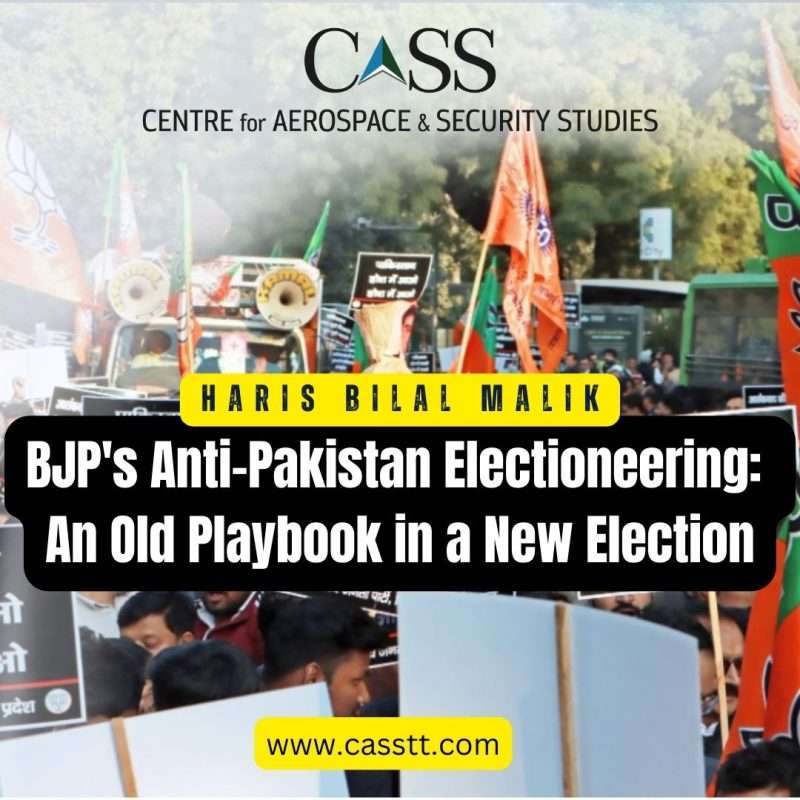
With the Lok Sabha elections around the corner in 2024, the debate around Indian electoral dynamics has attracted significant discourse. According to some estimates, the ruling Bharatiya Janata Party (BJP) is likely to win the elections for a third consecutive term. However, the concerning matter is that BJP’s election campaign which should ideally be based on a vision of India’s future outlook; unfortunately revolves around exploiting anti-Pakistan sentiments. While the BJP might win the upcoming elections, its current anti-Pakistan campaign could jeopardise regional peace and stability.
Experts in Pakistan, particularly, those who have served in India and understand BJP’s mindset believe that it is likely that BJP’s election campaign, would again be based on the same pattern – blaming Pakistan. Prime Minister Modi continues to accuse Pakistan of supporting terrorism for electoral gains. Moreover, during an electoral rally, he went to the extent of alleging that India had been living under terrorism for the past 40 years for which Pakistan was responsible. He suggested punishing Pakistan by saying that India would ‘hit them hard at home’. Unfortunately, this kind of narrative has become a very popular slogan to get the desired political gains and is likely to become an important factor in BJP’s election campaign.
Reflecting on the 2019 elections, it’s evident that this narrative benefitted the BJP, allowing them to attain their political objectives by leveraging anti-Pakistan sentiments. In this regard, nuclear signalling by the BJP’s leaders, particularly Mr Modi, was quite evident during the election campaign. The BJP brought the nuclear debate from strategic circles to political gatherings and manipulated public sentiments with slogans like ‘Qatal Ki Raat’. Though, this resulted in a landslide victory for the BJP; the victory came at the cost of jeopardising regional peace and stability.
The persistent reliance of the BJP on propagating unwanted criticism on Pakistan for electoral gains would have implications at both domestic, regional, and international levels. While at the domestic level, it might get firm support within the masses since it diverts attention away from pressing domestic issues like economic disparities and social welfare issues. At the regional level, this approach hinders prospects of constructive engagement between India and Pakistan on issues related to peace dialogue, trade, and regional cooperation, which are vital for long-lasting stability in South Asia. BJP’s aggressive and hegemonic designs have cultivated anti-India sentiments in the neighbouring countries. For instance, when the mural titled ‘Akhand Bharat’ (Undivided India) was revealed at the new building of the Indian Parliament earlier this year, it raised concerns from Pakistan, Bangladesh, and Nepal as a map of India was presented whose boundaries include most of present day South Asia. This move clearly shows the hegemonic aspirations of the BJP. At the international level, such tactics are also likely to have implications for Pakistan. For instance, Pakistan’s image at the international level is portrayed as a country harbouring terrorism in turn undermining the state’s credibility as a responsible nation. India’s excessive use of such a biased narrative could exacerbate cross-border tensions also with New Delhi itching to attempt another misadventure on the lines of February 2019.
Apart from the anti-Pakistan narrative, the BJP is also likely to exploit the ‘Hindutva’ factor extensively in the forthcoming elections. The BJP has effectively used Hindutva and anti-Pakistan sentiments to divert attention from governance challenges, and they might employ this strategy again.
Under Mr Modi’s leadership, the BJP must move beyond relying on anti-Pakistan slogans for short-term political gains. Instead, there’s an urgent need to formulate policies that address the pressing issues of minority rights, particularly concerning Muslims. The BJP’s divergence from Nehru’s inclusive ideology, embracing a Hindutva-centric narrative, has not only alienated a significant portion of the minority vote but also led to extreme policy decisions. These decisions, such as the Citizenship Amendment Act and the annexation of Jammu and Kashmir, have not only driven a wedge between the BJP and the Muslim community but have also intensified tensions with neighbouring Pakistan.
By revisiting and rectifying these policies, the BJP has an opportunity not only to re-engage its lost vote bank but also to address Pakistan’s concerns. Such a proactive approach could enhance Indo-Pak relations and pave the way for resolving long-standing bilateral issues. By taking these steps, India can position itself as a responsible nation, ensuring a brighter and more stable future for the entire South Asian region.
Haris Bilal Malik is a Research Assistant at the Centre for Aerospace & Security Studies (CASS), Islamabad, Pakistan. He can be reached at [email protected]
Design Credit: Mysha Dua Salman



