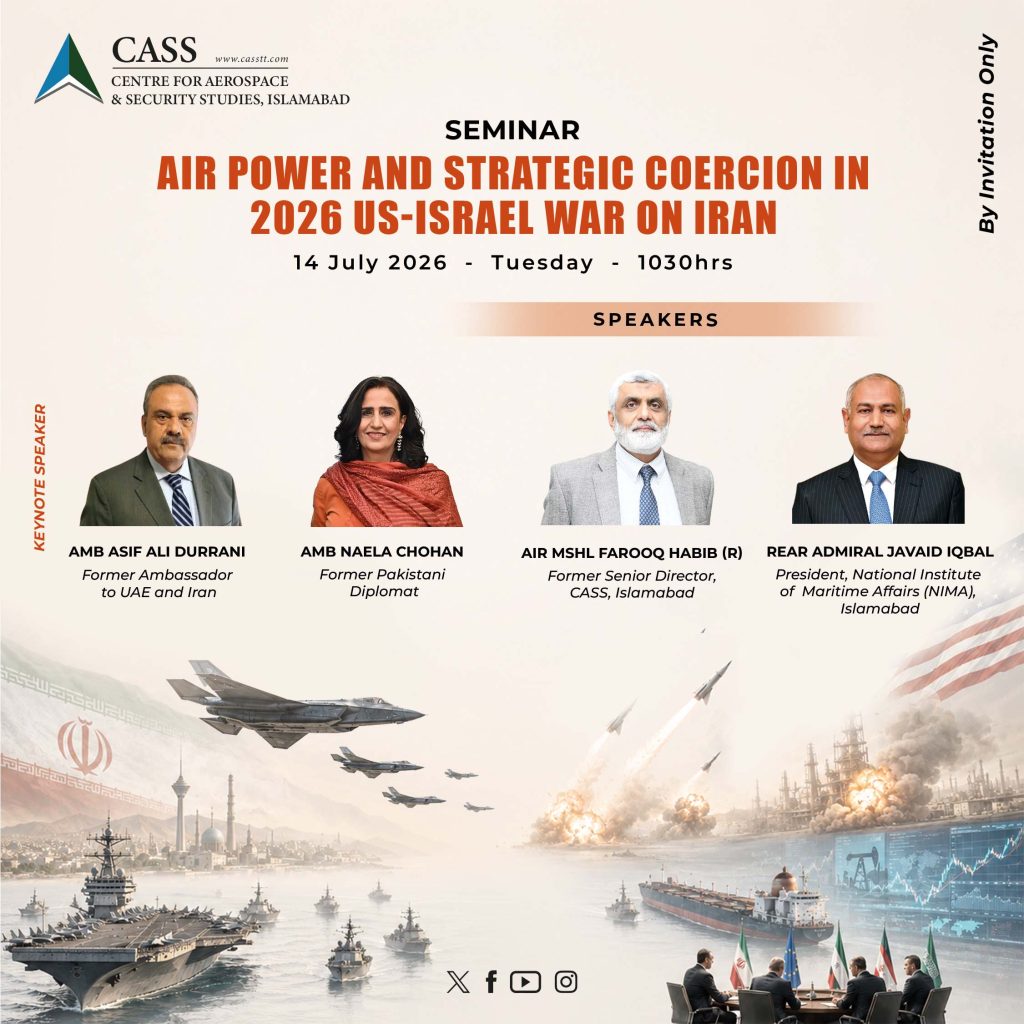
The 2026 U.S.-Israel war on Iran emerged as a defining security event in the Middle East, carrying significant military, political, economic, and geopolitical implications. The conflict did not occur in isolation but evolved from the unresolved tensions, competing strategic objectives, and fragile deterrence environment that persisted after the June 2025 Twelve-Day War. As regional rivalries intensified and diplomatic efforts failed to address core security concerns, the region witnessed a renewed cycle of escalation that culminated in large-scale hostilities.
The conflict highlighted the growing role of air and missile power as instruments of strategic coercion. Precision strikes, long-range aerospace operations, intelligence, surveillance and reconnaissance (ISR) capabilities, cyber and electronic warfare, integrated air and missile defence systems, and unmanned platforms shaped both the conduct and outcome of military operations.
Simultaneously, the maritime domain emerged as a critical theatre, with developments in and around the Strait of Hormuz affecting freedom of navigation, energy security, and global commerce.
Beyond the battlefield, the war generated far-reaching economic consequences. Fluctuations in energy markets, disruptions to maritime trade routes, and concerns regarding regional stability reverberated across the global economy. Diplomatic engagement, mediation efforts, and negotiations that followed the cessation of hostilities further underscored the relationship between military action and political outcomes.
This seminar seeks to examine the strategic drivers that led to the conflict, assess the effectiveness of military operations and coercive strategies employed by the warring parties, analyse the maritime and economic dimensions of the war, and evaluate the implications of the ceasefire for the future regional order. The discussion will also explore broader lessons regarding deterrence, escalation management, emerging military technologies, and the evolving nature of warfare in increasingly interconnected and contested strategic environment. The eminent speakers will address the following questions:
The discussion will focus on the following aspects:
- Speaker 1 – Asif Ali Durrani: From 12 Day War to Renewed Conflict: The road to 2026 War
- The developments between 12 day war of June 2025 till 28 February 2026
- What all reasons lead to second phase of war
- Politico military objectives of all warring sides
- Lead the argument to initiation of hostilities.
- Speaker 2 – AM Farooq Habib (Retd): Air Power, Missile Warfare and Strategic Coercion
- Unfolding of operations – Opening of air and missile campaign
- Targeting philosophy
- Aerospace, ISR, cyber and EW integration
- Iranian response – missile, drones and proxy integration
- Air and missile defence performance
- External support available to US- Israel and Iran
- Assessment of military effectiveness – achievement of objectives
- Till ceasefire (cessation of active hostilities)
- Speaker 3 – Rear Admiral Javaid Iqbal: Maritime Contestation and economic Warfare
- US-Israel operations against the Iranian Maritime capabilities
- Iran’s defensive operations (anti access/ area denial) – Losses – Response
- Passage restrictions of Strait of Hormuz and it aftershocks – Energy security and shipping restrictions
- Effect of world markets and oil prices
- Impact on Middle east in particular
- Speaker 4 – Amb Naela Chohan: Ceasefire, Negotiations and Emerging Regional Order
- Path to ceasefire and cessation of hostilities
- Diplomatic and mediation efforts and initiatives
- Strategic outcomes of war – winners/ losers
- Implications: US – Israel – Iran and Gulf states
- Implications on great power competition