How the Nature of Warfare Affects the AI Optimism

  • Post author:

Since the advent of Artificial Intelligence (AI), a pressing question is being asked: Is Clausewitz still relevant? The game-changing potential of AI and the idea of human-machine teaming (centaur systems) have led many to doubt the seemingly unchanged nature of war. Apparently, it has given rise to the belief that AI-powered systems will replace humans (generals) in the command loop. However, this view is detached from the complex nature of warfare, which remains fundamentally a human endeavour guided by violence, chance and friction.Just like other social institutions, war is generally an interpretivist paradigm rooted in complex human nature. It is a non-linear phenomenon whose conduct and outcomes cannot be determined by analytical predictions or algorithmic patterns. In other words, war usually does not proceed on pre-determined rules of engagement, prescriptive manuals, established patterns and predictive modelling. Instead, it is fought on judgment, adaptation to changing realities, commander’s intuition and paying attention to the unfolding of the unknown. 
Continue ReadingHow the Nature of Warfare Affects the AI Optimism

Two Faces of the Atom: India’s Nuclear Exceptionalism

  • Post author:

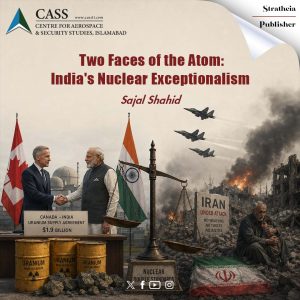
ew examples capture the inconsistencies of the nuclear world order more starkly than the events of 2 March 2026: as Prime Ministers' Mark Carney and Narendra Modi signed a landmark 1.9 billion USD uranium supply deal for India's civil nuclear sector, Iran was subjected to the third day of indiscriminate airstrikes by the US and Israel under the banner of nuclear non-proliferation, despite Iran agreeing to zero stockpiling of enriched uranium just days prior. This event, unfortunately, was not an isolated one, rather it reflects a pattern of nuclear exceptionalism where certain states such as India, continue to be rewarded for non-compliance with international regulations, while others such as Iran, are censured and even subjected to military action based on hypothetical realities.The latest deal would see Canada sell close to 22 million pounds of uranium concentrate to India over 8 years, starting in 2027, a sale more than ten times the last Canada-India uranium agreement of 2015, which supplied 7 million pounds of concentrate over 5 years.

Continue ReadingTwo Faces of the Atom: India’s Nuclear Exceptionalism

Data Centres as the New Military Targets in Modern Conflicts

  • Post author:

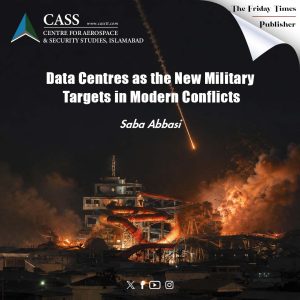
The character of warfare has evolved in tandem with the changing nature of military targets. In early March 2026, Iran bypassed traditional military targets and struck the physical part of the digital infrastructure at Amazon Web Services (AWS) data centres in the UAE and Bahrain. Until now data centres had been considered an unassuming target, as they did not house any military equipment or hardware. However, the US-Israel war on Iran, has transformed these billion dollar sites into high-value targets because of their ability to act as server farms on which adversaries’ websites, apps, AI systems and the entire digital infrastructure run.Data centres are digital ecosystems where the delivery of cloud services depends on the integrity of physical infrastructure. Disruption in any one part of the shared infrastructure does not remain isolated and risks triggering widespread systemic failure. In the case at hand, Amazon operated multiple availability zones within each region in the United Arab Emirates and Bahrain. Iran struck two of the three availability zones in the UAE, while in Bahrain, a zone was damaged by drone debris causing an extended power outage and connectivity problems that further disrupted service across the Gulf.

Continue ReadingData Centres as the New Military Targets in Modern Conflicts

The Sovereign Shield

  • Post author:

Pakistan's defence industry is gearing up from a localised purchase requirement to a globalising high-tech export industry. For long the military-industrial complex of Pakistan had been dominated by military needs of the border security and the costly importation of foreign technology. This tendency, however, seems to be reversing slowly. Pakistan is attempting to edge closer to a model of self-reliance in this regard in terms of tactical security and geoeconomic rebalancing that is spearheaded by the JF-17 Block III, the Super Mushshak, and the unmanned systems. This is very clear in its international defence contracts of between 10 to 13 billion dollars.But export headlines simply aren't enough to succeed. The defence ecosystem of Pakistan is built on the basis of a strategic triangle in which the PAF is the challenging end-user and technological enabler of the defence ecosystem, a nascent domestic defence sector with focus on platforms such as the JF-17 and the overall economy that will have to eventually underpin and benefit of the activity. The first two legs have demonstrated great strength. The most challenging one is the economic leg, however. Export spikes can be short lived unless structural reforms are adopted. It is the work to be done by chance, that is to assemble these three factors in a self-sustaining system.

Continue ReadingThe Sovereign Shield

The Cost of Pausing, Not Ending

  • Post author:

Weeks after concerted United States and Israeli attacks assassinated Iran's Supreme Leader Ayatollah Ali Khamenei and hit the country's military and civilian infrastructure, the conflict continues. Iranian retaliatory strikes persist, although at a reduced pace. The recent assassination of senior pragmatist Ali Larijani points towards further escalation. While Iran has successfully expanded the conflict, neither side have been able to deliver a decisive blow. This moment of impasse begs reflection on how the war may end. History has shown that even the most determined campaigns eventually run into insurmountable obstacles. These barriers are financial haemorrhage, mounting attrition, vocal discontent from allies, and the erosion of domestic support. This conflict is no exception to these barriers.

Continue ReadingThe Cost of Pausing, Not Ending

Who is Responsible When an AI Weapon Pulls the Trigger?

  • Post author:

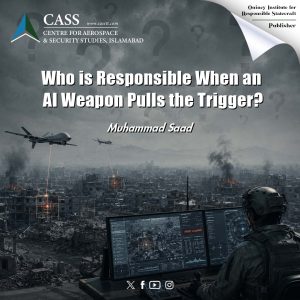
In 1863, Francis Lieber, the Prussian-American jurist commissioned by Abraham Lincoln to codify the laws of land warfare, wrote that no soldier may kill an enemy "who has laid down his arms." War, however brutal, must remain an act performed by a morally responsible agent. That agent must be able to account for what he has done and to whom it has been done. The Lieber Code was imperfect. Its application was racially selective and its humanitarian ambitions frequently betrayed in practice. But its foundational premise survived two world wars, the drafting of the Geneva Conventions, and the development of every weapons system from the machine gun to the precision-guided munition. That premise is that lethal force requires a human being who can be identified and interrogated. That human being must also be someone who can be held to account.

Continue ReadingWho is Responsible When an AI Weapon Pulls the Trigger?

Why Pakistan’s Afghan Policy Reached a Breaking Point

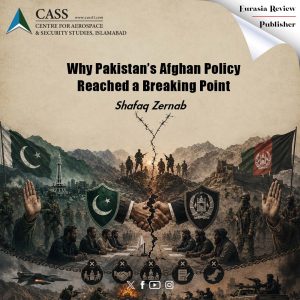
The ongoing war between Pakistan and Afghanistan is the result of a gradually worsening security situation along the Durand Line rather than a sudden strategic shift. The core issue was not the absence of dialogue, but its inability to deliver binding results to the foremost security concern of for Pakistan: the use of Afghan territory by militant groups to attack Pakistan. When Pakistan in response switched to cross-border strikes in February 2026, the state had already gone through several years of attempted accommodation without securing any meaningful restraint from the Tehreek-e-Taliban Pakistan (TTP) by Kabul.

Continue ReadingWhy Pakistan’s Afghan Policy Reached a Breaking Point